




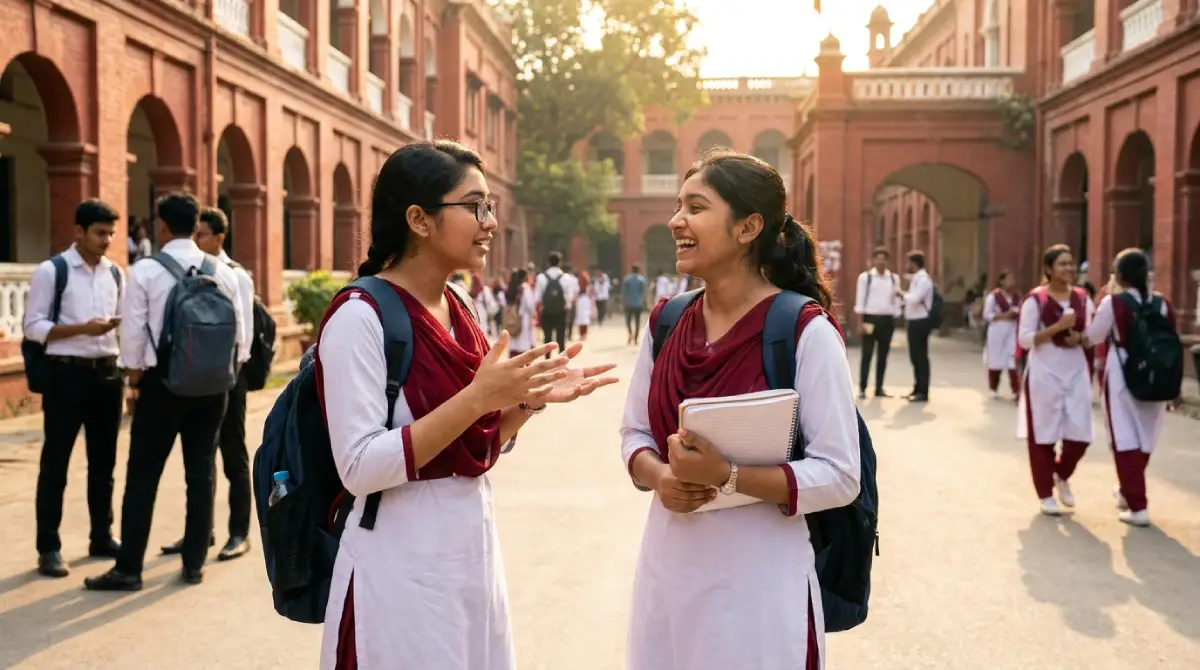
This Importance of Education in the Development of a Nation Dialogue for HSC (Class 11–12) is prepared according to the Bangladesh board exam standard. It includes Easy, Standard, and Advanced story versions (300–600 words) to help students improve writing skills and perform well in exams.
This mobile phone dialogue covers both advantages and disadvantages of mobile phones in a clear, exam-friendly format. Important vocabulary is highlighted with Bangla meanings, and additional sections like
🔐 Key Points to Remember
📝 How to Learn and Write This Dialogue in Exam
🧠 Memory tricks (mnemonics) are included for better understanding and quick revision. 😊
Importance of Education in the Development of a Nation Dialogue for HSC (Class 11–12) – 385 Words (Easy)
Nadi: Hello Adiba! Have you read today’s newspaper article about Bangladesh’s education sector?
Adiba: Hello Nadi! Yes, I did. It discussed the challenges and opportunities in our education system. What did you think about it?
Nadi: I found it very thought-provoking. The article emphasized that education is the backbone of national development. Do you agree?
Adiba: I absolutely agree. Education shapes the destiny of a nation. Can you explain how education contributes to overall development?
Nadi: Certainly! Education creates competent human resources who can drive economic, social, and political development. Without educated citizens, no country can progress.
Adiba: That is true. I have noticed that all developed nations have very high literacy rates and strong education systems.
Nadi: Exactly! Countries like Japan, Germany, and South Korea invested heavily in education after World War II and transformed themselves into economic powerhouses.
Adiba: What about the economic dimension specifically? How does education boost the economy?
Nadi: Education increases labor productivity, encourages entrepreneurship, and attracts foreign investment. An educated workforce can handle complex technologies and innovative processes.
Adiba: I see. Does education also help reduce inequality in society?
Nadi: Yes, it does! Education provides equal opportunities for all, regardless of their socioeconomic background. It is the most effective tool for social mobility.
Adiba: What about women’s empowerment? How does education help in that area?
Nadi: Women’s education is crucial for development. Educated women participate in the workforce, make informed reproductive health decisions, and raise healthier, better-educated children.
Adiba: I have also heard that education helps in population control. Is that correct?
Nadi: Absolutely! Studies show that educated families, especially when women are educated, tend to have fewer children and invest more in each child’s upbringing.
Adiba: What role does education play in technological advancement and innovation?
Nadi: Education is the foundation of all technological progress. Scientific research, technological innovation, and digital transformation all depend on highly educated professionals and researchers.
Adiba: Our government has launched Vision 2041 to make Bangladesh a developed country. Can we achieve it without improving education?
Nadi: Impossible! Vision 2041 depends entirely on creating a knowledge-based economy powered by educated, skilled citizens.
Adiba: What about moral and ethical development? Does education contribute to that?
Nadi: Definitely! Education instills values like honesty, tolerance, respect, and social responsibility. It creates ethical citizens who contribute positively to society.
Adiba: I have noticed that education also promotes cultural preservation and national identity.
Nadi: Yes! Through education, we learn about our heritage, history, language, and traditions. This strengthens our cultural identity and patriotism.
Adiba: What challenges does Bangladesh face in achieving universal quality education?
Nadi: We face several challenges including infrastructure gaps, teacher shortages, quality issues, and dropouts, especially in rural areas.
Adiba: How can we overcome these challenges?
Nadi: We need increased government funding, teacher training programs, infrastructure development, and community involvement in education.
Adiba: As future leaders, what responsibility do we have?
Nadi: We must excel in our studies, help educate others, and advocate for educational reforms that make quality education accessible to all Bangladeshis.
Adiba: Thank you, Nadi. This conversation has deepened my understanding of education’s multidimensional role in national development.
Nadi: I am glad! Let us commit to being change-makers through education.
Vocabulary
| Word | Bangla Meaning |
|---|---|
| Education sector | শিক্ষা খাত |
| Challenges | চ্যালেঞ্জ |
| Opportunities | সুযোগ |
| Backbone | মেরুদণ্ড |
| Destiny | ভাগ্য |
| Competent human resources | দক্ষ মানব সম্পদ |
| Economic | অর্থনৈতিক |
| Social | সামাজিক |
| Political development | রাজনৈতিক উন্নয়ন |
| Developed nations | উন্নত জাতি |
| Literacy rates | সাক্ষরতার হার |
| World War II | দ্বিতীয় বিশ্বযুদ্ধ |
| Economic powerhouses | অর্থনৈতিক শক্তি |
| Economic dimension | অর্থনৈতিক মাত্রা |
| Labor productivity | শ্রম উৎপাদনশীলতা |
| Entrepreneurship | উদ্যোক্তা |
| Foreign investment | বিদেশি বিনিয়োগ |
| Complex technologies | জটিল প্রযুক্তি |
| Innovative processes | উদ্ভাবনী প্রক্রিয়া |
| Inequality | অসমতা |
| Equal opportunities | সমান সুযোগ |
| Socioeconomic background | আর্থ-সামাজিক পটভূমি |
| Social mobility | সামাজিক গতিশীলতা |
| Women’s empowerment | নারীর ক্ষমতায়ন |
| Workforce | কর্মশক্তি |
| Reproductive health | প্রজনন স্বাস্থ্য |
| Population control | জনসংখ্যা নিয়ন্ত্রণ |
| Upbringing | লালন-পালন |
| Technological advancement | প্রযুক্তিগত অগ্রগতি |
| Innovation | উদ্ভাবন |
| Scientific research | বৈজ্ঞানিক গবেষণা |
| Technological innovation | প্রযুক্তিগত উদ্ভাবন |
| Digital transformation | ডিজিটাল রূপান্তর |
| Professionals | পেশাদার |
| Researchers | গবেষক |
| Vision 2041 | রূপকল্প ২০৪১ |
| Developed country | উন্নত দেশ |
| Knowledge-based economy | জ্ঞান-ভিত্তিক অর্থনীতি |
| Moral | নৈতিক |
| Ethical development | নৈতিক উন্নয়ন |
| Values | মূল্যবোধ |
| Honesty | সততা |
| Tolerance | সহনশীলতা |
| Respect | সম্মান |
| Social responsibility | সামাজিক দায়িত্ব |
| Ethical citizens | নৈতিক নাগরিক |
| Cultural preservation | সাংস্কৃতিক সংরক্ষণ |
| National identity | জাতীয় পরিচয় |
| Heritage | ঐতিহ্য |
| History | ইতিহাস |
| Language | ভাষা |
| Traditions | ঐতিহ্য |
| Cultural identity | সাংস্কৃতিক পরিচয় |
| Patriotism | দেশপ্রেম |
| Universal quality education | সর্বজনীন মানসম্মত শিক্ষা |
| Infrastructure gaps | অবকাঠামো ঘাটতি |
| Teacher shortages | শিক্ষক সংকট |
| Quality issues | মান সমস্যা |
| Dropouts | ঝরে পড়া |
| Government funding | সরকারি অর্থায়ন |
| Teacher training programs | শিক্ষক প্রশিক্ষণ কর্মসূচি |
| Infrastructure development | অবকাঠামো উন্নয়ন |
| Community involvement | সম্প্রদায় অংশগ্রহণ |
| Educational reforms | শিক্ষা সংস্কার |
| Multidimensional | বহুমাত্রিক |
| Change-makers | পরিবর্তনকারী |
Importance of Education in the Development of a Nation Dialogue for HSC (Class 11–12) – 440 Words (Standard)
Nadi: Good morning, Adiba! I was reading Professor Amartya Sen’s work on human development and capability approach. It has completely changed my perspective on education.
Adiba: Good morning, Nadi! That sounds intellectually stimulating. How does Amartya Sen’s theory relate to education and development?
Nadi: Sen argues that development should be measured not just by economic indicators but by people’s capabilities to live the lives they value. Education is fundamental to expanding these capabilities.
Adiba: That is a profound perspective. So you believe education’s role goes beyond mere economic utility?
Nadi: Absolutely! While education does contribute to GDP growth and economic prosperity, its true value lies in empowering individuals with freedom, agency, and the ability to make informed choices.
Adiba: I see. How does this apply to Bangladesh’s development trajectory?
Nadi: Bangladesh has achieved impressive macroeconomic growth, but we still face challenges in human development indicators. Improving education quality can address this gap and ensure inclusive development.
Adiba: What specific educational interventions have proven most effective for development?
Nadi: Research shows that universal primary education, girls’ secondary education, and vocational training have the highest returns on investment. Countries that prioritize these areas see rapid development.
Adiba: I have read about the Education for All movement and the Millennium Development Goals. How successful has Bangladesh been in achieving these targets?
Nadi: Bangladesh has made remarkable progress. We achieved gender parity in primary and secondary enrollment and significantly reduced illiteracy rates. However, quality gaps and learning outcomes remain concerning.
Adiba: What do you mean by quality gaps? Can you elaborate?
Nadi: Many students complete education without acquiring essential competencies like reading comprehension, mathematical reasoning, or critical analysis. This is called the learning crisis.
Adiba: That is alarming! What are the root causes of this learning crisis?
Nadi: Multiple factors contribute including outdated curricula, inadequate teacher training, large class sizes, rote memorization culture, and lack of pedagogical innovation.
Adiba: How does education contribute to democratic governance and civic participation?
Nadi: Education creates informed citizens who understand their constitutional rights, can engage in rational discourse, and hold public institutions accountable. This strengthens democratic culture.
Adiba: What about education’s role in addressing climate change and environmental sustainability?
Nadi: Education is crucial for environmental awareness, developing green technologies, and implementing sustainable practices. Bangladesh, being highly vulnerable to climate change, needs climate-literate citizens.
Adiba: I have noticed increasing emphasis on STEM education and technical skills. Is this the right direction?
Nadi: STEM is important for technological competitiveness, but we must also maintain humanities and liberal arts education. Well-rounded education produces versatile thinkers who can address complex challenges.
Adiba: How do you view the role of private sector and NGOs in education delivery?
Nadi: They play important complementary roles. Organizations like BRAC have pioneered innovative models for reaching underserved populations. However, the state must ensure regulatory oversight to maintain standards.
Adiba: What about digital education and online learning? The COVID-19 pandemic exposed huge digital divides.
Nadi: The pandemic highlighted both opportunities and challenges. While e-learning can democratize education, we must address internet accessibility, device availability, and digital literacy gaps.
Adiba: Looking at Vision 2041 and becoming a high-income country, what educational transformations are necessary?
Nadi: We need curriculum modernization, research-oriented universities, industry-academia collaboration, innovation ecosystems, and lifelong learning frameworks.
Adiba: What role can we, as college students, play in this transformation?
Nadi: We should excel academically, engage in community service, volunteer in education outreach programs, and advocate for evidence-based policies that improve educational access and quality.
Adiba: This has been an enriching discussion, Nadi. Education truly is the most powerful instrument for transforming Bangladesh.
Nadi: I agree completely. As Nelson Mandela said, “Education is the most powerful weapon which you can use to change the world.”
Vocabulary
| Word | Bangla Meaning |
|---|---|
| Human development | মানব উন্নয়ন |
| Capability approach | সামর্থ্য দৃষ্টিভঙ্গি |
| Economic indicators | অর্থনৈতিক সূচক |
| Capabilities | সামর্থ্য |
| Economic utility | অর্থনৈতিক উপযোগিতা |
| GDP growth | জিডিপি প্রবৃদ্ধি |
| Economic prosperity | অর্থনৈতিক সমৃদ্ধি |
| Freedom | স্বাধীনতা |
| Agency | কর্মক্ষমতা |
| Informed choices | সচেতন পছন্দ |
| Development trajectory | উন্নয়ন গতিপথ |
| Macroeconomic growth | সামষ্টিক অর্থনৈতিক প্রবৃদ্ধি |
| Human development indicators | মানব উন্নয়ন সূচক |
| Inclusive development | অন্তর্ভুক্তিমূলক উন্নয়ন |
| Educational interventions | শিক্ষাগত হস্তক্ষেপ |
| Universal primary education | সর্বজনীন প্রাথমিক শিক্ষা |
| Girls’ secondary education | মেয়েদের মাধ্যমিক শিক্ষা |
| Vocational training | বৃত্তিমূলক প্রশিক্ষণ |
| Returns on investment | বিনিয়োগের রিটার্ন |
| Education for All | সবার জন্য শিক্ষা |
| Millennium Development Goals | সহস্রাব্দ উন্নয়ন লক্ষ্য |
| Gender parity | লিঙ্গ সমতা |
| Illiteracy rates | নিরক্ষরতার হার |
| Quality gaps | মান ফাঁক |
| Learning outcomes | শিখন ফলাফল |
| Competencies | দক্ষতা |
| Reading comprehension | পড়া বোঝা |
| Mathematical reasoning | গাণিতিক যুক্তি |
| Critical analysis | সমালোচনামূলক বিশ্লেষণ |
| Learning crisis | শিখন সংকট |
| Outdated curricula | পুরনো পাঠ্যক্রম |
| Inadequate teacher training | অপর্যাপ্ত শিক্ষক প্রশিক্ষণ |
| Large class sizes | বড় শ্রেণির আকার |
| Rote memorization | মুখস্থ করা |
| Pedagogical innovation | শিক্ষাগত উদ্ভাবন |
| Democratic governance | গণতান্ত্রিক শাসন |
| Civic participation | নাগরিক অংশগ্রহণ |
| Informed citizens | সচেতন নাগরিক |
| Constitutional rights | সাংবিধানিক অধিকার |
| Rational discourse | যুক্তিসঙ্গত আলোচনা |
| Public institutions | জনপ্রতিষ্ঠান |
| Democratic culture | গণতান্ত্রিক সংস্কৃতি |
| Climate change | জলবায়ু পরিবর্তন |
| Environmental sustainability | পরিবেশগত স্থায়িত্ব |
| Environmental awareness | পরিবেশ সচেতনতা |
| Green technologies | সবুজ প্রযুক্তি |
| Sustainable practices | টেকসই অভ্যাস |
| Climate-literate | জলবায়ু-সাক্ষর |
| STEM education | বিজ্ঞান-প্রযুক্তি-প্রকৌশল-গণিত শিক্ষা |
| Technical skills | কারিগরি দক্ষতা |
| Technological competitiveness | প্রযুক্তিগত প্রতিযোগিতা |
| Humanities | মানবিক বিদ্যা |
| Liberal arts | উদার কলা |
| Well-rounded education | সর্বাঙ্গীণ শিক্ষা |
| Versatile thinkers | বহুমুখী চিন্তাবিদ |
| Private sector | বেসরকারি খাত |
| NGOs | এনজিও |
| Complementary roles | পরিপূরক ভূমিকা |
| BRAC | ব্র্যাক |
| Innovative models | উদ্ভাবনী মডেল |
| Underserved populations | সেবাবঞ্চিত জনগোষ্ঠী |
| Regulatory oversight | নিয়ন্ত্রক তত্ত্বাবধান |
| Digital education | ডিজিটাল শিক্ষা |
| Online learning | অনলাইন শিক্ষা |
| Digital divides | ডিজিটাল বিভাজন |
| E-learning | ই-লার্নিং |
| Internet accessibility | ইন্টারনেট প্রবেশাধিকার |
| Device availability | ডিভাইস প্রাপ্যতা |
| Digital literacy | ডিজিটাল সাক্ষরতা |
| Vision 2041 | রূপকল্প ২০৪১ |
| High-income country | উচ্চ আয়ের দেশ |
| Curriculum modernization | পাঠ্যক্রম আধুনিকীকরণ |
| Research-oriented universities | গবেষণা-ভিত্তিক বিশ্ববিদ্যালয় |
| Industry-academia collaboration | শিল্প-শিক্ষা সহযোগিতা |
| Innovation ecosystems | উদ্ভাবন বাস্তুতন্ত্র |
| Lifelong learning | আজীবন শিক্ষা |
| Community service | সম্প্রদায় সেবা |
| Education outreach programs | শিক্ষা সম্প্রসারণ কর্মসূচি |
| Evidence-based policies | প্রমাণ-ভিত্তিক নীতি |
Importance of Education in the Development of a Nation Dialogue for HSC (Class 11–12) – 490 Words (Advanced)
Nadi: Good afternoon, Adiba! I was analyzing the latest Human Development Report and Global Competitiveness Index. The data reveals interesting correlations between education and multidimensional development.
Adiba: Good afternoon, Nadi! That sounds like a rigorous analysis. What specific correlations did you identify?
Nadi: The data shows strong positive correlations between tertiary education enrollment, patent applications, innovation indices, and per capita income. Countries investing over 6% of GDP in education consistently outperform others in human development rankings.
Adiba: That is compelling empirical evidence. But how do we explain the causal mechanisms through which education drives such comprehensive development?
Nadi: From an economic perspective, human capital theory posits that education increases marginal productivity of labor. However, new institutional economics adds that education also creates social capital, reduces transaction costs, and strengthens institutional quality.
Adiba: Fascinating! So education operates through both direct and indirect channels?
Nadi: Exactly! Directly, it enhances cognitive skills, technical competencies, and creative capabilities. Indirectly, it promotes rule of law, accountability mechanisms, civil society engagement, and political stability – all crucial for sustainable development.
Adiba: How does Bangladesh’s education system perform when benchmarked against international standards like PISA scores or learning-adjusted years of schooling?
Nadi: Unfortunately, we lag significantly. While our enrollment rates are impressive, learning outcomes remain poor. The World Bank’s learning-adjusted years metric shows Bangladeshi students receive only about 6.5 effective years of education despite 10 years of schooling.
Adiba: That is a concerning efficiency gap. What are the structural impediments causing this?
Nadi: Multiple factors including inadequate pedagogical training, exam-oriented rather than competency-based curricula, weak assessment systems, limited research culture in universities, and insufficient public expenditure on education.
Adiba: Speaking of public expenditure, Bangladesh spends only about 2% of GDP on education, far below the UNESCO recommended 6%. What are the fiscal constraints?
Nadi: It reflects competing priorities and resource allocation challenges. However, this is shortsighted from a cost-benefit analysis perspective. Studies show education investments yield returns of 10-15% annually, higher than most physical infrastructure projects.
Adiba: How does education influence demographic transition and demographic dividend realization?
Nadi: Education, especially female education, accelerates fertility decline and improves child survival rates. This creates a demographic window where the working-age population exceeds dependents, potentially boosting economic growth – but only if this population is adequately educated.
Adiba: Bangladesh is currently in this demographic window. Are we capitalizing on it?
Nadi: Partially. While we have improved basic literacy, we are not producing enough high-skilled workers, scientists, engineers, and entrepreneurs needed for a knowledge economy. The skills mismatch between education outputs and labor market demands is significant.
Adiba: What about the role of education in social stratification and intergenerational mobility? Does our system promote equality?
Nadi: Unfortunately, education is increasingly reproducing rather than reducing inequality. Socioeconomic background strongly predicts educational attainment. Elite English-medium schools and private universities create parallel systems inaccessible to most Bangladeshis.
Adiba: That contradicts education’s meritocratic ideal. How can we make education more equitable?
Nadi: We need progressive policies like need-based scholarships, affirmative action for marginalized groups, quality improvement in public institutions, and elimination of informal fees that burden poor families.
Adiba: How does globalization and the knowledge economy reshape education’s role?
Nadi: In the globalized post-industrial economy, comparative advantage increasingly derives from intellectual property, innovation capacity, and adaptability rather than natural resources or cheap labor. Education determines whether countries are knowledge producers or merely consumers.
Adiba: Given artificial intelligence and automation trends, what educational paradigm shift is necessary?
Nadi: We must move from content transmission to competency development. Focus should shift to metacognitive skills, emotional intelligence, ethical reasoning, creative problem-solving, and collaborative abilities – capabilities where humans maintain comparative advantage over machines.
Adiba: What about philosophical and existential dimensions? Does education serve instrumental purposes only?
Nadi: That is a profound question. While education certainly has instrumental value for economic and social development, its intrinsic value lies in human flourishing, intellectual freedom, aesthetic appreciation, and enabling people to live examined lives with moral purpose.
Adiba: Drawing from Rabindranath Tagore’s educational philosophy, how should we balance nationalist and universalist orientations?
Nadi: Tagore advocated rooted cosmopolitanism – deep grounding in local culture while embracing universal humanistic values. Education should foster both cultural identity and global citizenship.
Adiba: This conversation has been intellectually enriching. Education clearly operates as the fundamental catalyst for holistic transformation across economic, social, political, cultural, and existential dimensions.
Nadi: Indeed! As we pursue Sonar Bangla – the Golden Bengal – envisioned by our national anthem, quality education for all remains our most critical imperative.
Vocabulary
| Word | Bangla Meaning |
|---|---|
| Human Development Report | মানব উন্নয়ন প্রতিবেদন |
| Global Competitiveness Index | বৈশ্বিক প্রতিযোগিতা সূচক |
| Correlations | পারস্পরিক সম্পর্ক |
| Tertiary education enrollment | উচ্চশিক্ষা ভর্তি |
| Patent applications | পেটেন্ট আবেদন |
| Innovation indices | উদ্ভাবন সূচক |
| Per capita income | মাথাপিছু আয় |
| Human development rankings | মানব উন্নয়ন র্যাঙ্কিং |
| Empirical evidence | অভিজ্ঞতালব্ধ প্রমাণ |
| Causal mechanisms | কার্যকারণ প্রক্রিয়া |
| Economic perspective | অর্থনৈতিক দৃষ্টিভঙ্গি |
| Human capital theory | মানব পুঁজি তত্ত্ব |
| Marginal productivity | প্রান্তিক উৎপাদনশীলতা |
| New institutional economics | নব প্রাতিষ্ঠানিক অর্থনীতি |
| Social capital | সামাজিক পুঁজি |
| Transaction costs | লেনদেন ব্যয় |
| Institutional quality | প্রাতিষ্ঠানিক মান |
| Direct channels | প্রত্যক্ষ মাধ্যম |
| Indirect channels | পরোক্ষ মাধ্যম |
| Cognitive skills | জ্ঞানীয় দক্ষতা |
| Technical competencies | কারিগরি দক্ষতা |
| Creative capabilities | সৃজনশীল সামর্থ্য |
| Rule of law | আইনের শাসন |
| Accountability mechanisms | জবাবদিহিতা প্রক্রিয়া |
| Civil society engagement | সুশীল সমাজ অংশগ্রহণ |
| Political stability | রাজনৈতিক স্থিতিশীলতা |
| International standards | আন্তর্জাতিক মান |
| PISA scores | পিসা স্কোর |
| Learning-adjusted years of schooling | শিখন-সমন্বিত শিক্ষা বছর |
| Enrollment rates | ভর্তির হার |
| Learning outcomes | শিখন ফলাফল |
| World Bank | বিশ্ব ব্যাংক |
| Effective years | কার্যকর বছর |
| Efficiency gap | দক্ষতা ব্যবধান |
| Structural impediments | কাঠামোগত বাধা |
| Inadequate pedagogical training | অপর্যাপ্ত শিক্ষাগত প্রশিক্ষণ |
| Exam-oriented | পরীক্ষা-ভিত্তিক |
| Competency-based | দক্ষতা-ভিত্তিক |
| Assessment systems | মূল্যায়ন ব্যবস্থা |
| Research culture | গবেষণা সংস্কৃতি |
| Public expenditure | সরকারি ব্যয় |
| UNESCO | ইউনেস্কো |
| Fiscal constraints | রাজস্ব সীমাবদ্ধতা |
| Competing priorities | প্রতিযোগী অগ্রাধিকার |
| Resource allocation | সম্পদ বরাদ্দ |
| Shortsighted | দূরদর্শিতাহীন |
| Cost-benefit analysis | ব্যয়-সুবিধা বিশ্লেষণ |
| Returns | রিটার্ন |
| Physical infrastructure | ভৌত অবকাঠামো |
| Demographic transition | জনমিতিক রূপান্তর |
| Demographic dividend | জনমিতিক লভ্যাংশ |
| Fertility decline | প্রজনন হ্রাস |
| Child survival rates | শিশু বেঁচে থাকার হার |
| Demographic window | জনমিতিক উইন্ডো |
| Working-age population | কর্মক্ষম জনসংখ্যা |
| Dependents | নির্ভরশীল |
| Economic growth | অর্থনৈতিক প্রবৃদ্ধি |
| Basic literacy | মৌলিক সাক্ষরতা |
| High-skilled workers | উচ্চ-দক্ষ কর্মী |
| Scientists | বিজ্ঞানী |
| Engineers | প্রকৌশলী |
| Entrepreneurs | উদ্যোক্তা |
| Knowledge economy | জ্ঞান অর্থনীতি |
| Skills mismatch | দক্ষতা অমিল |
| Labor market demands | শ্রমবাজার চাহিদা |
| Social stratification | সামাজিক স্তরবিন্যাস |
| Intergenerational mobility | আন্তঃপ্রজন্ম গতিশীলতা |
| Socioeconomic background | আর্থ-সামাজিক পটভূমি |
| Educational attainment | শিক্ষাগত অর্জন |
| Parallel systems | সমান্তরাল ব্যবস্থা |
| Meritocratic ideal | মেধাতান্ত্রিক আদর্শ |
| Equitable | ন্যায্য |
| Progressive policies | প্রগতিশীল নীতি |
| Need-based scholarships | প্রয়োজন-ভিত্তিক বৃত্তি |
| Affirmative action | ইতিবাচক পদক্ষেপ |
| Marginalized groups | প্রান্তিক গোষ্ঠী |
| Quality improvement | মান উন্নয়ন |
| Public institutions | সরকারি প্রতিষ্ঠান |
| Informal fees | অনানুষ্ঠানিক ফি |
| Globalization | বিশ্বায়ন |
| Knowledge economy | জ্ঞান অর্থনীতি |
| Post-industrial economy | শিল্পোত্তর অর্থনীতি |
| Comparative advantage | তুলনামূলক সুবিধা |
| Intellectual property | বৌদ্ধিক সম্পত্তি |
| Innovation capacity | উদ্ভাবন সক্ষমতা |
| Adaptability | অভিযোজন ক্ষমতা |
| Cheap labor | সস্তা শ্রম |
| Knowledge producers | জ্ঞান উৎপাদক |
| Consumers | ভোক্তা |
| Artificial intelligence | কৃত্রিম বুদ্ধিমত্তা |
| Automation | স্বয়ংক্রিয়করণ |
| Paradigm shift | দৃষ্টান্ত পরিবর্তন |
| Content transmission | বিষয়বস্তু স্থানান্তর |
| Competency development | দক্ষতা উন্নয়ন |
| Metacognitive skills | মেটাকগনিটিভ দক্ষতা |
| Emotional intelligence | আবেগিক বুদ্ধিমত্তা |
| Ethical reasoning | নৈতিক যুক্তি |
| Creative problem-solving | সৃজনশীল সমস্যা সমাধান |
| Collaborative abilities | সহযোগিতামূলক সামর্থ্য |
| Comparative advantage | তুলনামূলক সুবিধা |
| Philosophical | দার্শনিক |
| Existential | অস্তিত্বমূলক |
| Instrumental purposes | যন্ত্রগত উদ্দেশ্য |
| Instrumental value | যন্ত্রগত মূল্য |
| Intrinsic value | অন্তর্নিহিত মূল্য |
| Human flourishing | মানব বিকাশ |
| Intellectual freedom | বুদ্ধিবৃত্তিক স্বাধীনতা |
| Aesthetic appreciation | নান্দনিক উপলব্ধি |
| Examined lives | পরীক্ষিত জীবন |
| Moral purpose | নৈতিক উদ্দেশ্য |
| Rabindranath Tagore | রবীন্দ্রনাথ ঠাকুর |
| Nationalist | জাতীয়তাবাদী |
| Universalist | সার্বজনীনবাদী |
| Rooted cosmopolitanism | মূলসহ বিশ্বনাগরিকতা |
| Cultural identity | সাংস্কৃতিক পরিচয় |
| Global citizenship | বৈশ্বিক নাগরিকত্ব |
| Fundamental catalyst | মৌলিক অনুঘটক |
| Holistic transformation | সামগ্রিক রূপান্তর |
| Sonar Bangla | সোনার বাংলা |
📝 How to Learn and Write This Dialogue in Exam – For Class 11 & 12
1. Key Points to Remember
- Conceptual framework: Education is not just skill-building but expands human capabilities, freedom, and agency (reference Amartya Sen’s capability approach)
- Economic dimensions: Education creates human capital, increases labor productivity, attracts foreign investment, and drives GDP growth; mention returns on investment (10-15% annually)
- Development indicators: Discuss enrollment rates vs. learning outcomes, quality gaps, learning crisis, and learning-adjusted years of schooling
- Social impacts: Education promotes social mobility, gender equality, poverty alleviation, and is fundamental for achieving Sustainable Development Goals
- Democratic governance: Education creates informed citizens who understand constitutional rights, engage in rational discourse, and strengthen democratic institutions
- Technological advancement: STEM education is crucial for Fourth Industrial Revolution, but balanced with humanities for well-rounded development
- Bangladesh context: Reference Vision 2041, Digital Bangladesh, demographic dividend, reciprocal agreements with universities, BRAC initiatives
- Global perspective: Mention UNESCO recommendations (6% GDP on education), international comparisons (Japan, South Korea, Singapore), PISA scores
- Policy issues: Discuss public expenditure (Bangladesh spends only 2% of GDP), curriculum reform, teacher training, infrastructure gaps, digital divide
- Philosophical dimensions: Balance instrumental value (economic utility) with intrinsic value (human flourishing, intellectual freedom, moral purpose)
- Future challenges: Address AI and automation, need for metacognitive skills, emotional intelligence, creative problem-solving, lifelong learning
2. Memory Trick / Mnemonic
Remember EDUCATION TRANSFORMS for Importance of Education (HSC level):
- E = Economic growth (human capital theory, productivity, GDP, 10-15% returns)
- D = Democratic governance (informed citizens, constitutional rights, accountability)
- U = UNESCO standards (6% GDP recommendation, international benchmarks)
- C = Capability approach (Amartya Sen – freedom, agency, informed choices)
- A = Achievement gaps (enrollment vs. learning outcomes, quality issues)
- T = Technological advancement (STEM, Fourth Industrial Revolution, AI challenges)
- I = Institutional quality (social capital, rule of law, civil society engagement)
- O = Opportunities for women (empowerment, workforce participation, family health)
- N = National development (Vision 2041, Digital Bangladesh, demographic dividend)
- T = Training and skills (vocational training, competency-based learning, innovation)
- R = Research culture (universities, industry-academia collaboration, innovation ecosystems)
- A = Access and equity (marginalized communities, need-based scholarships, affirmative action)
- N = New pedagogies (shift from rote learning to critical thinking and problem-solving)
- S = Sustainability (environmental awareness, climate literacy, green technologies)
- F = Fiscal investment (public expenditure, cost-benefit analysis, resource allocation)
- O = Outcomes measurement (learning-adjusted years, PISA scores, competencies)
- R = Rights-based approach (fundamental right, Education for All, universal quality education)
- M = Multidimensional impact (economic, social, political, cultural, existential dimensions)
- S = Social mobility (intergenerational mobility, meritocracy, reducing inequality)
3. Exam Writing Checklist
✅ Did I reference at least one major educational theorist or framework (Amartya Sen’s capability approach, human capital theory, or Rabindranath Tagore’s educational philosophy)?
✅ Did I include specific data points and statistics (Bangladesh spends 2% of GDP vs. UNESCO’s 6% recommendation, learning-adjusted years showing 6.5 effective years from 10 years of schooling, 10-15% returns on education investment)?
✅ Did I mention at least three international examples or organizations (UNESCO, World Bank, PISA scores, Japan/South Korea/Singapore development models, BRAC initiatives, Education for All movement, Millennium Development Goals)?
✅ Did I discuss both quantitative achievements (enrollment rates, gender parity, literacy rates) and qualitative challenges (learning outcomes, competency gaps, learning crisis, skills mismatch)?
✅ Did I address contemporary issues relevant to HSC level (Vision 2041, Fourth Industrial Revolution, artificial intelligence and automation, digital divide, climate literacy, demographic dividend, knowledge economy, curriculum reform, need for STEM and humanities balance)?
4. One-Line Summary
Education serves as the fundamental catalyst for multidimensional national transformation by creating human capital, expanding individual capabilities and freedoms, strengthening democratic institutions, driving technological innovation, and enabling Bangladesh to achieve Vision 2041 and participate effectively in the global knowledge economy.
FAQ Section on Importance of Education Dialogue – For Class 11 & 12
Q1: What is Amartya Sen’s capability approach and how does it relate to education?
Answer: Amartya Sen’s capability approach argues that development should be measured by people’s capabilities to live lives they value, not just economic indicators. Education is fundamental to expanding these capabilities by providing freedom, agency, and the ability to make informed choices.
Q2: What is the difference between enrollment rates and learning outcomes?
Answer: Enrollment rates measure the percentage of eligible students attending school, while learning outcomes assess actual knowledge and competencies gained. Bangladesh has high enrollment but poor learning outcomes, indicating a quality gap in education delivery.
Q3: What does “learning-adjusted years of schooling” mean?
Answer: This World Bank metric adjusts years of schooling by learning quality. Bangladesh students receive about 6.5 effective years despite 10 years of schooling, meaning poor learning outcomes reduce the actual educational value received.
Q4: How does education contribute to demographic dividend?
Answer: Education, especially female education, reduces fertility rates and improves child survival, creating a demographic window where working-age population exceeds dependents. However, this population must be educated and skilled to generate actual economic growth benefits.
Q5: What is the learning crisis and why is it concerning?
Answer: The learning crisis refers to students completing education without acquiring essential competencies like reading comprehension, mathematical reasoning, or critical analysis. This undermines education’s effectiveness in driving development despite high enrollment numbers.
Q6: Why does Bangladesh spend only 2% of GDP on education vs. UNESCO’s 6% recommendation?
Answer: This reflects competing fiscal priorities and resource allocation challenges. However, this is shortsighted since education investments yield 10-15% annual returns, higher than most physical infrastructure projects.
Q7: How does education strengthen democratic governance?
Answer: Education creates informed citizens who understand their constitutional rights, can engage in rational discourse, and hold public institutions accountable. This civic literacy and political participation strengthen democratic culture and institutional quality.
Q8: What is the Fourth Industrial Revolution and why does education matter for it?
Answer: The Fourth Industrial Revolution involves AI, automation, and advanced technologies transforming economies. Education must develop metacognitive skills, emotional intelligence, and creative problem-solving where humans maintain comparative advantage over machines.
Q9: What is the skills mismatch problem in Bangladesh?
Answer: There is a gap between educational outputs and labor market demands. We are not producing enough high-skilled workers, scientists, engineers, and entrepreneurs needed for a knowledge economy, despite improving basic literacy.
Q10: How should education balance STEM subjects with humanities?
Answer: While STEM is important for technological competitiveness, humanities and liberal arts develop critical thinking, ethical reasoning, and cultural awareness. Well-rounded education produces versatile thinkers who can address complex multidimensional challenges effectively.
প্রিয় শিক্ষার্থীবৃন্দ
আমরা আশা করি এই Dialogue গুলো তোমাদের পরীক্ষায় ভালো নম্বর অর্জনে সহায়ক হবে। যদি কন্টেন্টটি উপকারী মনে হয়, তাহলে তোমাদের মতামত ও প্রয়োজনীয় টপিক কমেন্ট সেকশনে জানাও।
নিয়মিত পরীক্ষার প্রস্তুতি ও গুরুত্বপূর্ণ আপডেট পেতে আমাদের
▶️ YouTube Channel সাবস্ক্রাইব করো এবং
ⓕ Facebook Page লাইক দিয়ে আমাদের সাথে যুক্ত থাকো 🚀
তোমাদের সফল প্রস্তুতিই আমাদের মূল লক্ষ্য 💪
🔗 Explore More for Preparation
📚 পরীক্ষার জন্য আরও প্রস্তুতি নাও
-
📌 Stories