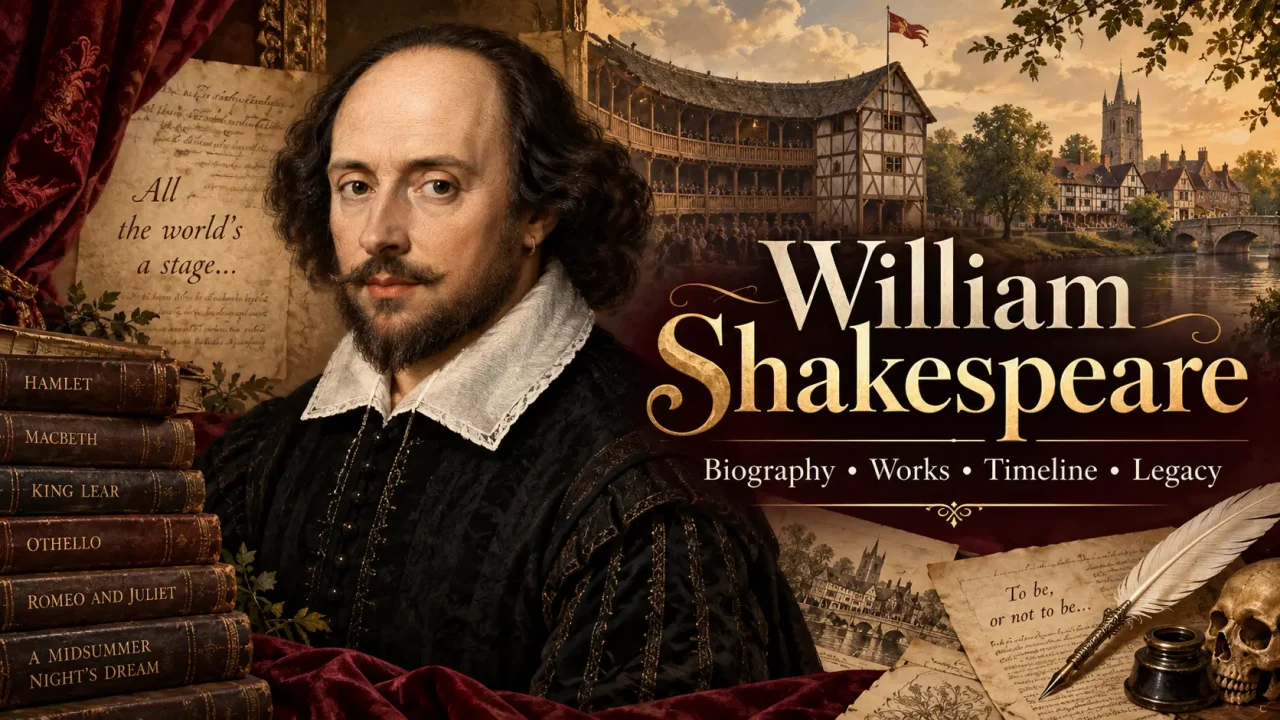



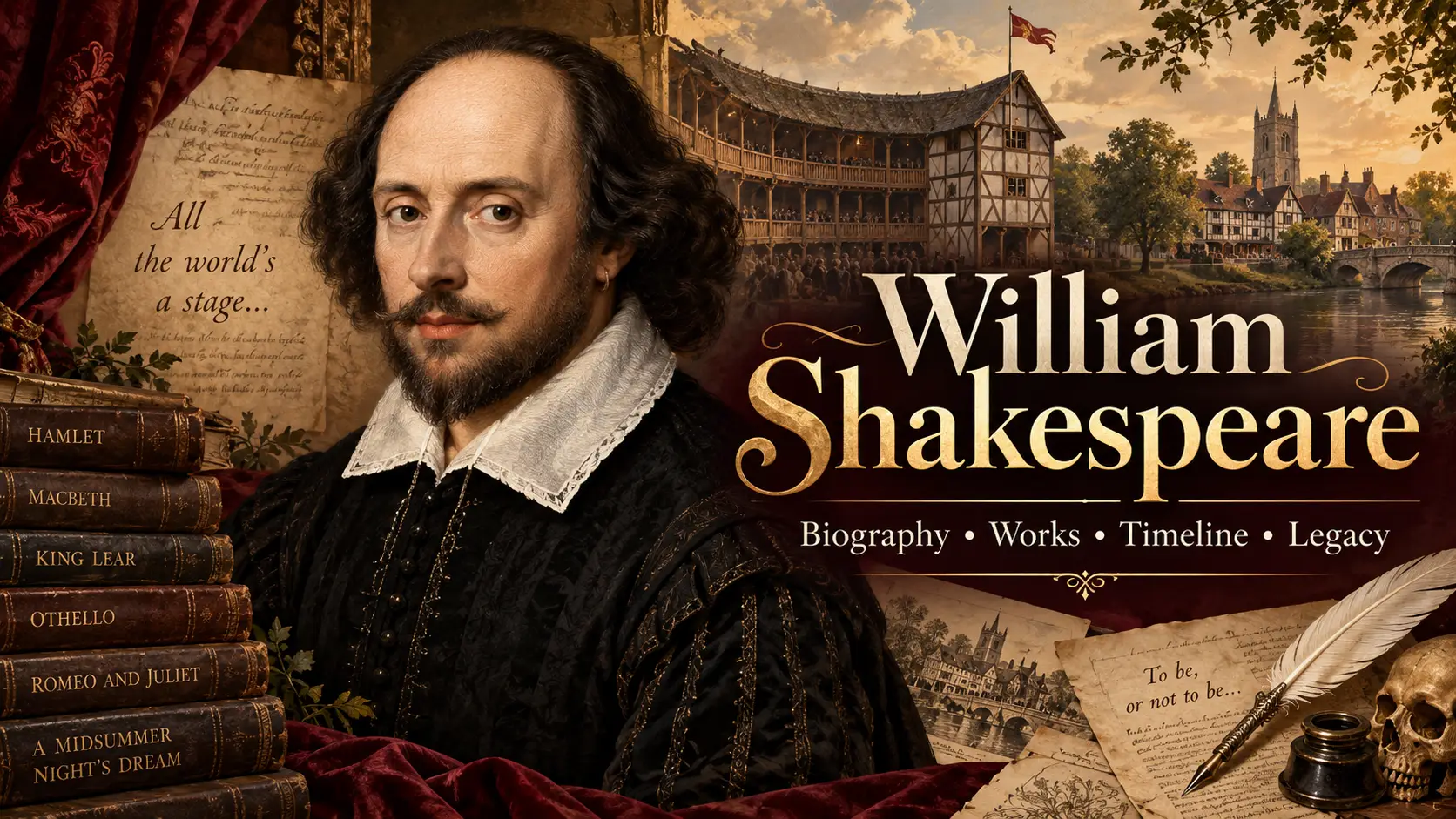
William Shakespeare (1564–1616) was an English playwright, poet, actor, and theatre shareholder whose works became central to English-language literature and theatre. Plays such as Hamlet, Macbeth, Othello, King Lear, Romeo and Juliet, A Midsummer Night’s Dream, and The Tempest continue to be performed, translated, studied, and adapted around the world.
Shakespeare’s achievement was not simply that he wrote memorable stories. His plays explore power, love, ambition, jealousy, grief, justice, identity, and the limits of human understanding. His language can be comic, intimate, philosophical, political, or deeply unsettling, often within the same play. The works have survived more than four centuries because each generation finds new questions in them.
Yet the historical Shakespeare is not completely known to us. Records survive about his baptism, family, marriage, property, theatrical career, publications, and will, but no diary or substantial collection of personal letters explains his private thoughts. A careful biography must therefore distinguish documented facts from reasonable conclusions and later legends.
In Short
William Shakespeare was born in Stratford-upon-Avon in 1564 and became a successful playwright, poet, actor, and shareholder in London’s professional theatre. He was associated with the Lord Chamberlain’s Men, which became the King’s Men under James I, and with the Globe Theatre. His family included his wife, Anne Hathaway, and their three children: Susanna, Hamnet, and Judith. Shakespeare died in 1616. His surviving works are conventionally counted as 38 plays, 154 sonnets, and several narrative and shorter poems, although collaboration and disputed attribution complicate the boundaries of his canon.
William Shakespeare at a Glance
| Category | Information |
| Full name | William Shakespeare |
| Born | 1564; exact birth date is unknown |
| Baptized | 26 April 1564, in Stratford-upon-Avon |
| Traditional birthday | 23 April, celebrated by tradition rather than established by a surviving birth record |
| Birthplace | Stratford-upon-Avon, Warwickshire, England |
| Father | John Shakespeare |
| Mother | Mary Arden |
| Wife | Anne Hathaway, whom he married in 1582 |
| Children | Susanna, Hamnet, and Judith |
| Occupations | Playwright, poet, actor, shareholder, and property owner |
| Acting company | Lord Chamberlain’s Men; later the King’s Men |
| Associated theatres | The Globe and Blackfriars, among other playhouses and performance venues |
| Surviving plays | Conventionally 38 in the modern canon, including collaborative works |
| Sonnets | 154 in the 1609 collection |
| Major narrative poems | Venus and Adonis and Lucrece |
| Documented lost play | Cardenio, associated with Shakespeare and John Fletcher |
| Died | 1616; his Stratford monument gives 23 April as the date |
| Buried | Holy Trinity Church, Stratford-upon-Avon |
| First Folio | Published in 1623, seven years after his death |
William Shakespeare: A Brief Timeline
| Year | Event |
| 1564 | Shakespeare is born in Stratford-upon-Avon; the parish register records his baptism on 26 April. |
| 1582 | He marries Anne Hathaway. |
| 1583 | His daughter Susanna is baptized. |
| 1585 | The twins Hamnet and Judith are baptized. |
| c. 1585–1592 | The years for which Shakespeare’s activities are poorly documented. |
| 1592 | A hostile reference to “Shake-scene” suggests that he is established in London theatre. |
| 1593 | Venus and Adonis is published. |
| 1594 | Lucrece is published; Shakespeare is associated with the Lord Chamberlain’s Men. |
| 1597 | He buys New Place in Stratford-upon-Avon. |
| 1599 | The Globe Theatre opens and becomes associated with his company. |
| 1603 | The company becomes the King’s Men under James I. |
| 1609 | The collection of 154 sonnets is published. |
| 1613 | The original Globe burns during a performance of Henry VIII. |
| 1614 | The rebuilt Globe reopens. |
| 1616 | Shakespeare dies in Stratford-upon-Avon. |
| 1623 | The First Folio is published by his colleagues John Heminge and Henry Condell. |
This timeline gives a general orientation, not a complete record of Shakespeare’s life. Some dates are documented by surviving records, while others are approximate or reflect the best current scholarly estimates.
Shakespeare’s Birth and Early Life
William Shakespeare was born in Stratford-upon-Avon, a market town in Warwickshire, England, in 1564. The exact date of his birth is not documented. The parish register records his baptism on 26 April 1564, and 23 April is traditionally celebrated as his birthday. It is reasonable to place his birth a few days before the baptism, but the familiar birthday should not be presented as a proven fact. The surviving baptism record is available through Shakespeare Documented.
Shakespeare grew up in a town shaped by trade, agriculture, religion, and local government. His father, John Shakespeare, worked as a leatherworker and glove-maker and held civic offices in Stratford, eventually serving as bailiff, a position comparable in some respects to a leading town official. His mother, Mary Arden, came from a Warwickshire family with land and local standing.
These circumstances do not prove what Shakespeare thought or experienced as a child, but they place him in a household connected with commerce and civic life rather than in an isolated literary environment. His later plays show a sustained interest in social rank, money, law, work, family responsibilities, and the public performance of authority.
No reliable childhood diary or personal account survives. Details beyond the documentary record must therefore be treated cautiously. Later stories about Shakespeare’s childhood can be interesting, but they should not be repeated as established biography unless evidence supports them.
Parents, Marriage, and Children
John Shakespeare and Mary Arden were William’s parents. The surviving evidence connects John with leatherworking and town government and Mary with the Arden family. Their son was part of a relatively large family, although not all of his siblings survived into adulthood.
In 1582, when he was eighteen, Shakespeare married Anne Hathaway, who was older than him. Their first child, Susanna, was baptized in 1583. Twins, Hamnet and Judith, were baptized in 1585. These records provide firm evidence of the family, but they tell us little about the private character of the marriage.
The family’s home life is difficult to reconstruct. Shakespeare’s professional career was based largely in London, while Anne and the children were connected with Stratford. The exact arrangements and timing of his moves are not fully documented. Claims that the couple had a happy or unhappy marriage go beyond the evidence unless presented as interpretation.
Hamnet died in 1596, aged eleven. His death has encouraged readers to look for connections between family grief and plays such as Hamlet, but no surviving document shows precisely how Hamnet’s death affected Shakespeare or whether it directly influenced a particular work. The similarity between the names is noteworthy, not proof of a direct connection.
Susanna later married the physician John Hall, and their daughter Elizabeth was Shakespeare’s granddaughter. Judith married Thomas Quiney in 1616. Shakespeare has no known surviving direct descendants. These family relationships matter to his biography because they place him within the domestic and legal world of Stratford, a world to which he returned increasingly during his later years.
What Did William Shakespeare Look Like?
No photograph or unquestionably verified life portrait of Shakespeare survives. Two images are especially important to discussions of his appearance: the engraving by Martin Droeshout printed in the 1623 First Folio and the memorial bust in Holy Trinity Church, Stratford-upon-Avon. Both are treated by the Folger Shakespeare Library as among the most credible likenesses because they were associated with people who knew Shakespeare. The Droeshout engraving appeared seven years after his death and was accompanied by praise from his contemporary Ben Jonson.
The Chandos Portrait is another widely reproduced image, but its identification and history are less certain. It is often proposed as a portrait made during Shakespeare’s lifetime, yet it should not be presented as conclusively authenticated. For a historical article, use captions that identify the image and explain its evidential status rather than implying that every familiar Shakespeare portrait is a confirmed likeness. See the Folger’s discussion of the First Folio portrait and its article on images associated with Shakespeare.
Education and Literary Influences
There is no surviving school enrolment record proving that Shakespeare attended Stratford’s grammar school. Nevertheless, scholars generally regard attendance as highly probable because of his family’s position in the town and the classical learning reflected in his writing. This should be expressed as a strong historical inference, not as a surviving documentary fact.
Grammar-school education in Shakespeare’s time placed heavy emphasis on Latin grammar, translation, rhetoric, memorization, and classical literature. Students might encounter authors such as Ovid, Virgil, Cicero, Seneca, Terence, and Plautus. Shakespeare’s plays and poems show familiarity with classical stories and dramatic traditions, though the precise route by which he encountered individual texts is not always certain.
No evidence shows that Shakespeare attended a university. That does not mean he lacked education. University attendance and education are not the same thing, and a grammar-school education could be demanding. His career also depended on learning through reading, theatre work, observation, collaboration, performance, and revision.
Shakespeare drew on a wide range of literary sources. These included Ovid’s Metamorphoses, Plutarch’s lives of Greek and Roman figures, Raphael Holinshed’s historical chronicles, Senecan tragedy, Roman comedy, Italian prose tales, English plays, romances, classical mythology, and the Bible. Borrowing plots was common in Renaissance literature. Shakespeare’s distinction often lies in the changes he made: reshaping characters, adding competing motives, reorganizing events, sharpening political questions, and intensifying emotional conflict.
A useful question when approaching a Shakespeare play is not simply “Did he invent the story?” but “What did he transform, and why?” The answer often reveals how he converted inherited material into complex drama.
The Lost Years
The period between the mid-1580s and 1592 is commonly called Shakespeare’s “lost years” because surviving evidence tells us little about his activities. We do not know exactly when he left Stratford for London or how he first entered the theatre profession.
Later traditions claim that he worked as a schoolteacher, joined travelling actors, worked in a legal setting, or fled Stratford after an alleged deer-poaching incident. These stories vary in reliability and are not established by strong contemporary evidence. They should be labelled as traditions rather than facts.
The careful conclusion is straightforward: Shakespeare’s activities during much of this period remain uncertain. A strong biography does not need to fill every gap with a dramatic story. Explaining what is known and what is not known is more trustworthy than presenting a legend as history.
Shakespeare in London
By 1592, Shakespeare was sufficiently visible in London’s theatrical world to attract criticism from other writers. A posthumously published work associated with the dramatist Robert Greene attacked an “upstart Crow” and included the phrase “Shake-scene,” generally understood as a hostile reference to Shakespeare. The passage suggests that he had become a recognizable competitor in the professional theatre.
Shakespeare worked as a playwright and actor and became a shareholder in an acting company. This combination is important: he was not simply an author writing for private readers. He worked in a commercial theatre culture in which plays needed to attract audiences, suit performers, and operate within the practical realities of rehearsal, venues, patronage, and ticket income.
His reputation grew during the 1590s. In 1593, he published the narrative poem Venus and Adonis, followed in 1594 by Lucrece. These poems brought him literary recognition at a time when the London playhouses were affected by recurring outbreaks of plague and interruptions to performance. His career developed through both the stage and the printed book market.
Shakespeare became associated with the Lord Chamberlain’s Men, one of the leading acting companies of the period. When James I came to the English throne in 1603, the company received royal patronage and became known as the King’s Men. Royal patronage increased the company’s prestige, although it did not remove the practical and political pressures under which theatre companies worked.
Shakespeare’s success also brought financial security. Records show property purchases and investments, including the purchase of New Place, a substantial residence in Stratford in 1597. The evidence presents him as both a creative writer and a businessman who invested in property and shared in the commercial enterprise of theatre.
Theatre Companies, the Globe, and Blackfriars
Theatre in Shakespeare’s London was a collaborative industry. A successful company needed actors, playwrights, musicians, costumes, rehearsal time, venues, financial partners, and audiences. Plays were shaped by performance conditions, not just by the words on a page. The surviving records connect Shakespeare with the Lord Chamberlain’s Men and, after 1603, the King’s Men.
The Globe Theatre
The Globe opened in 1599 on Bankside, south of the River Thames. Shakespeare was among the company’s shareholders. The theatre became closely associated with many of his best-known plays, including Julius Caesar, Hamlet, Othello, King Lear, and Macbeth.
The Globe was an open-air playhouse with a stage that projected into the audience. Some spectators stood in the yard, while others paid for places in galleries. Performances generally took place in daylight. Scenery and lighting differed greatly from those of modern theatres, so language, costume, music, gesture, and audience imagination played major roles in establishing a location or mood.
In June 1613, the original Globe caught fire during a performance of Henry VIII, reportedly after a theatrical cannon set fire to the thatched roof. A second Globe was built and reopened in 1614. The event is one of the best-known episodes in the theatre’s history. The Folger Shakespeare Library’s overview of Shakespeare’s theatre explains the playhouses, their audiences, and their practical conditions.
Blackfriars Theatre
The King’s Men also performed at the indoor Blackfriars Theatre. An indoor venue offered a different atmosphere from a large open-air playhouse: it was smaller, sheltered from the weather, and could charge higher admission prices. Artificial lighting and closer audience proximity created different opportunities for staging. Shakespeare’s late career should therefore be understood in relation to more than one kind of performance space.
Why the theatre matters
The conditions of Elizabethan and Jacobean performance help explain Shakespeare’s use of direct address, soliloquies, quick scene changes, verbal description, disguises, and strong contrasts between public and private speech. They also remind us that a play is not only a literary text. Meaning changes through acting, directing, design, audience expectations, and the historical moment of a production.
How Many Plays Did Shakespeare Write?
There is no perfectly simple answer because the boundaries of Shakespeare’s canon involve collaboration, uncertain attribution, and at least one lost play. The conventional modern canon usually contains 38 surviving plays. The 1623 First Folio contains 36 plays; Pericles and The Two Noble Kinsmen are commonly included in the modern canon even though they are not in that collection. Cardenio, a lost play associated with Shakespeare and John Fletcher, is documented in early records but its original text has not survived.
Other works, including Edward III and Sir Thomas More, raise questions about whether Shakespeare contributed to only part of a text. These works should be discussed as possible or disputed contributions rather than silently counted as wholly Shakespearean plays. Counting plays therefore requires a stated method: the answer depends on whether one counts only surviving generally accepted works, collaborative plays, lost works, or partial attributions.
The Complete Surviving Play List
The following list covers the 38 plays commonly included in the modern Shakespeare canon. Composition dates are approximate and classifications can vary among editions. Some plays were collaborative, and scholars continue to debate the authorship of portions of particular works.
| Play | Broad date range or period | Common classification |
| The Two Gentlemen of Verona | Early 1590s | Comedy |
| The Taming of the Shrew | Early 1590s | Comedy |
| Henry VI, Part 2 | Early 1590s | History |
| Henry VI, Part 3 | Early 1590s | History |
| Titus Andronicus | Early 1590s | Tragedy |
| Henry VI, Part 1 | Early 1590s | History; authorship debated |
| Richard III | Early 1590s | History |
| The Comedy of Errors | Early to mid-1590s | Comedy |
| Love’s Labour’s Lost | Mid-1590s | Comedy |
| Romeo and Juliet | Mid-1590s | Tragedy |
| A Midsummer Night’s Dream | Mid-1590s | Comedy |
| Richard II | Mid-1590s | History |
| King John | Mid-1590s | History |
| The Merchant of Venice | Late 1590s | Comedy / problem play |
| Henry IV, Part 1 | Late 1590s | History |
| Henry IV, Part 2 | Late 1590s | History |
| The Merry Wives of Windsor | Late 1590s | Comedy |
| Much Ado About Nothing | Late 1590s | Comedy |
| Henry V | Around 1599 | History |
| Julius Caesar | Around 1599 | Tragedy |
| As You Like It | Around 1599–1600 | Comedy |
| Hamlet | Around 1600–1601 | Tragedy |
| Twelfth Night | Around 1601 | Comedy |
| Troilus and Cressida | Early 1600s | Tragedy / problem play |
| All’s Well That Ends Well | Early 1600s | Comedy / problem play |
| Measure for Measure | Around 1604 | Comedy / problem play |
| Othello | Around 1603–1604 | Tragedy |
| Timon of Athens | Around 1605–1608; uncertain | Tragedy / problem play; possible collaboration |
| King Lear | Around 1605–1606 | Tragedy |
| Macbeth | Around 1606 | Tragedy |
| Antony and Cleopatra | Around 1606–1607 | Tragedy |
| Coriolanus | Around 1608 | Tragedy |
| Pericles | Around 1607–1608 | Romance; collaborative |
| Cymbeline | Around 1609–1610 | Late romance |
| The Winter’s Tale | Around 1610–1611 | Late romance |
| The Tempest | Around 1611 | Late romance |
| Henry VIII | Around 1613 | History; collaborative authorship widely discussed |
| The Two Noble Kinsmen | Around 1613–1614 | Tragicomedy; Shakespeare and John Fletcher |
The dates above should be treated as guides, not exact publication dates. A play could be written, revised, performed, and printed at different times. The surviving record does not always reveal when its first version was completed.
Shakespeare’s Comedies
Shakespeare’s comedies are not merely light entertainment. They explore romantic desire, friendship, marriage, money, mistaken identity, social hierarchy, gender, reputation, and the gap between appearance and reality. Many use disguise, confusion, and verbal wit to expose the rules by which people judge one another. Their endings often restore social order through marriage or reconciliation, but modern audiences may also notice unresolved questions about power, consent, and equality.
A Midsummer Night’s Dream
This play brings together young lovers, quarrelling supernatural rulers, and amateur performers preparing a play. A forest becomes a place where ordinary social rules are disrupted. Love appears unstable, identity shifts, and theatre itself becomes part of the subject. The play is often a good first Shakespeare experience because its fantasy, comedy, and interwoven plots make the stage world vivid.
Much Ado About Nothing
Wit and romance coexist with gossip, deception, and the damage caused by public accusations. The plot asks how reputation can be manipulated and how much trust relationships require. Its comic surface therefore contains more serious questions about gender and social honour.
As You Like It
Political exile sends several characters into the Forest of Arden, where disguise enables them to experiment with identity and affection. Rosalind is one of Shakespeare’s most resourceful characters, using language and performance to challenge expectations about gender and courtship.
Twelfth Night
Shipwreck, disguise, desire, and mistaken identity drive the plot. Viola’s disguise as Cesario complicates romantic relationships and social roles, while the subplot exposes vanity and self-deception. The play balances comedy with melancholy and uncertainty.
The Merchant of Venice
Traditionally grouped with the comedies, this play raises difficult questions about law, mercy, debt, religion, prejudice, and social exclusion. Shylock’s treatment has made the play central to debates about antisemitism and interpretation. A responsible account should not reduce the work to a simple contest between good and evil.
Other comedies and problem plays
The Comedy of Errors relies on mistaken identity between two sets of twins. The Taming of the Shrew is often discussed for its portrayal of marriage, gender, and power. Love’s Labour’s Lost makes language and intellectual performance central to courtship. The Merry Wives of Windsor turns comic attention toward domestic and middle-class life. Measure for Measure and All’s Well That Ends Well complicate their comic endings with questions of coercion, justice, consent, and social rank. These plays show why genre labels are useful starting points, not complete interpretations.
Shakespeare’s History Plays
Shakespeare’s English history plays dramatize struggles over the crown, rebellion, legitimacy, military leadership, and national identity. They draw on historical chronicles but are not neutral textbooks. Shakespeare selected and reshaped events for theatrical and political effect.
The major English history plays are King John, Richard II, Henry IV, Part 1, Henry IV, Part 2, Henry V, Henry VI, Parts 1–3, Richard III, and Henry VIII. Their stories overlap, allowing audiences to see how one ruler’s choices become another ruler’s crisis.
Richard II
Richard’s removal from power raises questions about kingship, inheritance, ceremony, and political legitimacy. The play asks whether a monarch’s authority comes from sacred status, lawful succession, personal conduct, or the consent and support of others.
Henry IV, Part 1 and Part 2
The reign of Henry IV is shadowed by the rebellion that brought him to power. Prince Hal’s relationship with the comic and unruly Falstaff creates a second world alongside court politics. Hal’s eventual transformation into a king involves both personal development and the deliberate management of public image.
Henry V
Henry V presents a king preparing for war in France. The play explores leadership, rhetoric, national unity, military duty, and the human cost of conflict. Productions differ greatly in whether they emphasize heroic achievement, political calculation, or the suffering that war creates.
Richard III
Richard is one of Shakespeare’s most theatrical villains. He uses persuasion, self-presentation, and manipulation to pursue power. The play also reflects the political storytelling of the Tudor period, so it should be read as drama shaped by its sources and context rather than as an impartial account of fifteenth-century history.
Shakespeare’s Tragedies
Shakespeare’s tragedies bring personal desire into conflict with politics, family, violence, and uncertainty. Their protagonists are rarely explained by one flaw alone. They make choices, misread evidence, respond to pressure, and become caught in consequences that they cannot fully control.
Hamlet
Prince Hamlet returns to Denmark after his father’s death and encounters a court shaped by secrecy, suspicion, and political instability. The demand for revenge collides with questions about evidence, morality, performance, and mortality. Hamlet’s hesitation cannot be reduced simply to an inability to act; he inhabits a world where reliable knowledge is difficult to obtain.
Macbeth
After hearing a prophecy, Macbeth begins to imagine that he might become king. Ambition, pressure, and his own decisions lead him to murder Duncan and seize the throne. Instead of giving him security, power intensifies fear and suspicion. Lady Macbeth’s changing response to guilt is also central to the play’s psychological force.
Othello
Othello is a respected military commander whose marriage to Desdemona is destroyed by Iago’s manipulation. The play explores jealousy, trust, race, outsider status, reputation, and the danger of treating insinuation as evidence. Iago succeeds partly by directing how Othello interprets what he sees and hears.
King Lear
Lear divides his kingdom according to his daughters’ public declarations of love. His demand for flattery prevents him from recognizing genuine loyalty, and political misjudgment leads to family and social catastrophe. The play examines authority, age, blindness, suffering, homelessness, and the limits of human understanding.
Romeo and Juliet
The young lovers are trapped in a violent feud between their families. The tragedy is not only about romantic love; it also exposes how inherited hatred and impulsive decisions can destroy lives. The play remains powerful because the lovers’ private hopes collide with a public conflict they did not create.
Other important tragedies
Julius Caesar examines assassination, rhetoric, republican ideals, and unintended political consequences. Antony and Cleopatra stages the conflict between intimate desire and imperial power. Coriolanus explores class conflict, military identity, pride, and citizenship. Titus Andronicus is an early revenge tragedy notable for its extreme violence. Timon of Athens investigates wealth, friendship, patronage, and misanthropy, and is often discussed in relation to possible collaboration. Troilus and Cressida offers a skeptical treatment of heroic reputation, desire, and the values of war.
The traditional group of Shakespeare’s “four great tragedies” consists of Hamlet, Othello, King Lear, and Macbeth. The label is influential, but it does not mean the other tragedies are unimportant or less worthy of study.
The Late Romances
Several later plays are commonly called romances or tragicomedies because they combine loss and suffering with wonder, recognition, forgiveness, and reunion. Major examples are Pericles, Cymbeline, The Winter’s Tale, and The Tempest. Their plots often involve separation, travel, apparent death, family conflict, and the possibility of renewal.
The Winter’s Tale
Leontes becomes consumed by baseless jealousy and destroys his family through accusations and punishment. After a long passage of time, the play moves toward recognition and reconciliation. Its tonal shift from tragedy toward renewal is central to its structure.
The Tempest
Prospero, exiled on an island with his daughter Miranda, uses knowledge and supernatural power to shape encounters with his former enemies. The play has been read as a story of forgiveness and political restoration, but also as a work concerned with authority, service, language, and colonial power. Its ending invites debate over what reconciliation requires and who controls the terms of freedom.
The late romances do not erase the harm that characters have caused. Instead, they ask whether damaged relationships and communities can be repaired, and what must happen before that repair becomes possible.
Shakespeare’s Poetry and Sonnets
Shakespeare was a significant poet as well as a dramatist. During his lifetime, his narrative poems were widely read and repeatedly reprinted. His poetry often revisits themes that also appear in the plays: desire, beauty, time, sexual violence, honour, mortality, and the power of language.
Venus and Adonis
Published in 1593, Venus and Adonis adapts a classical story about the goddess Venus and the young Adonis. The poem explores desire, attraction, resistance, and mortality. Its success helped establish Shakespeare’s reputation as a poet in print.
Lucrece
Published in 1594 and also known as The Rape of Lucrece, this narrative poem recounts sexual violence and its political consequences in ancient Rome. It examines consent, shame, honour, grief, and the relationship between private suffering and public action.
The Phoenix and the Turtle
This short and enigmatic poem, printed in 1601, uses the symbolic deaths of two birds to explore love, unity, and paradox. Its compressed form makes it open to multiple interpretations.
The 154 Sonnets
Shakespeare’s sonnets were published together in 1609. The collection contains 154 fourteen-line poems, usually written in iambic pentameter and commonly using the rhyme scheme ABAB CDCD EFEF GG. The standard form consists of three quatrains followed by a final couplet, though poems can vary in how they use the pattern.
The sonnets address beauty, the passage of time, love, friendship, sexual desire, jealousy, betrayal, aging, death, memory, and poetry’s power to preserve a name or image. Many readers group sonnets 1–17 as procreation sonnets, a larger group as poems addressed to a young man often called the “Fair Youth,” and sonnets 127–152 as the “Dark Lady” sequence. These are later critical labels, not names supplied by Shakespeare, and the sequence should not automatically be treated as a factual autobiography.
Other poems and uncertain attributions
The Passionate Pilgrim, published under Shakespeare’s name in 1599, includes poems by more than one author; not every poem in the collection is accepted as Shakespeare’s. A Lover’s Complaint, printed with the sonnets in 1609, has also been debated. Such cases show why publication under a famous author’s name is not always conclusive evidence of authorship.
Shakespeare’s Language and Dramatic Style
Shakespeare’s writing is known for its variety. He uses metaphor, simile, pun, paradox, irony, antithesis, repetition, imagery, rhetorical questions, prose, rhyme, and blank verse. His characters often reveal emotion indirectly through rhythm, comparison, contradiction, or changes in how they speak.
Blank verse and iambic pentameter
Much of Shakespeare’s dramatic poetry uses blank verse: unrhymed verse commonly based on iambic pentameter. A simplified pattern is five repetitions of an unstressed syllable followed by a stressed syllable. Shakespeare does not use this rhythm mechanically. He varies it to convey authority, urgency, hesitation, intimacy, anger, or psychological disturbance.
Prose and verse
Shakespeare moves between prose and verse for reasons that can include social situation, character, intimacy, comedy, disguise, emotional intensity, or changes in power. It is too simple to claim that nobles always speak verse and servants always speak prose. The important question is why the language changes at a particular moment and what the change makes an audience notice.
Soliloquy and dramatic thought
A soliloquy allows a character to speak thoughts aloud, often when alone on stage or when other characters cannot hear. Shakespeare did not invent the device, but his plays use it to make uncertainty, self-persuasion, and internal conflict dramatically visible. A soliloquy is not always a transparent report of a character’s stable beliefs; the speaker may be testing an argument, deceiving himself, or discovering what he thinks while speaking.
Did Shakespeare invent thousands of English words?
The popular claim that Shakespeare personally invented thousands of English words is often overstated. An early surviving written example does not prove that an author invented a word; it may have been used earlier in speech or in a text that no longer survives. A more careful statement is that Shakespeare used English with extraordinary creativity and helped popularize many words, meanings, expressions, and rhetorical patterns.
Major Themes in Shakespeare
Shakespeare’s plays are not governed by one universal message. They raise conflicting questions and often leave audiences to weigh competing explanations. Several themes recur across genres.
Love and desire. Romantic love can bring joy, but it can also become possessive, impulsive, or destructive. Shakespeare also explores friendship, parental love, marriage, and loyalty.
Power and legitimacy. Kings and political leaders must do more than possess force; they must persuade others that their authority is justified. The histories and tragedies show power sustained through rhetoric, ancestry, violence, performance, and public consent.
Ambition. Macbeth’s rise demonstrates how the desire for power can turn into fear and tyranny. Ambition also motivates figures in the history plays and Roman tragedies.
Jealousy and manipulation. In Othello and The Winter’s Tale, false interpretation destroys relationships. Characters respond not only to events but to stories and suspicions planted in their minds.
Appearance and reality. Disguise, acting, lies, and mistaken identity make it difficult to know whom to trust. Shakespeare repeatedly asks how people distinguish truth from performance.
Time and mortality. The sonnets consider beauty’s decline and poetry’s attempt to preserve memory. The tragedies confront death, grief, and the limits of human control.
Justice, mercy, and law. Measure for Measure and The Merchant of Venice examine the gap between strict legal rules and moral judgment. Mercy can be sincere, strategic, or hypocritical.
Memory and history. Characters remember events differently, while rulers shape public accounts of the past. The plays suggest that historical narratives can be contested and politically useful.
Performance and identity. Characters play roles before others, conceal motives, and alter their behaviour to gain acceptance or power. Theatre becomes a way to investigate how identity is made and recognized.
Family and generational conflict. Parent-child relationships, inheritance, sibling rivalry, and marriage often connect private relationships with wider social structures.
Women, Gender, Race, and Cultural Difference
Women did not perform on the public commercial stage in Shakespeare’s England; female roles were played by boys or young men. This convention creates additional layers of performance in plays where female characters disguise themselves as men. Viola in Twelfth Night, Rosalind in As You Like It, and Portia in The Merchant of Venice use disguise to move through social settings and gain forms of freedom that their ordinary roles might deny them.
Major female characters include Juliet, Lady Macbeth, Cleopatra, Desdemona, Cordelia, Ophelia, Beatrice, Rosalind, Viola, Portia, Hermione, and Paulina. Their situations differ: some challenge expectations, some face severe limits, and some exercise authority within restrictive structures. Modern feminist scholarship asks how marriage, inheritance, sexuality, voice, silence, violence, and power shape their choices.
Questions of race and cultural difference are also central to modern interpretations. Othello examines race, foreignness, military service, marriage, and exclusion in Venetian society. The Merchant of Venice requires careful discussion of Jewish identity, Christian prejudice, money, law, and forced conversion. The Tempest has become important in debates about colonization, language, land, servitude, and cultural authority. Titus Andronicus raises questions about racial representation and violence through its character Aaron.
These plays were written in a different historical world, and their language can reflect prejudices of that world. Responsible teaching neither ignores these elements nor assumes that a modern interpretation is the only possible reading. It explains the historical setting and asks how performance, editing, and present-day values affect what audiences see.
Politics and Religion
Shakespeare worked under Elizabeth I and James I. His plays repeatedly investigate monarchy, succession, rebellion, assassination, tyranny, diplomacy, war, nationalism, public opinion, and political rhetoric. Rulers are often shown performing authority: they need supporters, must manage appearances, and may use stories about the past to justify their power.
The history plays draw on English chronicles, while Julius Caesar, Antony and Cleopatra, and Coriolanus explore political life through Roman settings. These works should not be treated as transparent statements of Shakespeare’s personal political opinions. Drama can show competing arguments without providing a single final answer.
Religion shaped Shakespeare’s culture during a period of major change and conflict in England. His writing engages with sin, confession, ghosts, burial, mercy, conscience, damnation, salvation, providence, judgment, and repentance. However, scholars debate Shakespeare’s personal religious beliefs, and surviving evidence does not justify reducing them to one certain label.
Sources, Collaboration, and Disputed Works
Shakespeare often adapted existing stories, histories, and plays, and he sometimes collaborated with other dramatists. Collaboration was a normal part of early modern theatre. Recognizing it does not erase Shakespeare’s achievement; it places him within a working theatrical company rather than imagining him as an entirely solitary author.
Pericles
Pericles is commonly regarded as a collaborative play. It was printed in quarto in 1609 and was not included in the First Folio. Modern editions usually include it in the Shakespeare canon, while noting the collaborative nature of the text.
Henry VIII
Often discussed as a collaboration between Shakespeare and John Fletcher, Henry VIII was included in the First Folio. Scholars have used stylistic and linguistic evidence to study the likely contributions, although details remain debated.
The Two Noble Kinsmen
This play is generally accepted as a collaboration between Shakespeare and John Fletcher. It was printed in 1634 and is often regarded as Shakespeare’s final dramatic work, although the exact chronology of late plays is not perfectly certain.
Timon of Athens
The play’s date and authorship have been debated, and possible collaboration has been considered. Its account in a general overview should acknowledge this uncertainty rather than present it as a simple, fully settled case.
Sir Thomas More and Hand D
The manuscript of Sir Thomas More contains revisions by several contributors. Pages written by a hand identified by scholars as “Hand D” have long been associated with Shakespeare, based on handwriting, language, and stylistic evidence. Because very little securely identified Shakespearean handwriting survives, the attribution cannot be treated as absolute certainty.
Edward III and Love’s Labour’s Won
Some scholars believe Shakespeare contributed to parts of Edward III, though the extent of the contribution remains disputed. A reference from 1598 names a play called Love’s Labour’s Won, but no surviving work can be identified with complete certainty as that play. It may have been lost or may have been an alternative title for another comedy.
Cardenio: the lost play
Records indicate that a play called Cardenio or a variant of that title was performed by the King’s Men in 1613 and was later associated with Shakespeare and Fletcher. The accepted original text has not survived. Unlike an unsupported legend, Cardenio is a documented lost play; what remains uncertain is the precise nature of its text and the extent of each dramatist’s contribution.
The mainstream scholarly position is that William Shakespeare of Stratford wrote the works traditionally associated with his name, while collaborating on some plays. Alternative authorship theories exist, but they are not accepted by the scholarly consensus. It is appropriate to discuss the evidence and the history of debate without presenting fringe theories as equally supported alternatives.
Quartos, the First Folio, and Textual History
Shakespeare’s plays reached modern readers through a complicated history of manuscripts, performance, copying, printing, and editing. No complete authorial manuscript of an accepted Shakespeare play survives. Instead, readers rely on early printed editions and later scholarly work.
What is a quarto?
A quarto is a small printed book made by folding a sheet of paper twice to create four leaves, or eight pages. During Shakespeare’s lifetime, many plays appeared as individual quarto editions. Some are close to later texts, while others differ substantially. The first quarto of Hamlet, for example, differs significantly from the second quarto and the First Folio text.
What is the First Folio?
Published in 1623, seven years after Shakespeare’s death, the First Folio was assembled by his fellow actors and colleagues John Heminge and Henry Condell. Its title was Mr. William Shakespeares Comedies, Histories, & Tragedies. It contains 36 plays and grouped them as comedies, histories, and tragedies. Eighteen of those plays had not previously appeared in print and might otherwise have been lost.
The First Folio is essential because it preserves texts including Macbeth, Julius Caesar, and The Tempest. It also contains the Droeshout engraving, one of the most widely accepted images of Shakespeare. The Folger Shakespeare Library explains the collection’s importance in its overview of the Shakespeare First Folio.
The First Folio is not identical to a modern definitive script. Early printings contain errors and variations, and some plays have more than one important early textual version. Editors compare the available evidence to produce editions for readers and performers. Differences can affect wording, characterization, pacing, and interpretation.
Why textual scholarship matters
Textual scholarship is not only a technical concern. The version of a play used in a production or classroom can change what a character says and how a scene is understood. Comparing quartos and folios helps readers see that Shakespeare’s works have a history: they were performed, printed, revised, and edited rather than transmitted as unchanging documents.
Shakespeare’s Final Years and Death
Shakespeare appears to have spent increasing amounts of time in Stratford during his later years, although the exact date when he stopped working regularly in London is uncertain. His late-period works include The Winter’s Tale, The Tempest, Henry VIII, and The Two Noble Kinsmen. Several are associated with collaboration, a reminder that the theatre remained a collective enterprise through the end of his career.
Shakespeare’s will is a major surviving personal document. It includes a bequest to Anne Hathaway of his “second-best bed.” The wording has attracted speculation, but an interpretation that it was an insult is not established fact. Household beds had practical and social meanings in the period, and the surviving will does not explain the emotional meaning of the bequest.
Shakespeare died in Stratford-upon-Avon in 1616 and was buried in Holy Trinity Church. His monument gives 23 April as the date of death, but the exact cause of his death is unknown. Claims that confidently name one specific disease should be treated cautiously unless evidence is provided and uncertainty is made clear.
Shakespeare’s Literary and Cultural Legacy
Shakespeare’s influence developed over centuries through publication, education, theatre, translation, criticism, and adaptation. The First Folio helped preserve many plays, but his reputation was not simply handed down unchanged. Editors made choices about difficult texts; actors and directors discovered new ways to present characters; and readers in different periods connected the plays to their own political and personal concerns.
His dramatic writing helped establish models for complex characterization, shifting tone, memorable dialogue, and the use of private speech to reveal inner conflict. His plots and characters have inspired novels, poems, operas, ballets, films, television, and modern stage works. Adaptations may preserve the original setting, move the action to a different country or century, change the point of view, or challenge assumptions in the original text. They can be valuable interpretations rather than merely substitutes for reading the plays.
Shakespeare has also become a global writer. His works are translated into many languages and staged in cultural contexts far removed from Elizabethan England. A successful production does not need to pretend that the plays are timeless or culturally neutral. Instead, performers can explore both historical differences and the conflicts that remain recognizable, such as family loyalty, political ambition, jealousy, discrimination, grief, and the misuse of authority.
His legacy is also debated. Some traditional approaches have treated Shakespeare as a universal genius whose greatness stands outside history. Contemporary scholarship asks how the plays relate to monarchy, religion, class, gender, race, colonialism, and the institutions that have promoted Shakespeare. These questions do not require abandoning the works. They make interpretation more historically informed and invite audiences to consider whose experiences have been emphasized or overlooked.
The continuing value of Shakespeare therefore lies not in one fixed meaning. It lies in the ability of the plays and poems to generate new performances, arguments, and interpretations while remaining connected to the historical world in which they were created.
How to Start Reading Shakespeare
Readers do not need to understand every historical reference or unfamiliar word before they can enjoy a play. Begin with the characters’ goals and the conflict in the scene. Ask who wants what, what prevents them from getting it, and how language helps or harms their efforts.
A few practical steps can make the plays easier to read:
- Read a short plot summary first. Knowing the main events allows you to concentrate on language and character rather than trying to solve every plot detail at once.
- Read the play aloud or listen to a performance. Shakespeare wrote for the stage, and rhythm, tone, pauses, and physical action often clarify a line that seems difficult on the page.
- Use a reliable edition with notes. An edition from the Folger Shakespeare Library or another established scholarly publisher can explain unfamiliar words and historical references.
- Notice changes in language. A shift from prose to verse, a sudden image, a pun, or a repeated word may reveal a change in feeling or power.
- Compare interpretations. Different productions may make the same character seem heroic, selfish, comic, or tragic. Consider which choices in acting and staging support each interpretation.
For a first play, Romeo and Juliet offers an accessible story of love and conflict; Macbeth provides a compact tragedy about ambition and fear; A Midsummer Night’s Dream offers fantasy and comedy; and Hamlet introduces more complex questions about knowledge, grief, and revenge. Readers interested in politics may begin with Julius Caesar or Henry V.
Frequently Asked Questions
Who was William Shakespeare?
William Shakespeare was an English playwright, poet, actor, and theatre shareholder who lived from 1564 to 1616. He worked primarily in London’s theatre industry and became one of the most influential writers in English.
When was Shakespeare born?
Shakespeare was born in 1564, but his exact birth date is unknown. He was baptized on 26 April 1564, and 23 April is traditionally celebrated as his birthday.
Where was Shakespeare born?
He was born in Stratford-upon-Avon, Warwickshire, England.
Who were Shakespeare’s parents?
His parents were John Shakespeare, a leatherworker and civic official, and Mary Arden, who came from a Warwickshire family.
Who was Shakespeare’s wife?
He married Anne Hathaway in 1582. They had three children: Susanna, Hamnet, and Judith.
How many plays did Shakespeare write?
The conventional modern canon usually includes 38 surviving plays, though the exact boundaries of the canon are affected by collaboration and disputed attributions. A lost play called Cardenio is also documented.
What are Shakespeare’s most famous plays?
Often-cited examples include Hamlet, Macbeth, Romeo and Juliet, Othello, King Lear, A Midsummer Night’s Dream, Julius Caesar, and The Tempest. There is no objective single ranking of popularity or importance.
What are Shakespeare’s four great tragedies?
A traditional critical grouping includes Hamlet, Othello, King Lear, and Macbeth. The label is influential but does not mean his other tragedies are unimportant.
How many sonnets did Shakespeare write?
The 1609 collection contains 154 sonnets.
Did Shakespeare attend university?
No surviving evidence shows that Shakespeare attended a university. Scholars generally regard attendance at Stratford’s grammar school as highly probable, but no enrolment record survives.
Did Shakespeare invent thousands of words?
This claim is often exaggerated. Shakespeare was highly inventive with language and helped popularize words and expressions, but the earliest surviving written use of a word does not prove that he invented it.
What was Shakespeare’s acting company called?
He was associated with the Lord Chamberlain’s Men, which received royal patronage after James I became king and became known as the King’s Men in 1603.
Why is the First Folio important?
Published in 1623, the First Folio collected 36 plays. Eighteen had not previously appeared in print, so the collection preserved works that might otherwise have been lost.
What was Shakespeare’s lost play?
Cardenio, associated with Shakespeare and John Fletcher, is documented in records from the early seventeenth century, but its original text has not survived.
Did Shakespeare write all the works attributed to him alone?
Not necessarily. Collaboration was common in early modern theatre, and scholars identify collaborative or potentially collaborative contributions in several plays. The mainstream scholarly position remains that Shakespeare wrote the works traditionally associated with his name, sometimes working with other dramatists.
Why is Shakespeare still studied today?
His works combine theatrical energy, complex characters, inventive language, historical significance, and questions about power, identity, love, violence, justice, and human judgment that remain open to new interpretations.
Conclusion
William Shakespeare began life in Stratford-upon-Avon and became a playwright, poet, actor, shareholder, and property owner at the center of England’s professional theatre. His career connected the domestic life of a market town with the commercial and political world of London playhouses. The surviving evidence gives us a great deal about his family, business affairs, and professional relationships, but it does not reveal every detail of his private life.
His works include comedies, history plays, tragedies, late romances, 154 sonnets, and narrative poems. Some texts were created in collaboration, some attributions remain debated, and one documented play, Cardenio, is lost. Early printed editions and the First Folio helped preserve the plays, while later editors and performers shaped how they are read and staged.
Shakespeare’s continuing importance lies not in one universal message but in the dramatic questions his writing keeps alive. His characters struggle with loyalty, ambition, grief, desire, authority, and uncertainty. Their contradictions and choices give actors, students, historians, and audiences new ways to examine the world. More than four centuries after his death, Shakespeare remains a writer whose work is still being performed, questioned, and reinterpreted.
Research Sources and Further Reading
The following institutional resources provide reliable starting points for checking Shakespeare’s life, works, theatre, and publishing history. Use them to verify important dates and to explore areas where the evidence remains uncertain.
- Folger Shakespeare Library: Shakespeare’s Life — overview of his birth, family, London career, and later years.
- Shakespeare Documented: Baptism Record — the parish record documenting his baptism on 26 April 1564.
- Folger Shakespeare Library: The First Folio — why the 1623 collection matters and how it preserved plays.
- Folger Shakespeare Library: Shakespeare’s Theatre — information about playhouses, audiences, and performance conditions.
- Folger Shakespeare Library: Shakespeare’s Works — scholarly editions and introductory essays on individual plays and poems.
- Shakespeare Documented — a collection of documentary references to Shakespeare, his family, and his works.
- Shakespeare Birthplace Trust — resources on Shakespeare’s life, Stratford, and the surviving documentary record.
- Royal Shakespeare Company — productions, performance context, and educational resources.
- Shakespeare’s Globe — information about the theatre, performance, and early modern stage practice.
Dates of composition are approximate where records do not establish them precisely. Genre classifications may vary by edition, and collaborative authorship remains an active area of scholarship. Claims about Shakespeare’s private emotions or undocumented activities should be identified as interpretation rather than established fact.