


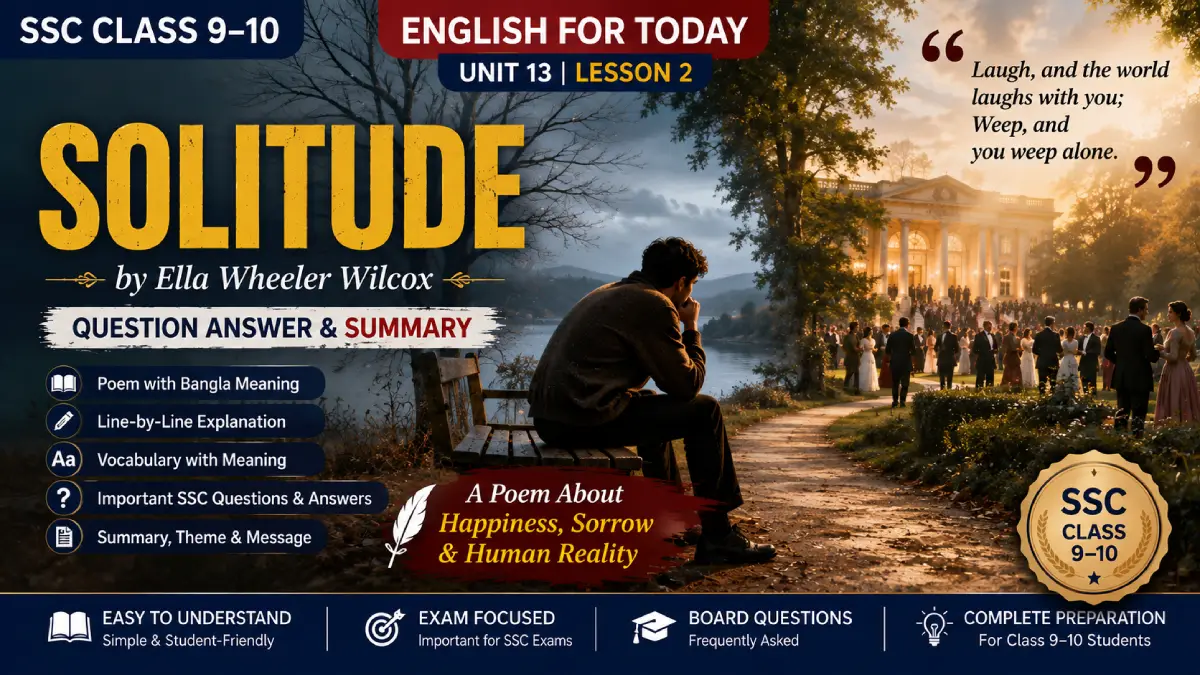

Poem: “Solitude”
Poet: Ella Wheeler Wilcox
Textbook: English for Today
Unit: 13
Lesson: 2
For: Class 9, Class 10 & SSC
“Solitude” by Ella Wheeler Wilcox is a thought-provoking poem about human relationships, happiness, sorrow, loneliness, and the reality of life. The poet shows that people usually like to share our happiness, success, and pleasure, but they often stay away when we are suffering. The poem therefore teaches us that although we may have many companions in times of joy, we must develop the strength to face pain and hardship by ourselves. The current SSC question pattern also shows strong focus on the poem’s final message, the contrast between joy and sorrow, friendship, the “sad old earth,” “halls of pleasure,” and the famous opening lines.
The Poem: “Solitude”
Solitude
by Ella Wheeler Wilcox
Laugh, and the world laughs with you;
Weep, and you weep alone;
For the sad old earth must borrow its mirth,
But has trouble enough of its own.
Sing, and the hills will answer;
Sigh, it is lost on the air;
The echoes bound to a joyful sound,
But shrink from voicing care.
Rejoice, and men will seek you;
Grieve, and they turn and go;
They want full measure of all your pleasure,
But they do not need your woe.
Be glad, and your friends are many;
Be sad, and you lose them all,—
There are none to decline your nectared wine,
But alone you must drink life’s gall.
Feast, and your halls are crowded;
Fast, and the world goes by.
Succeed and give, and it helps you live,
But no man can help you die.
There is room in the halls of pleasure
For a large and lordly train,
But one by one we must all file on
Through the narrow aisles of pain.
“Solitude” কবিতার বাংলা অর্থ
Laugh, and the world laughs with you;
হাসো, আর পৃথিবী তোমার সঙ্গে হাসবে।
Weep, and you weep alone;
কাঁদো, আর তোমাকে একাই কাঁদতে হবে।
For the sad old earth must borrow its mirth,
কারণ দুঃখে ভরা এই পুরোনো পৃথিবীকে অন্যের কাছ থেকে আনন্দ ধার করতে হয়,
But has trouble enough of its own.
কিন্তু তার নিজেরই যথেষ্ট দুঃখ-কষ্ট রয়েছে।
Sing, and the hills will answer;
গান গাও, আর পাহাড়গুলো তার প্রতিধ্বনি দিয়ে সাড়া দেবে।
Sigh, it is lost on the air;
দীর্ঘশ্বাস ফেলো, তা বাতাসে হারিয়ে যাবে।
The echoes bound to a joyful sound,
প্রতিধ্বনি আনন্দময় শব্দের দিকে ছুটে আসে,
But shrink from voicing care.
কিন্তু দুঃখ-কষ্টের কথা প্রকাশ করা শব্দ থেকে দূরে সরে যায়।
Rejoice, and men will seek you;
আনন্দ করো, আর মানুষ তোমার সঙ্গ খুঁজবে।
Grieve, and they turn and go;
শোক করো, আর তারা মুখ ফিরিয়ে চলে যাবে।
They want full measure of all your pleasure,
তারা তোমার আনন্দের পূর্ণ অংশ পেতে চায়,
But they do not need your woe.
কিন্তু তারা তোমার দুঃখ চায় না।
Be glad, and your friends are many;
আনন্দিত থাকো, আর তোমার বন্ধুর সংখ্যা অনেক হবে।
Be sad, and you lose them all,—
দুঃখী হও, আর তুমি তাদের সবাইকে হারাবে।
There are none to decline your nectared wine,
তোমার সুখের অমৃততুল্য পানীয় গ্রহণ করতে কেউ না বলবে না,
But alone you must drink life’s gall.
কিন্তু জীবনের তিক্ততা তোমাকেই একা সহ্য করতে হবে।
Feast, and your halls are crowded;
ভোজের আয়োজন করো, আর তোমার ঘর মানুষে ভরে যাবে।
Fast, and the world goes by.
উপবাসে বা দুঃসময়ে থাকো, আর পৃথিবী তোমাকে পাশ কাটিয়ে চলে যাবে।
Succeed and give, and it helps you live,
সফল হও এবং অন্যদের দাও, তা তোমার জীবনকে সহজ ও সুন্দর করতে সাহায্য করবে,
But no man can help you die.
কিন্তু মৃত্যুর সময় কেউ তোমাকে সাহায্য করতে পারবে না।
There is room in the halls of pleasure
আনন্দের প্রাসাদে অনেক মানুষের জন্য জায়গা আছে,
For a large and lordly train,
একটি বিশাল ও রাজকীয় অনুসারী দলের জন্য।
But one by one we must all file on
কিন্তু আমাদের সবাইকে একে একে এগিয়ে যেতে হবে
Through the narrow aisles of pain.
যন্ত্রণার সেই সংকীর্ণ পথ দিয়ে।
Vocabulary & Key Terms
| Word / Phrase | Easy English Meaning | বাংলা অর্থ |
|---|---|---|
| Mirth | Happiness, laughter, and joy | আনন্দ / উল্লাস / হাসি |
| Borrow | Take or get something from another | ধার করা / গ্রহণ করা |
| Bound | Move quickly toward something | ছুটে আসা / দ্রুত এগিয়ে যাওয়া |
| Shrink | Move away or avoid something | পিছিয়ে যাওয়া / সরে যাওয়া |
| Voicing care | Expressing sorrow or worry | দুঃখ-কষ্ট বা উদ্বেগ প্রকাশ করা |
| Rejoice | Feel or show great happiness | আনন্দ করা / আনন্দ উদযাপন করা |
| Grieve | Feel deep sadness | গভীর শোক বা দুঃখ করা |
| Full measure | The complete amount | পূর্ণ অংশ / সম্পূর্ণ ভাগ |
| Woe | Great sorrow or trouble | দুঃখ-দুর্দশা / শোক |
| Decline | Refuse or say no | প্রত্যাখ্যান করা / না বলা |
| Nectared wine | Sweet drink symbolizing life’s joys | অমৃততুল্য সুখ / জীবনের মধুর আনন্দ |
| Life’s gall | Bitterness and suffering in life | জীবনের তিক্ততা ও দুঃখ |
| Feast | A large and joyful meal or celebration | ভোজ / আনন্দের আয়োজন |
| Fast | Go without food; suffer hardship | উপবাস / অনাহার / দুঃসময় |
| Lordly train | A grand and large group of followers | রাজকীয় বা অভিজাত অনুসারীদের দল |
| File on | Move forward one by one | একে একে এগিয়ে চলা |
| Narrow aisles of pain | The lonely path of suffering and death | বেদনার সংকীর্ণ পথ |
Short Summary of “Solitude”
The poem “Solitude” presents a realistic view of human relationships. The poet says that people usually join us when we are happy, successful, or wealthy, but they often leave us when we are sad or in trouble. The world likes to share our “mirth”, pleasure, and success, but it does not want our “woe” or pain. In the end, everyone must face suffering and death alone. Therefore, the poem teaches us to be mentally strong, value genuine relationships, and be prepared to face difficult times by ourselves.
বাংলা সারসংক্ষেপ
‘Solitude’ কবিতায় এলা হুইলার উইলকক্স মানবজীবন ও মানবসম্পর্কের একটি বাস্তব চিত্র তুলে ধরেছেন। মানুষ সাধারণত একজন সুখী, সফল ও আনন্দময় মানুষের সঙ্গে থাকতে পছন্দ করে। কিন্তু সেই মানুষটি দুঃখ, ব্যর্থতা বা কষ্টের মধ্যে পড়লে অনেকেই তার কাছ থেকে দূরে সরে যায়।
কবি দেখিয়েছেন যে মানুষ অন্যের সুখ ও আনন্দ ভাগ করে নিতে চায়, কিন্তু অন্যের দুঃখের ভার নিতে চায় না। জীবনের চূড়ান্ত কষ্ট এবং মৃত্যুর পথ প্রত্যেক মানুষকে একাই পাড়ি দিতে হয়। তাই আমাদের মানসিকভাবে শক্ত হতে হবে এবং জীবনের কঠিন সময় নিজেকে সামলানোর ক্ষমতা অর্জন করতে হবে।
Solitude SSC Question Answer
These questions are arranged for SSC and Class 9–10 students, with the most important exam ideas placed first. The answers are rewritten in very easy English so students can understand them quickly, learn them easily, and write them naturally in the examination.
Recent 2026 board materials specifically include questions on the poem’s final message, friendship during happiness and sadness, the importance of solitude, “the sad old earth must borrow its mirth,” “halls of pleasure,” the hills’ response to songs, and the opening “Laugh/Weep” lines.
⭐⭐⭐ Most Important Questions
1. What is the overall theme of the poem “Solitude”?
Answer: The poem shows that people gladly share our happiness but often leave us when we suffer. It also teaches us that every person must face deep pain and death alone.
2. Explain the lines: “Laugh, and the world laughs with you; / Weep, and you weep alone.”
Answer: People usually join us when we are happy, but when we are sad, we often have to face our sorrow alone.
3. What is the final message of the poem “Solitude”?
Answer: The final message is that people come to share our happiness but often leave us in sorrow. Therefore, we should become strong enough to face hardship alone.
4. When do you have many friends and when do they leave you?
Answer: We have many friends when we are happy and successful. They often leave us when we are sad, poor, or in trouble.
5. What does “nectared wine” and “life’s gall” symbolize?
Answer: “Nectared wine” symbolizes the sweet joys and pleasures of life, while “life’s gall” symbolizes pain, sorrow, and hardship.
6. What is the contrast between the “halls of pleasure” and the “narrow aisles of pain”?
Answer: The “halls of pleasure” are full of people who enjoy happiness together. The “narrow aisles of pain” show that every person must face deep suffering alone.
7. What does “Succeed and give, and it helps you live, / But no man can help you die” mean?
Answer: When we are successful and generous, people support us. But no one can share our final suffering or death.
8. What does the poem teach about human nature?
Answer: It shows that people are often attracted to happiness and success but avoid sorrow and suffering.
9. Why do the hills echo our songs but not our sighs?
Answer: The poet means that joy attracts a response, but sorrow often receives no response from others.
10. What happens when you rejoice compared with when you grieve?
Answer: When you rejoice, people seek your company. When you grieve, they often turn away and leave you.
⭐⭐ Important Questions
11. What does the poet mean by “the sad old earth must borrow its mirth”?
Answer: It means that the world already has enough sorrow, so it needs to take joy from happy people.
12. What does “Be glad, and your friends are many; / Be sad, and you lose them all” mean?
Answer: When you are happy, many people want to be with you. When you are sad, many of them leave you.
13. What do people want from your “pleasure” but not from your “woe”?
Answer: They want to share your happiness and enjoyment, but they do not want to share your sorrow and suffering.
14. Why does the poet say that no one can help you die?
Answer: Death is a personal and unavoidable experience. No one can take away another person’s final suffering.
15. What does “full measure” mean in the poem?
Answer: “Full measure” means the complete amount. People want to enjoy all of your happiness.
16. What happens when you feast and when you fast?
Answer: When you feast, many people come to enjoy your celebration. When you fast or suffer, the world often ignores you.
17. What does the poem mean by “life’s gall”?
Answer: “Life’s gall” means the bitter experiences, pain, sorrow, and hardships of life.
18. What does “narrow aisles of pain” mean?
Answer: It means the lonely path of suffering and death that every person must face.
19. What does “halls of pleasure” mean?
Answer: It means the happy and enjoyable parts of life where many people gather together.
20. What kind of people gather in the “halls of pleasure”?
Answer: A large and cheerful group of people gathers there to share happiness and pleasure.
21. What does the poem suggest about solitude?
Answer: It suggests that true suffering is often experienced alone, so we need inner strength to face it.
Additional Practice Questions
22. Who wrote the poem “Solitude”?
Answer: Ella Wheeler Wilcox wrote the poem.
23. What happens when you laugh according to the poem?
Answer: When you laugh, the world laughs with you.
24. What happens when you weep?
Answer: When you weep, you often have to weep alone.
25. What happens when you sing?
Answer: When you sing, the hills answer with echoes.
26. What happens when you sigh?
Answer: Your sigh is lost in the air without a response.
27. How does the poem describe the reaction of society to sorrow?
Answer: Society often moves away from a person who is suffering instead of sharing the sorrow.
28. Why do people avoid another person’s woe?
Answer: They avoid it because they prefer happiness and do not want the burden of another person’s pain.
29. What does the phrase “Succeed and give” suggest?
Answer: It suggests that success and generosity attract people and support.
30. What does “one by one we must all file on” mean?
Answer: It means that every person must face life’s final suffering individually.
31. What does “a large and lordly train” mean?
Answer: It means a large, impressive, and prosperous group of people.
32. How does the poem portray the relationship between joy and sorrow?
Answer: Joy usually brings people together, while sorrow often makes a person feel alone.
33. What emotion is mainly expressed in the poem?
Answer: The poem mainly expresses sadness and thoughtful reflection about human loneliness.
34. What does the poem teach us about friendship?
Answer: It teaches that some friendships may depend on happiness and success, so we should value loyal friends who stay during difficult times.
35. What is the importance of self-reliance in the poem?
Answer: Self-reliance is important because we may have to face serious suffering without the help of others.
36. Why does the poet contrast feasting and fasting?
Answer: She contrasts them to show that people gather around us in prosperity but often leave us in hardship.
37. Why does the poet repeat the contrast between joy and sorrow?
Answer: The repetition makes the poem’s main truth about human relationships clear and memorable.
38. Do you agree with the poet’s view of human companionship? Why?
Answer: Yes, partly. People often enjoy sharing happiness, but true friends should also stay beside us during difficult times.
Detailed Summary of “Solitude”
Happiness Attracts People
The poem begins with the famous idea that if we laugh, the world laughs with us. People naturally enjoy happiness. When someone is cheerful, others feel comfortable joining that happiness.
Sorrow Often Brings Loneliness
The poet immediately contrasts happiness with sorrow. When we weep, we often have to weep alone. People do not usually want to share another person’s pain.
Joy Receives a Response
The poet compares singing with sighing. A song receives an echo from the hills, but a sigh disappears into the air.
This is a symbolic picture of society: joy receives attention, while suffering may be ignored.
People Seek Pleasure
When we rejoice, people seek our company. They want to enjoy our happiness. But when we grieve, they often turn away.
The poet therefore presents many relationships as conditional.
Happiness and Sorrow
The expressions “nectared wine” and “life’s gall” create a strong contrast.
- Nectared wine = sweetness and pleasure
- Life’s gall = bitterness and pain
People happily share the sweetness, but we must often suffer the bitterness alone.
Prosperity and Poverty
The same idea appears through “Feast” and “Fast.”
When a person celebrates and has plenty, the halls become crowded. When the person suffers or has nothing, the world passes by.
Life and Death
The poem then moves to a deeper truth. Success and generosity may attract people and support life, but nobody can help another person die.
Death is ultimately a personal experience.
The Final Image
The final stanza contrasts the “halls of pleasure” with the “narrow aisles of pain.”
Many people can gather together in pleasure, but every human being must ultimately travel through suffering and toward death alone.
Structure of the Poem
| Part | Main Idea |
|---|---|
| Joy and Sorrow | People share happiness but often avoid sorrow. |
| Songs and Sighs | Joy receives an echo, while pain receives little response. |
| Rejoicing and Grieving | People seek happy companions but avoid grieving people. |
| Nectared Wine and Life’s Gall | People want life’s sweetness, not its bitterness. |
| Feast and Fast | Prosperity attracts people, while hardship drives them away. |
| Life and Death | People may help us live, but no one can help us die. |
| Halls of Pleasure and Aisles of Pain | Joy can be shared, but deep suffering must ultimately be faced alone. |
The poem moves from:
Joy → Sorrow → Friendship → Hardship → Death → Solitude
Main Theme of “Solitude”
English Theme
The main theme of “Solitude” is the loneliness of human suffering and the conditional nature of many human relationships.
The poet observes that people like to share happiness, pleasure, and success, but they often avoid sorrow and hardship. In the final stanza, she presents a deeper truth: although people may gather around us in happy times, every individual must ultimately face the deepest pain and death alone.
The poem therefore also encourages self-reliance and inner strength.
মূলভাব
‘Solitude’ কবিতার মূলভাব হলো মানুষের সম্পর্কের স্বার্থপরতা, সুখের সময়ে মানুষের সঙ্গ এবং দুঃখের সময়ে একাকীত্ব। মানুষ সাধারণত অন্যের আনন্দ ভাগ করে নিতে চায়, কিন্তু অন্যের কষ্ট ও দুঃখ ভাগ করে নিতে চায় না।
জীবনের গভীর দুঃখ ও মৃত্যুর পথে প্রত্যেক মানুষকে শেষ পর্যন্ত একাই এগিয়ে যেতে হয়। তাই কঠিন সময় মোকাবিলা করার জন্য আমাদের মানসিক শক্তি ও আত্মনির্ভরতা অর্জন করতে হবে।
Line-by-Line Explanation of “Solitude”
“Laugh, and the world laughs with you”
People love to share happiness.
Easy idea: When you are happy, others become happy with you.
“Weep, and you weep alone”
People often avoid another person’s sorrow.
Easy idea: When you are sad, you may have to suffer alone.
“For the sad old earth must borrow its mirth”
The world itself is full of troubles and needs happiness.
Easy idea: The world wants to take happiness from cheerful people.
“But has trouble enough of its own”
The earth already has enough suffering.
Easy idea: The world does not need more sorrow.
“Sing, and the hills will answer”
A joyful song receives an echo.
Easy idea: Happiness gets a positive response.
“Sigh, it is lost on the air”
A sigh disappears without an answer.
Easy idea: Sadness often receives no response.
“The echoes bound to a joyful sound”
Echoes respond quickly to joyful sounds.
Easy idea: Joy attracts attention.
“But shrink from voicing care”
Echoes do not respond to sorrow.
Easy idea: Pain often gets little response.
“Rejoice, and men will seek you”
People want to join happiness.
Easy idea: Happiness attracts people.
“Grieve, and they turn and go”
People may avoid someone who is grieving.
Easy idea: Sorrow can make people leave.
“They want full measure of all your pleasure”
People want all the happiness they can get.
Easy idea: They want to enjoy your happiness completely.
“But they do not need your woe”
They do not want to share your suffering.
Easy idea: They avoid your sadness.
“Be glad, and your friends are many”
Happiness attracts many companions.
Easy idea: Happy people often have many friends.
“Be sad, and you lose them all”
Sadness may drive people away.
Easy idea: Difficult times can reveal who really stays.
“There are none to decline your nectared wine”
People happily accept the sweetness of life.
Easy idea: People want to share your success and pleasure.
“But alone you must drink life’s gall”
The painful side of life must often be faced alone.
Easy idea: Deep suffering is personal.
“Feast, and your halls are crowded”
People gather around celebrations and prosperity.
Easy idea: Success attracts crowds.
“Fast, and the world goes by”
Hardship can make people ignore you.
Easy idea: The world often moves on when you suffer.
“Succeed and give, and it helps you live”
Success and generosity attract support.
Easy idea: Success and sharing can make social life easier.
“But no man can help you die”
Death cannot be experienced for someone else.
Easy idea: Everyone must face death alone.
“There is room in the halls of pleasure”
Many people can share happiness.
Easy idea: Joy can be enjoyed together.
“For a large and lordly train”
A large, prosperous crowd can gather around pleasure.
Easy idea: Many people join successful and happy people.
“But one by one we must all file on”
Everyone has an individual journey.
Easy idea: Each person must face life’s final journey personally.
“Through the narrow aisles of pain”
The final journey includes suffering and death.
Easy idea: Deep pain is ultimately a lonely experience.
Important Literary Devices in “Solitude”
Contrast
The poem repeatedly contrasts:
- Laugh → Weep
- Sing → Sigh
- Rejoice → Grieve
- Glad → Sad
- Feast → Fast
- Pleasure → Pain
These contrasts make the central idea very clear.
Repetition
The repeated structure of the poem emphasizes how differently society reacts to joy and sorrow.
Metaphor
The poet uses several important metaphors.
“Nectared wine” represents the sweetness of life.
“Life’s gall” represents suffering and bitterness.
“Halls of pleasure” represent happy social life.
“Narrow aisles of pain” represent the lonely journey through suffering and death.
Personification
The earth is presented as if it can borrow happiness, while echoes are described as responding differently to joyful and sorrowful sounds.
Antithesis
The poem uses opposite ideas side by side, such as:
“Laugh” / “Weep”
and
“Be glad” / “Be sad”
This sharp contrast strengthens the poem’s message.
Symbolism
The poem’s central idea of solitude symbolizes the fact that each person must ultimately face deep suffering and death individually.
Tone of “Solitude”
The tone of the poem is mainly:
- Realistic
- Reflective
- Sad
- Philosophical
- Slightly critical
Exam-ready answer: The tone is realistic, reflective, and philosophical, because the poet presents a serious truth about human relationships and loneliness.
Message of “Solitude”
The poem teaches us that people often share our happiness but avoid our sorrow. Therefore, we should not depend completely on others during difficult times.
We should develop inner strength, courage, and self-reliance so that we can face life’s difficulties with confidence.
Quick Revision Notes
| Topic | Easy Answer |
|---|---|
| Poet | Ella Wheeler Wilcox |
| Main theme | Human loneliness and conditional relationships |
| Laugh | The world shares our happiness |
| Weep | We often suffer alone |
| Mirth | Joy and happiness |
| Woe | Great sorrow |
| Nectared wine | Sweet pleasures of life |
| Life’s gall | Pain and hardship |
| Feast | Prosperity and celebration |
| Fast | Hardship or poverty |
| Halls of pleasure | Social happiness |
| Narrow aisles of pain | Lonely suffering and death |
| Lordly train | Large group of companions |
| File on | Move forward one by one |
| Main lesson | Develop inner strength and face hardship bravely |
| Tone | Realistic and philosophical |
Frequently Asked Questions
Who wrote the poem “Solitude”?
Answer: Ella Wheeler Wilcox wrote the poem.
What is the poem “Solitude” about?
Answer: It is about human loneliness, the selfish side of relationships, happiness, sorrow, and death.
What does “Laugh, and the world laughs with you” mean?
Answer: It means that people gladly share your happiness.
What does “Weep, and you weep alone” mean?
Answer: It means that you may have to face your sorrow without much support from others.
What does “nectared wine” mean?
Answer: It means the sweet pleasures and joys of life.
What does “life’s gall” mean?
Answer: It means the pain, sorrow, and hardships of life.
What does “halls of pleasure” mean?
Answer: It means the happy and enjoyable parts of life where people gather together.
What does “narrow aisles of pain” mean?
Answer: It means the lonely path of suffering and death.
What happens when you feast?
Answer: Your halls become crowded with people who want to share your happiness.
What happens when you fast?
Answer: The world passes by and leaves you alone.
What is the main message of the poem?
Answer: The poem teaches us that happiness attracts people, but deep suffering is often faced alone.
🔗 Explore More for Preparation
📚 পরীক্ষার জন্য আরও প্রস্তুতি নাও