



Poem: “Stopping by Woods on a Snowy Evening”
Poet: Robert Frost
Textbook: English for Today
Unit: 11
Lesson: 5
For: Class 9, Class 10 & SSC
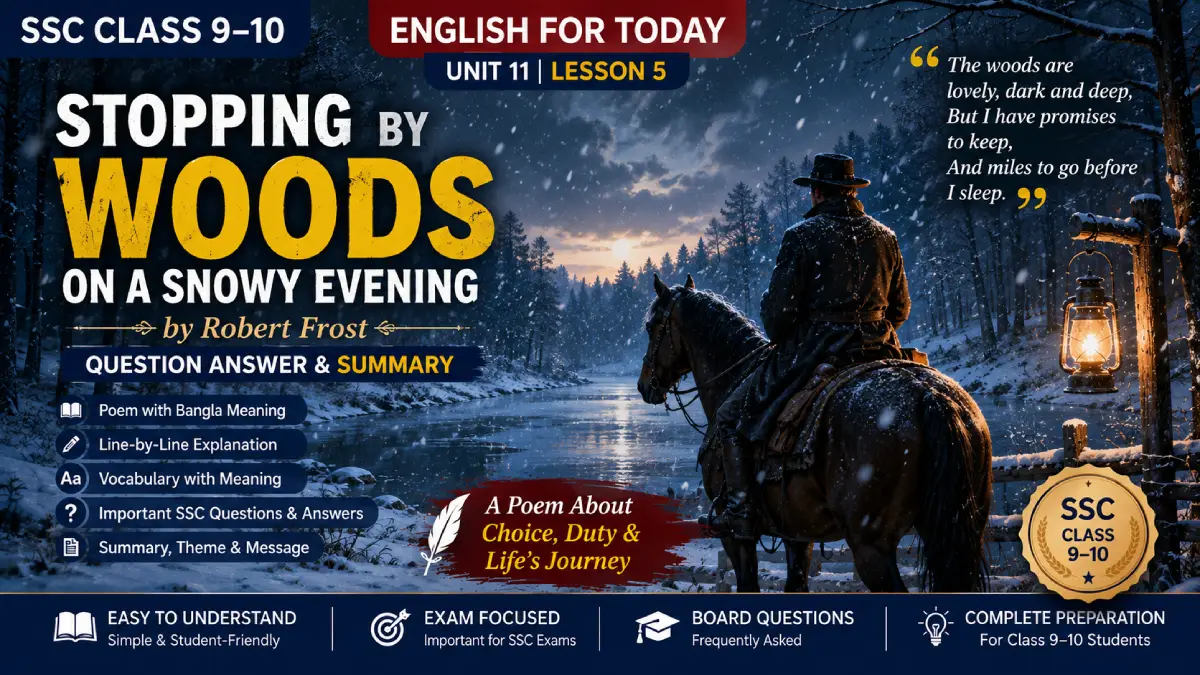
“Stopping by Woods on a Snowy Evening” by Robert Frost is a thoughtful poem about the beauty of nature, the desire for peace, and the responsibilities of life. The speaker stops to enjoy a quiet, snow-covered forest on a dark winter evening. The beauty and silence of the woods attract him, but he remembers that he has “promises to keep” and “miles to go.” He therefore leaves the woods and continues his journey. The poem suggests that although people may want rest and escape, they must remember their duties and responsibilities in life.
The Poem: “Stopping by Woods on a Snowy Evening”
Stopping by Woods on a Snowy Evening
by Robert Frost
Whose woods these are I think I know.
His house is in the village though;
He will not see me stopping here
To watch his woods fill up with snow.
My little horse must think it queer
To stop without a farmhouse near
Between the woods and frozen lake
The darkest evening of the year.
He gives his harness bells a shake
To ask if there is some mistake.
The only other sound’s the sweep
Of easy wind and downy flake.
The woods are lovely, dark and deep,
But I have promises to keep,
And miles to go before I sleep,
And miles to go before I sleep.
“Stopping by Woods on a Snowy Evening” কবিতার বাংলা অর্থ
Whose woods these are I think I know.
এই বন কার, তা বোধহয় আমি জানি।
His house is in the village though;
তবে তাঁর বাড়ি গ্রামের মধ্যে।
He will not see me stopping here
তিনি আমাকে এখানে থেমে থাকতে দেখতে পাবেন না,
To watch his woods fill up with snow.
তাঁর বনভূমি তুষারে ঢেকে যাওয়ার দৃশ্য দেখছি বলে।
My little horse must think it queer
আমার ছোট্ট ঘোড়াটি নিশ্চয়ই এটিকে অদ্ভুত মনে করছে,
To stop without a farmhouse near
কাছাকাছি কোনো খামারবাড়ি না থাকা সত্ত্বেও এখানে থেমে যাওয়াকে,
Between the woods and frozen lake
বন আর বরফে জমে থাকা হ্রদের মাঝখানে,
The darkest evening of the year.
বছরের সবচেয়ে অন্ধকার সন্ধ্যায়।
He gives his harness bells a shake
সে তার লাগামের ঘণ্টাগুলো ঝাঁকিয়ে দেয়,
To ask if there is some mistake.
জানতে চায় কোনো ভুল হয়েছে কি না।
The only other sound’s the sweep
এখানে আর যে একমাত্র শব্দ শোনা যায়,
Of easy wind and downy flake.
তা হলো মৃদু বাতাসের প্রবাহ আর পালকের মতো নরম তুষারকণার পতন।
The woods are lovely, dark and deep,
বনটি সুন্দর, অন্ধকার এবং গভীর,
But I have promises to keep,
কিন্তু আমার কিছু প্রতিশ্রুতি রক্ষা করার আছে,
And miles to go before I sleep,
আর ঘুমানোর আগে আমাকে আরও অনেক পথ যেতে হবে,
And miles to go before I sleep.
হ্যাঁ, ঘুমানোর আগে আমাকে আরও অনেক পথ যেতে হবে।
Vocabulary & Key Terms
| Word / Phrase | Easy English Meaning | বাংলা অর্থ |
|---|---|---|
| Woods | A forest or group of trees | বন / অরণ্য |
| Queer | Strange or unusual | অদ্ভুত / অস্বাভাবিক |
| Farmhouse | A house on a farm | খামারবাড়ি |
| Frozen lake | A lake covered with ice | বরফে জমাটবদ্ধ হ্রদ |
| Darkest evening | The darkest evening of the year | বছরের সবচেয়ে অন্ধকার সন্ধ্যা |
| Harness bells | Bells attached to the horse’s harness | ঘোড়ার সাজে বাঁধা ঘণ্টা |
| Mistake | An error or wrong action | ভুল / ভ্রান্তি |
| Sweep | A gentle flowing movement or sound | মৃদু বাতাসের প্রবাহ / শোঁ শোঁ শব্দ |
| Easy wind | A soft, gentle breeze | মৃদু বাতাস |
| Downy flake | A soft, light snowflake | পালকের মতো নরম তুষারকণা |
| Lovely, dark and deep | Beautiful, mysterious and deep | সুন্দর, অন্ধকার ও গভীর |
| Promises to keep | Duties and responsibilities to fulfil | পালন করার দায়িত্ব / প্রতিশ্রুতি |
| Miles to go | A long journey still remaining | অনেক পথ পাড়ি দেওয়া বাকি |
| Sleep | Rest; also a possible symbol of death | ঘুম / রূপকার্থে চিরনিদ্রা |
Short Summary of “Stopping by Woods on a Snowy Evening”
The poem describes a speaker who stops near a beautiful forest on a snowy winter evening. He stops to watch the woods slowly fill with snow. His horse finds the stop unusual because there is no farmhouse nearby. It shakes its harness bells as if asking whether something is wrong.
The place is quiet except for the gentle wind and falling snow. The speaker is deeply attracted to the “lovely, dark and deep” woods. However, he remembers his “promises to keep” and knows that he still has “miles to go.” Therefore, he cannot remain there and must continue his journey.
বাংলা সারসংক্ষেপ
‘Stopping by Woods on a Snowy Evening’ কবিতায় একজন ব্যক্তি শীতের এক অন্ধকার সন্ধ্যায় তুষারে ঢাকা সুন্দর বনের পাশে থেমে যান। তিনি নীরবে তুষারপাতের দৃশ্য উপভোগ করেন। তাঁর ছোট ঘোড়াটি এমন নির্জন স্থানে থামাকে অদ্ভুত মনে করে এবং তার গলার ঘণ্টা ঝাঁকিয়ে দেয়।
বনের নীরবতা ও সৌন্দর্য কবিকে গভীরভাবে আকৃষ্ট করে। কিন্তু তিনি মনে করেন যে তাঁর কিছু প্রতিশ্রুতি ও দায়িত্ব পালন করা বাকি এবং সামনে আরও অনেক পথ যেতে হবে। তাই তিনি বনে না থেকে নিজের যাত্রা চালিয়ে যান। কবিতাটি শেখায় যে জীবনের সৌন্দর্য ও বিশ্রামের আকর্ষণ থাকলেও মানুষের কর্তব্য ও দায়িত্ব ভুলে যাওয়া উচিত নয়।
Stopping by Woods on a Snowy Evening SSC Question Answer
These questions are arranged for SSC and Class 9–10 students, with the most important exam ideas placed first. The answers are deliberately written in very easy English so students can understand them quickly, remember them easily, and write them in the examination.
⭐⭐⭐ Most Important Questions
1. What is the central theme of “Stopping by Woods on a Snowy Evening”?
Answer: The main theme is the conflict between the beauty of nature and the duties of life. The speaker wants to stay in the woods but chooses to continue because he has responsibilities.
2. What do the repeated lines “And miles to go before I sleep” mean?
Answer: They mean that the speaker has many duties and responsibilities to complete before the end of his life.
3. What does the poet mean by “promises to keep”?
Answer: It means the duties, responsibilities, and commitments that the speaker must fulfil in life.
4. How are the woods described in the last stanza? What do they suggest?
Answer: The woods are “lovely, dark and deep.” They suggest peace, beauty, silence, mystery, and a strong desire to escape from worldly life.
5. Why did the horse shake its harness bells?
Answer: The horse shook its bells because it found it strange to stop in such a lonely place without a farmhouse nearby.
6. Why does the speaker leave the woods?
Answer: He leaves because he remembers his promises and responsibilities and knows that he still has many miles to go.
7. What is the significance of “the darkest evening of the year”?
Answer: It emphasizes the cold, dark, quiet, and lonely atmosphere of the poem.
8. How does the poem show the conflict between nature and human duty?
Answer: The speaker is attracted by the beautiful and peaceful woods, but his duties force him to leave and continue his journey.
9. What does “sleep” symbolize in the poem?
Answer: “Sleep” means ordinary rest, but it can also symbolize death or the final rest of life.
10. What is the main message of the poem?
Answer: The poem teaches that we may enjoy beauty and rest, but we must not forget our duties and responsibilities in life.
⭐⭐ Important Questions
11. Why does the speaker think the owner of the woods will not see him?
Answer: The owner’s house is in the village, so he is not there to see the speaker stopping in the woods.
12. Why does the horse think it is “queer” to stop there?
Answer: The horse thinks it is strange because they have stopped in a lonely place between the woods and a frozen lake, with no farmhouse nearby.
13. What sounds does the speaker hear in the woods?
Answer: He hears the sound of the horse’s harness bells, the gentle wind, and the falling snow.
14. What does the “frozen lake” add to the poem?
Answer: The frozen lake adds to the cold, quiet, lonely, and mysterious atmosphere.
15. What does the snow symbolize in the poem?
Answer: The snow suggests peace, purity, silence, and stillness.
16. Why is the horse important in the poem?
Answer: The horse brings the speaker back to practical reality. Its bell reminds him that he should continue his journey.
17. How does the poem explore human mortality?
Answer: The word “sleep” can suggest death. The poem reminds us that life is limited and we must complete our duties before our final rest.
18. What does “miles to go” suggest?
Answer: It suggests that the speaker still has a long journey and many responsibilities before the end of life.
19. What mood does the poet create in the poem?
Answer: The poem creates a quiet, peaceful, mysterious, reflective, and slightly sad mood.
20. Why is the speaker attracted to the woods?
Answer: He is attracted by the woods because they are beautiful, quiet, dark, deep, and covered with soft snow.
21. What does the horse’s action suggest?
Answer: The horse’s action suggests that the speaker should not remain there for too long and should continue his journey.
22. What is the universal idea presented in the poem?
Answer: The poem presents the universal conflict between the desire for peace and rest and the need to fulfil our duties.
Additional Practice Questions
23. Where does the speaker stop?
Answer: He stops between the woods and a frozen lake on a snowy winter evening.
24. What was the speaker doing when he stopped?
Answer: He was watching the woods fill with snow.
25. What kind of wind was blowing?
Answer: An easy, gentle wind was blowing.
26. What does “downy flake” mean?
Answer: It means a soft, light snowflake that falls like a feather.
27. What does “lovely, dark and deep” suggest?
Answer: It suggests that the woods are beautiful, peaceful, mysterious, and attractive.
28. Why can the speaker not stay in the woods?
Answer: He cannot stay because he has promises to keep and a long journey ahead.
29. What is the setting of the poem?
Answer: The setting is a quiet, snowy forest between a frozen lake and the village on a dark winter evening.
30. What does the horse’s harness bell symbolize?
Answer: It symbolizes a return to reality and practical duties.
31. What does the repetition of “And miles to go before I sleep” emphasize?
Answer: It emphasizes the speaker’s many duties, long journey, and limited time in life.
32. How does nature affect the speaker?
Answer: Nature makes him calm, thoughtful, and deeply attracted to the peaceful woods.
33. What is the significance of the silence in the woods?
Answer: The silence creates a feeling of peace, mystery, solitude, and deep thought.
34. Do you like the poem? Why?
Answer: Yes. I like it because it beautifully shows the charm of nature and the importance of duty.
35. What lesson can students learn from the poem?
Answer: Students can learn that they should enjoy life but always remember their duties and responsibilities.
36. Why does the speaker repeat the final line?
Answer: He repeats it to strongly emphasize his duties, long journey, and the limited time before his final rest.
Detailed Summary of “Stopping by Woods on a Snowy Evening”
The Speaker Stops by the Woods
The poem begins with the speaker stopping near some woods. He believes he knows who owns the woods, but the owner lives in the village. Therefore, no one will see him stopping there to watch the beautiful snow.
The Beautiful Winter Scene
The woods are filling with snow. The place is quiet, isolated, and peaceful. The speaker enjoys the beauty of nature while standing beside the woods.
The Horse Finds It Strange
The speaker’s little horse thinks it is strange to stop in such a lonely place. There is no farmhouse nearby. The horse shakes its harness bells as if asking whether the speaker has made a mistake.
The Silence of Nature
Apart from the horse’s bells, the speaker hears only the gentle movement of the wind and falling snow. These sounds make the place even more peaceful and mysterious.
The Attraction of the Woods
The woods are described as “lovely, dark and deep.” The speaker is strongly attracted to their beauty and quietness. The woods seem to offer peace and escape from the busy world.
The Speaker Remembers His Duties
Although the woods are attractive, the speaker remembers that he has “promises to keep.” He cannot stay there because he has responsibilities in life.
The Long Journey
The speaker says he has “miles to go” before he sleeps. This means that he still has a long journey and many duties to complete. The repeated line may also suggest that he still has much to do before the final sleep of death.
Structure of the Poem
| Part | Main Idea |
|---|---|
| Stopping by the Woods | The speaker stops to watch the snow. |
| The Horse’s Reaction | The horse finds the stop unusual. |
| Winter Silence | The speaker hears only bells, wind, and snow. |
| Beauty of the Woods | The speaker is deeply attracted to the woods. |
| Promises and Duties | He remembers his responsibilities. |
| Long Journey | He must continue because he has many miles to go. |
The poem moves from:
Nature → Beauty → Solitude → Temptation → Duty → Journey
Main Theme of “Stopping by Woods on a Snowy Evening”
English Theme
The main theme of the poem is the conflict between the desire to enjoy peaceful nature and the need to fulfil life’s duties and responsibilities.
The speaker is deeply attracted to the quiet, beautiful woods. However, he cannot stay because he has promises to keep. The poem therefore shows that people may want rest or escape, but they must continue their journey and fulfil their responsibilities.
মূলভাব
কবিতাটির মূলভাব হলো প্রকৃতির সৌন্দর্যের প্রতি মানুষের আকর্ষণ এবং জীবনের দায়িত্ব-কর্তব্যের মধ্যে দ্বন্দ্ব। কবি তুষারে ঢাকা সুন্দর বনে থেমে তার সৌন্দর্য উপভোগ করতে চান। কিন্তু তাঁর মনে পড়ে যে তাঁর কিছু প্রতিশ্রুতি ও দায়িত্ব পালন করা বাকি আছে। তাই তাঁকে আবার যাত্রা শুরু করতে হয়।
Line-by-Line Explanation of “Stopping by Woods on a Snowy Evening”
“Whose woods these are I think I know.”
The speaker believes he knows who owns the woods.
Easy idea: He knows the owner of the woods.
“His house is in the village though;”
The owner lives in the village.
Easy idea: The owner does not live near the woods.
“He will not see me stopping here”
The speaker knows that nobody will see him stopping.
Easy idea: He can quietly watch the woods.
“To watch his woods fill up with snow.”
He stops to enjoy the snow covering the woods.
Easy idea: He likes watching the snowfall.
“My little horse must think it queer”
The horse finds the speaker’s action strange.
Easy idea: The horse thinks stopping there is unusual.
“To stop without a farmhouse near”
There is no farmhouse nearby.
Easy idea: The place is lonely and unusual for a stop.
“Between the woods and frozen lake”
The speaker is between the woods and a frozen lake.
Easy idea: He is in a cold, isolated place.
“The darkest evening of the year.”
It is a very dark winter evening.
Easy idea: The setting is dark, cold, and quiet.
“He gives his harness bells a shake”
The horse shakes its bells.
Easy idea: The horse wants the speaker to notice something.
“To ask if there is some mistake.”
The horse seems to ask why they have stopped.
Easy idea: The horse thinks the stop may be a mistake.
“The only other sound’s the sweep”
The speaker hears another soft sound.
Easy idea: The woods are almost completely silent.
“Of easy wind and downy flake.”
The sound comes from gentle wind and falling snow.
Easy idea: The wind and snow make a soft, peaceful sound.
“The woods are lovely, dark and deep”
The woods are beautiful, quiet, mysterious, and deep.
Easy idea: The speaker is strongly attracted to their beauty.
“But I have promises to keep”
The speaker remembers his duties.
Easy idea: He cannot stay because he has responsibilities.
“And miles to go before I sleep”
He still has a long journey ahead.
Easy idea: He has much to do before he can rest.
“And miles to go before I sleep.”
The repetition gives the final message greater importance.
Easy idea: He must continue until his duties and journey are complete.
Important Literary Devices in “Stopping by Woods on a Snowy Evening”
Personification
The horse is presented as if it can think, question, and understand.
“My little horse must think it queer”
This makes the horse an active part of the poem.
Repetition
The last line is repeated:
“And miles to go before I sleep.”
It emphasizes the speaker’s responsibilities and long journey.
Imagery
The poem creates clear images of:
- Snow-covered woods
- A frozen lake
- A dark evening
- Harness bells
- Gentle wind
- Falling snow
Symbolism
The woods can symbolize peace, solitude, escape, or temptation.
Sleep can mean ordinary rest and may also suggest death or final rest.
Contrast
The poem contrasts:
Nature → Duty
Rest → Responsibility
Solitude → Social life
Temptation → Commitment
Sound Devices
The repeated sounds and soft descriptions of wind, snow, and bells create a quiet and musical effect.
Tone of “Stopping by Woods on a Snowy Evening”
The tone of the poem is mainly:
- Peaceful
- Reflective
- Mysterious
- Melancholic
- Thoughtful
Exam-ready answer: The tone is peaceful, reflective, and slightly melancholic, as the speaker admires the beauty of the woods while thinking about his responsibilities.
Message of “Stopping by Woods on a Snowy Evening”
The poem teaches us that beautiful moments of peace and escape are valuable, but we must not forget our responsibilities.
Life may tempt us to stop and rest, but we have promises to keep and duties to perform. Therefore, we must continue our journey until our responsibilities are fulfilled.
Quick Revision Notes
| Topic | Easy Answer |
|---|---|
| Poet | Robert Frost |
| Setting | Snowy woods on a dark winter evening |
| Speaker | A traveller stopping near the woods |
| Horse | Finds the stop strange |
| Frozen lake | Adds coldness and loneliness |
| Harness bells | Remind the speaker of reality |
| Downy flake | Soft falling snow |
| Lovely, dark and deep | Beauty and mystery of the woods |
| Promises to keep | Duties and responsibilities |
| Miles to go | A long journey and many duties remain |
| Sleep | Rest; possibly final rest or death |
| Main theme | Nature versus duty |
| Main message | Fulfil responsibilities before resting |
| Tone | Peaceful, reflective and melancholic |
Frequently Asked Questions
Who wrote “Stopping by Woods on a Snowy Evening”?
Answer: Robert Frost wrote the poem.
Where does the speaker stop?
Answer: He stops between the woods and a frozen lake on a snowy evening.
Why does the speaker stop there?
Answer: He stops to watch the woods fill with snow.
Why does the horse shake its bells?
Answer: The horse shakes its bells because it finds the stop strange.
What sounds does the speaker hear?
Answer: He hears the horse’s bells, the gentle wind, and the falling snow.
What do the woods symbolize?
Answer: The woods symbolize peace, beauty, solitude, and the temptation to escape from duties.
What does “promises to keep” mean?
Answer: It means the duties and responsibilities that the speaker must fulfil.
What does “miles to go” mean?
Answer: It means the speaker has a long journey and many duties remaining.
What does “sleep” mean?
Answer: It means rest, and it may also symbolize death or final rest.
Why does the speaker leave the woods?
Answer: He leaves because he must fulfil his promises and continue his journey.
What is the main message of the poem?
Answer: The poem teaches us to enjoy life but never forget our duties and responsibilities.
🔗 Explore More for Preparation
📚 পরীক্ষার জন্য আরও প্রস্তুতি নাও