



Poem: “The Sands of Dee”
Poet: Charles Kingsley
Textbook: English for Today
Unit: 11
Lesson: 3
For: Class 9, Class 10 & SSC
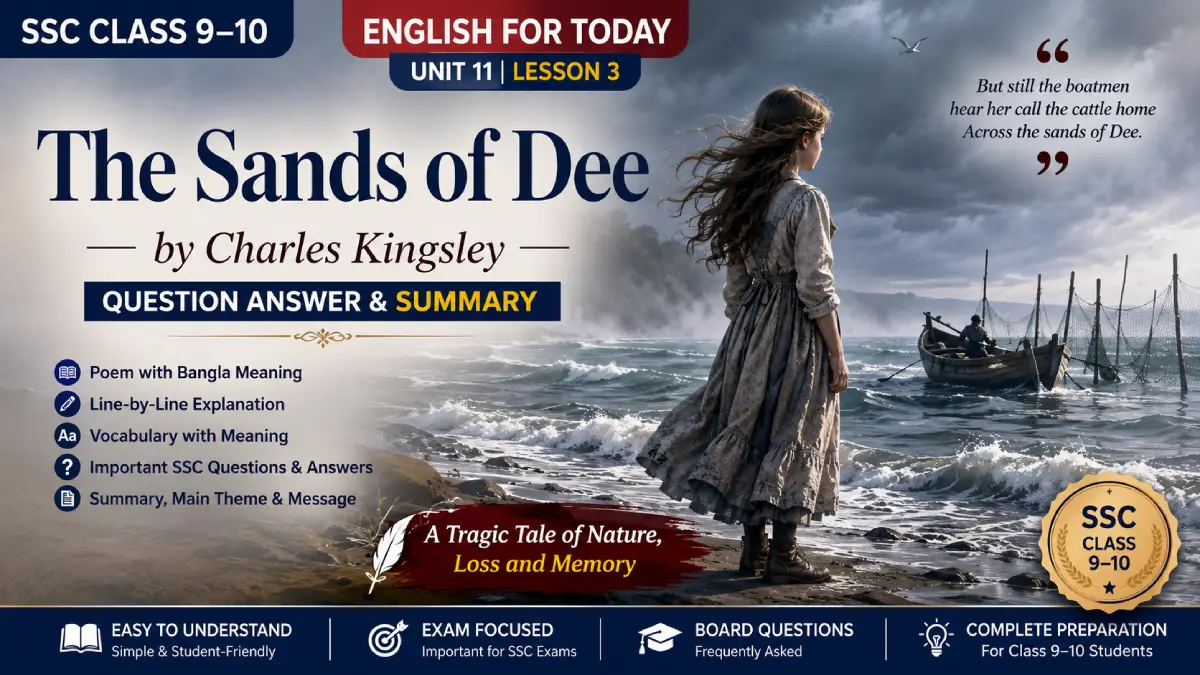
“The Sands of Dee” poem’s question answer and summary are important for SSC Class 9–10 students. Charles Kingsley’s poem tells the tragic story of Mary, who goes to call the cattle home but is drowned by the rising tide and thick mist. This guide provides easy question answers, Bangla meaning, vocabulary, summary, explanation, theme, and exam preparation.
The Poem: “The Sands of Dee”
The Sands of Dee
by Charles Kingsley
“O Mary, go and call the cattle home,
And call the cattle home,
And call the cattle home,
Across the sands of Dee!”
The western wind was wild and dank with foam,
And all alone went she.
The western tide crept up along the sand,
And o’er and o’er the sand,
And round and round the sand,
As far as eye could see;
The rolling mist came down and hid the land—
And never home came she.
“Oh! is it weed, or fish, or floating hair?—
A tress of golden hair,
A drowned maiden’s hair,
Above the nets at sea?
Was never salmon yet that shone so fair,
Among the stakes of Dee.”
They rowed her in across the rolling foam,
The cruel crawling foam,
The cruel hungry foam,
To her grave beside the sea:
But still the boatmen hear her call the cattle home
Across the sands of Dee.
“The Sands of Dee” কবিতার বাংলা অর্থ
“O Mary, go and call the cattle home,”
“ও মেরি, যাও এবং গবাদিপশুগুলোকে বাড়িতে ডেকে নিয়ে এসো।”
“And call the cattle home,”
“গবাদিপশুগুলোকে বাড়িতে ডেকে নিয়ে এসো।”
“And call the cattle home,”
“গবাদিপশুগুলোকে বাড়িতে ডেকে নিয়ে এসো।”
“Across the sands of Dee!”
“ডি নদীর বালুময় চর পেরিয়ে!”
The western wind was wild and dank with foam,
পশ্চিমের বাতাস ছিল প্রচণ্ড এবং সমুদ্রের ফেনায় স্যাঁতসেঁতে।
And all alone went she.
আর মেরি একাই সেখানে চলে গেল।
The western tide crept up along the sand,
পশ্চিম দিকের জোয়ার ধীরে ধীরে বালুর ওপর উঠে আসতে লাগল।
And o’er and o’er the sand,
এবং বারবার বালুর ওপর দিয়ে এগিয়ে যেতে লাগল।
And round and round the sand,
এবং বালুর চারপাশে ঘুরে ঘুরে এগিয়ে গেল।
As far as eye could see;
যতদূর চোখে দেখা যায়।
The rolling mist came down and hid the land—
ঘন ঘূর্ণায়মান কুয়াশা নেমে এসে পুরো স্থলভাগ ঢেকে দিল।
And never home came she.
আর মেরি আর কখনো বাড়ি ফিরে এল না।
“Oh! is it weed, or fish, or floating hair?”
“আহা! এটা কি কোনো জলজ উদ্ভিদ, মাছ, নাকি ভাসমান চুল?”
A tress of golden hair,
এক গোছা সোনালি চুল,
A drowned maiden’s hair,
এক ডুবে যাওয়া তরুণীর চুল,
Above the nets at sea?
সমুদ্রে মাছ ধরার জালের ওপর ভাসছে?
Was never salmon yet that shone so fair,
এত সুন্দর ও উজ্জ্বল স্যামন মাছ কখনো দেখা যায়নি,
Among the stakes of Dee.
ডি নদীর মাছ ধরার জালের খুঁটির মাঝে।
They rowed her in across the rolling foam,
তারা উত্তাল ফেনার মধ্য দিয়ে নৌকা বেয়ে তার দেহটি তীরে নিয়ে এল,
The cruel crawling foam,
সেই নিষ্ঠুর ধীরে ধীরে এগিয়ে আসা ফেনার মধ্য দিয়ে,
The cruel hungry foam,
সেই নিষ্ঠুর ক্ষুধার্ত ফেনার মধ্য দিয়ে,
To her grave beside the sea:
সমুদ্রের পাশে তার কবরের কাছে।
But still the boatmen hear her call the cattle home
কিন্তু এখনও মাঝিরা তার গরুগুলোকে বাড়ি ডাকার কণ্ঠ শুনতে পায়,
Across the sands of Dee.
ডি নদীর বালুময় চর পেরিয়ে।
Vocabulary & Key Terms
| Word / Phrase | Easy English Meaning | বাংলা অর্থ |
|---|---|---|
| Cattle | Cows and bulls kept on a farm | গবাদিপশু / গরু |
| Sands of Dee | Sandy area near the River Dee | ডি নদীর বালুময় চর |
| Wild | Fierce or violent | উন্মত্ত / প্রচণ্ড |
| Dank | Cold, wet and unpleasant | স্যাঁতসেঁতে / ভেজা |
| Foam | Bubbles on sea water | সমুদ্রের ফেনা |
| Tide | The rise and fall of sea water | সমুদ্রের জোয়ার |
| Crept up | Moved slowly forward | ধীরে ধীরে এগিয়ে আসা |
| Rolling mist | Thick moving fog | ঘন ঘূর্ণায়মান কুয়াশা |
| Hid | Covered or made invisible | ঢেকে দিল / অদৃশ্য করল |
| Weed | A wild plant growing in water | জলজ উদ্ভিদ / শৈবাল |
| Floating hair | Hair moving on the water | পানিতে ভাসমান চুল |
| Tress | A lock or bunch of hair | চুলের গোছা |
| Drowned | Died under water | পানিতে ডুবে মৃত |
| Maiden | A young girl | তরুণী / কুমারী |
| Salmon | A type of fish | এক ধরনের মাছ |
| Fair | Beautiful or shining | সুন্দর / উজ্জ্বল |
| Stakes | Wooden posts used for fishing nets | মাছ ধরার জালের খুঁটি |
| Cruel crawling foam | Foam moving forward like a cruel creature | নিষ্ঠুর অগ্রসরমান ফেনা |
| Cruel hungry foam | Foam described as if it wants to swallow people | নিষ্ঠুর ক্ষুধার্ত / সর্বগ্রাসী ফেনা |
| Boatmen | Men who row boats | মাঝি / নৌকার লোক |
Short Summary of “The Sands of Dee”
“The Sands of Dee” tells the tragic story of Mary, who is asked to go across the sands of Dee and call the cattle home. She goes there alone when the western wind is wild and the sea is covered with foam. Soon the tide rises slowly over the sand, while thick mist covers the land.
Mary cannot return home. Later, the fishermen see a lock of golden hair floating above their nets and realize that Mary has drowned. They bring her body to the shore and bury her beside the sea. However, her memory does not disappear. The boatmen still hear her calling the cattle home across the sands of Dee.
বাংলা সারসংক্ষেপ
‘The Sands of Dee’ কবিতাটি মেরি নামের এক তরুণীর করুণ মৃত্যুর কাহিনি। তাকে ডি নদীর বালুময় চর পেরিয়ে গবাদিপশুগুলোকে বাড়িতে ফিরিয়ে আনতে পাঠানো হয়। সে একা সেখানে যায়। তখন পশ্চিমের বাতাস প্রচণ্ড এবং সমুদ্রের জোয়ার ধীরে ধীরে বালুর ওপর উঠে আসছিল। এরপর ঘন কুয়াশা পুরো এলাকা ঢেকে দেয়।
মেরি আর বাড়িতে ফিরে আসতে পারে না। পরে মাঝিরা জালের ওপর ভাসমান সোনালি চুল দেখতে পায় এবং বুঝতে পারে যে মেরি ডুবে মারা গেছে। তারা তার দেহ তীরে নিয়ে এসে সমুদ্রের পাশে কবর দেয়। কিন্তু তার স্মৃতি হারিয়ে যায় না। এখনও মাঝিরা যেন ডি নদীর বালুচর পেরিয়ে মেরির গবাদিপশু ডাকার কণ্ঠ শুনতে পায়।
The Sands of Dee Question Answer – SSC Class 9–10
The following questions are arranged for SSC Class 9–10 preparation, with the most important questions first. The answers are intentionally written in easy English, so students can understand them quickly and learn them with less effort.
Recent SSC board questions have focused especially on the weather, sea, western tide, Mary’s hair, human-nature relationship, Mary’s task, and the “cruel/hungry” sea. The textbook also directly asks students to explain repetition, describe the sea, narrate Mary’s story, and discuss what they would do if they saw Mary drowning.
⭐⭐⭐ Top Priority Questions
1. What is the central theme of the poem “The Sands of Dee”?
Answer: The central theme is the power of nature and the helplessness of human life. Mary cannot escape the dangerous tide and mist.
2. What happened to Mary when she went to call the cattle home?
Answer: Mary was caught by the rising tide and thick mist. She drowned and never returned home.
3. What was the weather like when Mary went to bring the cattle home?
Answer: The weather was wild, wet, and dangerous. The western wind was strong, and the sea was covered with foam.
4. How has the poet described the sea?
Answer: The poet describes the sea as cruel, hungry, powerful, and dangerous. It slowly covered the sand and took Mary’s life.
5. Why does the poet call the foam “cruel crawling” and “cruel hungry”?
Answer: The poet gives the foam human qualities. It seems like a cruel and hungry creature that slowly moves forward and swallows Mary.
6. What task was Mary given in the poem?
Answer: Mary was asked to go across the sands of Dee and call the cattle home.
7. What does the poem suggest about the relationship between humans and nature?
Answer: The poem shows that nature is very powerful and humans can be helpless before its dangerous forces.
8. How is Mary’s hair described in the poem?
Answer: Mary’s hair is described as a beautiful golden tress floating on the water. It shines more beautifully than a fair salmon.
9. Why is the sea described as “hungry”?
Answer: The sea is called “hungry” because it is described as if it were a wild creature that wants to swallow and destroy human life.
10. What is the significance of the “rolling mist”?
Answer: The rolling mist creates danger and uncertainty. It covers the land and prevents Mary from finding her way home.
⭐⭐ High-Priority Questions
11. What does the phrase “all alone went she” suggest about Mary?
Answer: It shows that Mary was alone and helpless when she went across the dangerous sands.
12. How has the poet described the western tide?
Answer: The poet describes the western tide as moving slowly but steadily over and around the sand. It finally covers the area where Mary is lost.
13. What did the fishermen discover in the sea?
Answer: They discovered a lock of golden hair and the drowned body of Mary among the fishing nets.
14. What did the fishermen first think about Mary’s golden hair?
Answer: At first, they wondered whether the floating thing was seaweed, a fish, or human hair.
15. What does “full of foam” or the repeated description of foam suggest about the sea?
Answer: It suggests that the sea was rough, violent, and dangerous.
16. What does the repetition of “call the cattle home” emphasize?
Answer: It emphasizes Mary’s innocent voice, her unfinished task, and the sadness of her death. It also makes the poem musical and haunting.
17. Why does the poet repeat “the cruel crawling foam” and “the cruel hungry foam”?
Answer: The repetition emphasizes the danger and cruelty of the sea and makes the tragic scene more powerful.
18. Where was Mary buried?
Answer: Mary was buried in a grave beside the sea.
19. What do the boatmen hear after Mary’s death?
Answer: The boatmen still hear Mary’s voice calling the cattle home across the sands of Dee.
20. What does the final line of the poem suggest?
Answer: It suggests that although Mary died, her memory and voice continue to live in the minds of the boatmen.
⭐ Additional Important Questions
21. How is Mary portrayed in the poem?
Answer: Mary is portrayed as a young, innocent, obedient, and hardworking girl whose life ends tragically.
22. Why does the poet focus on Mary’s golden hair?
Answer: Her golden hair shows her youth and beauty. It also makes her tragic death more touching.
23. What does the phrase “never home came she” mean?
Answer: It means that Mary never returned home because she drowned in the sea.
24. How did the tide overtake the land?
Answer: The tide slowly moved over, around, and across the sand until the land was covered with water.
25. What are the “stakes of Dee”?
Answer: The “stakes of Dee” are wooden posts used to hold fishing nets in the water.
26. What role do the boatmen play in the poem?
Answer: The boatmen recover Mary’s body, take it to the shore, and keep her memory alive by hearing her voice after her death.
27. What feelings does the poem create in the minds of readers?
Answer: The poem creates feelings of sadness, pity, fear, and sympathy for Mary and awe at the power of nature.
28. What lesson can readers learn from Mary’s tragic fate?
Answer: We learn that human life is fragile and nature can be dangerous and unpredictable.
⭐ Standard & Board-Practice Questions
29. Why did Mary never return home?
Answer: Mary never returned home because the rising tide and thick mist trapped her, and she drowned.
30. Narrate the story of Mary in your own words.
Answer: Mary was asked to call the cattle home across the sands of Dee. She went there alone in bad weather. The tide slowly rose, and thick mist covered the land. Mary could not return and drowned. Later, the boatmen found her body and buried her beside the sea. They still hear her voice calling the cattle home.
31. What repeated words, phrases, or lines are found in the poem? Why are they repeated?
Answer: The phrases “call the cattle home,” “across the sands of Dee,” “the cruel crawling foam,” and “the cruel hungry foam” are repeated. They create rhythm, sadness, emphasis, and a haunting effect.
32. What would you do if you saw Mary drowning?
Answer: I would immediately try to help her and call the boatmen for help. I would do my best to save her without putting my own life in unnecessary danger.
33. What does “cruel hungry foam” suggest?
Answer: It suggests that the sea is like a hungry creature that wants to swallow human life.
34. How does the poem show human helplessness before nature?
Answer: Mary is unable to escape even though she is going home. The rising tide and thick mist overcome her, showing the great power of nature.
35. What does Mary’s death symbolize?
Answer: Mary’s death symbolizes the fragility of human life and the destructive power of nature.
36. How does the poem convey the idea of remembrance?
Answer: Mary dies physically, but the boatmen still hear her voice. Thus, her memory remains alive even after her death.
37. Why is “The Sands of Dee” a tragic poem?
Answer: It is tragic because an innocent young girl goes to perform an ordinary task but loses her life because of the dangerous forces of nature.
38. Do you like the poem “The Sands of Dee”? Why?
Answer: Yes, I like it because it tells a sad and touching story and teaches us about the power of nature and the value of human life.
Detailed Summary of “The Sands of Dee”
Mary’s Simple Task
The poem begins with a simple request to Mary. She is told to call the cattle home across the sands of Dee. It appears to be an ordinary task.
The Dangerous Weather
However, the weather is not safe. The western wind is wild and dank with foam. Mary goes there all alone.
The Rising Tide
The western tide begins to move slowly over the sand. It spreads farther and farther until it covers the area. The repeated description of the tide makes the danger feel gradual but unavoidable.
The Rolling Mist
A thick rolling mist comes down and hides the land. Mary loses the safe view of the shore. She cannot find her way back home.
Mary’s Death
Mary never returns home. Later, the fishermen notice something floating above their nets. At first, they wonder whether it is weed, fish, or floating hair.
The Golden Hair
They discover a beautiful golden tress, which belongs to the drowned maiden. The poet compares its beauty with the shining salmon.
The Burial
The boatmen row Mary’s body through the dangerous foam and take her to the shore. She is buried beside the sea.
Mary’s Memory Lives On
The poem ends with a haunting image. Even after Mary’s death, the boatmen still hear her calling the cattle home across the sands of Dee.
This ending shows that death can end a person’s physical life, but memory can keep that person alive in people’s hearts and stories.
Structure of the Poem
| Part | Main Idea |
|---|---|
| Mary’s Task | Mary is asked to call the cattle home. |
| Dangerous Weather | The western wind is wild and wet with foam. |
| Rising Tide | The tide slowly covers the sand. |
| Rolling Mist | The mist hides the land. |
| Mary’s Death | Mary disappears and drowns. |
| Discovery | The fishermen find her golden hair and body. |
| Burial | Mary is buried beside the sea. |
| Final Memory | The boatmen still hear her calling the cattle home. |
The poem moves from:
Simple Task → Danger → Rising Tide → Mist → Death → Burial → Remembrance
Main Theme of “The Sands of Dee”
English Theme
The main theme of “The Sands of Dee” is the power and danger of nature and the helplessness of human beings before it.
Mary is innocent and performs an ordinary duty. However, the rising tide and thick mist become too powerful for her. Her death shows how fragile human life can be when faced with dangerous natural forces.
The poem also deals with loss and remembrance. Although Mary dies, her voice seems to remain across the sands of Dee.
মূলভাব
‘The Sands of Dee’ কবিতার মূলভাব হলো প্রকৃতির শক্তি ও নির্মমতার সামনে মানুষের অসহায়ত্ব। মেরি একটি সাধারণ কাজ করতে গিয়েছিল, কিন্তু হঠাৎ জোয়ার ও ঘন কুয়াশার কারণে সে মারা যায়।
কবিতাটি একই সঙ্গে স্মৃতি ও বেদনার কথাও বলে। মেরি শারীরিকভাবে মারা গেলেও তার কণ্ঠস্বর ও স্মৃতি মাঝিদের মনে বেঁচে থাকে।
Line-by-Line Explanation of “The Sands of Dee”
“O Mary, go and call the cattle home”
Someone asks Mary to bring the cattle home.
Easy idea: Mary is given a simple task.
“And call the cattle home”
The same instruction is repeated.
Easy idea: The repetition emphasizes the task.
“And call the cattle home”
The repeated words also create a musical and emotional effect.
Easy idea: The line makes Mary’s call memorable.
“Across the sands of Dee!”
Mary has to cross the sandy area of Dee.
Easy idea: She must cross a dangerous coastal area.
“The western wind was wild and dank with foam”
The western wind is strong, wet, and covered with sea foam.
Easy idea: The weather is dangerous.
“And all alone went she.”
Mary goes alone.
Easy idea: Mary is isolated and vulnerable.
“The western tide crept up along the sand”
The tide slowly moves onto the sand.
Easy idea: The sea is coming closer.
“And o’er and o’er the sand”
The water continues moving over the sand.
Easy idea: The tide keeps spreading.
“And round and round the sand”
The water surrounds the sandy area.
Easy idea: Mary is becoming surrounded by water.
“As far as eye could see”
The water extends as far as one can see.
Easy idea: The danger is very wide.
“The rolling mist came down and hid the land”
Thick mist covers the land.
Easy idea: Mary can no longer see the safe land clearly.
“And never home came she.”
Mary never returns.
Easy idea: She has drowned.
“Oh! is it weed, or fish, or floating hair?”
The fishermen see something floating and wonder what it is.
Easy idea: They are unsure what they have found.
“A tress of golden hair”
They see a beautiful lock of golden hair.
Easy idea: They discover Mary’s hair.
“A drowned maiden’s hair”
They realize that it belongs to a drowned young woman.
Easy idea: Mary has died.
“Above the nets at sea?”
The hair is floating above the fishing nets.
Easy idea: Mary’s body is near the fishing nets.
“Was never salmon yet that shone so fair”
The golden hair looks more beautiful than a shining salmon.
Easy idea: The poet emphasizes Mary’s beauty.
“Among the stakes of Dee.”
The discovery is made among the fishing posts of Dee.
Easy idea: Mary is found near the fishermen’s nets.
“They rowed her in across the rolling foam”
The boatmen take Mary’s body toward the shore.
Easy idea: They bring her body back by boat.
“The cruel crawling foam”
The foam is described as cruel and slowly moving.
Easy idea: The sea seems dangerous and merciless.
“The cruel hungry foam”
The foam is described as hungry, as if it wants to swallow human life.
Easy idea: The sea is shown as a deadly force.
“To her grave beside the sea”
Mary is buried beside the sea.
Easy idea: Her life ends near the place where she drowned.
“But still the boatmen hear her call the cattle home”
The boatmen still imagine hearing Mary’s voice.
Easy idea: Her memory remains alive.
“Across the sands of Dee.”
The memory of Mary’s voice seems to remain forever over the sands.
Easy idea: Mary lives on through memory and legend.
Important Literary Devices in “The Sands of Dee”
Repetition
The poet repeatedly uses phrases such as:
- “call the cattle home”
- “across the sands of Dee”
- “the cruel crawling foam”
- “the cruel hungry foam”
The repetition creates rhythm, emphasis, sadness, and a haunting effect.
Personification
The sea foam is described as:
“cruel crawling foam”
“cruel hungry foam”
The foam is given human or animal-like qualities.
Easy idea: The sea is presented as if it were a cruel creature.
Imagery
The poem creates strong pictures through descriptions of:
- Wild western wind
- Sea foam
- Rising tide
- Rolling mist
- Golden hair
- Fishing nets
- The sea-side grave
Symbolism
The sea can symbolize the uncontrollable and dangerous forces of nature.
The rolling mist can symbolize uncertainty and danger.
Mary’s golden hair represents her youth and beauty, making her death more tragic.
Contrast
The poem contrasts Mary’s innocent and ordinary task with the terrible outcome of her journey.
Sound and Rhythm
The repeated lines and phrases create a musical rhythm that makes Mary’s final call sound almost like a haunting echo.
Tone of “The Sands of Dee”
The tone of the poem is mainly:
- Sad
- Tragic
- Melancholic
- Haunting
- Sympathetic
Exam-ready answer: The tone of the poem is tragic, sad, and haunting because it describes the death of an innocent girl and the lasting memory of her voice.
Message of “The Sands of Dee”
The poem teaches us that human life is fragile and nature can be extremely powerful and dangerous.
It also reminds us that a person’s physical life may end, but their memory can continue to live in the hearts and stories of others.
Quick Revision Notes
| Topic | Easy Answer |
|---|---|
| Poet | Charles Kingsley |
| Main character | Mary |
| Mary’s task | To call the cattle home |
| Place | The sands of Dee |
| Weather | Wild, wet and dangerous |
| Danger | Rising tide and thick mist |
| What happened to Mary? | She drowned |
| Mary’s hair | Beautiful golden hair |
| Sea | Cruel, hungry and powerful |
| Cruel foam | Personification of the dangerous sea |
| Boatmen | Recover Mary’s body and remember her |
| Final idea | Mary’s memory lives on |
| Main theme | Nature’s power and human helplessness |
| Tone | Tragic and haunting |
| Main lesson | Human life is fragile; memories can live forever |
Frequently Asked Questions
Who wrote “The Sands of Dee”?
Answer: Charles Kingsley wrote the poem.
Who is Mary in “The Sands of Dee”?
Answer: Mary is a young girl who goes to call the cattle home but drowns in the sea.
What was Mary asked to do?
Answer: She was asked to call the cattle home across the sands of Dee.
Why did Mary die?
Answer: She died because the rising tide and thick mist trapped her, and she drowned.
How was the weather when Mary went out?
Answer: The weather was wild, wet, and dangerous.
What does “rolling mist” mean?
Answer: It means thick moving fog that covered the land.
What happened to Mary’s body?
Answer: The boatmen found and brought her body to the shore and buried her beside the sea.
How is Mary’s hair described?
Answer: It is described as a beautiful golden tress floating above the nets.
Why is the foam called “cruel” and “hungry”?
Answer: Because the poet describes the sea as if it were a cruel creature that wanted to swallow human life.
What do the boatmen hear after Mary’s death?
Answer: They still hear her voice calling the cattle home across the sands of Dee.
What is the main message of the poem?
Answer: The poem teaches that human life is fragile, nature is powerful, and memories can survive after death.