


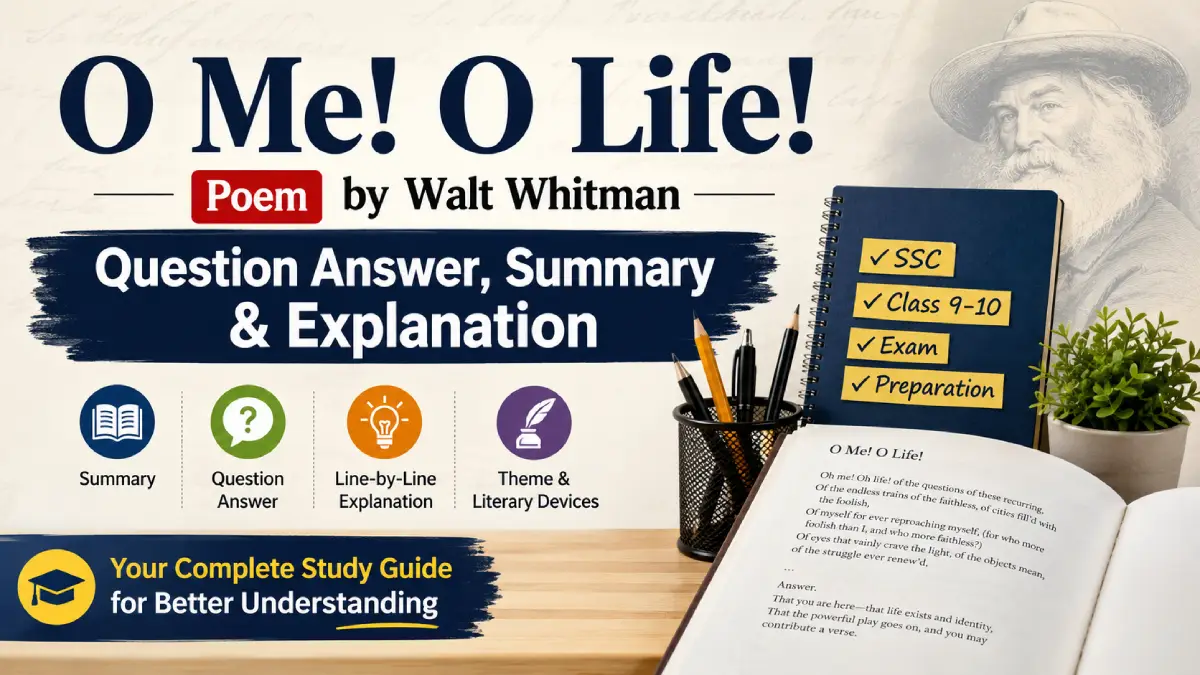
The Poem: “O Me! O Life!”
Poet: Walt Whitman (1819–1892)
Textbook: English for Today
Unit: 1
Lesson: 3
For: Class 9, Class 10 & SSC
“O Me! O Life!” is a reflective poem by Walt Whitman about the struggles, failures, disappointments, and meaning of human life. The poet begins by questioning the value of life but ends with a hopeful answer: life is valuable, every person has an identity, and everyone can make a meaningful contribution.
Table of Contents
- 1. The Poem: “O Me! O Life!”
- 2. “O Me! O Life!” কবিতার বাংলা অর্থ
- 3. Vocabulary & Key Terms
- 4. Short Summary of “O Me! O Life!”
- 5. “O Me! O Life!” এর বাংলা সারসংক্ষেপ
- 6. O Me! O Life! SSC Question Answer
- 7. Detailed Summary of “O Me! O Life!”
- 8. Structure of the Poem
- 9. Main Theme of “O Me! O Life!”
- 10. Line-by-Line Explanation of “O Me! O Life!”
- 11. Important Literary Devices in “O Me! O Life!”
- 12. Tone of “O Me! O Life!”
- 13. Message of “O Me! O Life!”
- 14. Quick Revision Notes
- 15. Frequently Asked Questions
- 16. 🔗 Explore More for Preparation
The Poem: “O Me! O Life!”
Oh me! Oh life! of the questions of these recurring,
Of the endless trains of the faithless, of cities fill’d with the foolish,
Of myself for ever reproaching myself, (for who more foolish than I, and who more faithless?)
Of eyes that vainly crave the light, of the objects mean, of the struggle ever renew’d,
Of the poor results of all, of the plodding and sordid crowds I see around me,
Of the empty and useless years of the rest, with the rest me intertwined,
The question, O me! so sad, recurring—What good amid these, O me, O life?
Answer.
That you are here—that life exists and identity,
That the powerful play goes on, and you may contribute a verse.
“O Me! O Life!” কবিতার বাংলা অর্থ
Oh me! Oh life! of the questions of these recurring,
হায় আমি! হায় জীবন! এই প্রশ্নগুলো বারবার আমার মনে ফিরে আসে।
Of the endless trains of the faithless, of cities fill’d with the foolish,
অসংখ্য বিশ্বাসহীন মানুষের অবিরাম ভিড় এবং নির্বোধ মানুষে ভরা শহরগুলোর কথা আমি ভাবি।
Of myself for ever reproaching myself, (for who more foolish than I, and who more faithless?)
আমি সব সময় নিজেকেও দোষ দিই—কারণ আমার চেয়ে বেশি নির্বোধ বা বিশ্বাসহীন আর কে হতে পারে?
Of eyes that vainly crave the light, of the objects mean, of the struggle ever renew’d,
আমি দেখি মানুষ বৃথাই আলো বা সত্যের সন্ধান করছে, তুচ্ছ বিষয়ের পেছনে ছুটছে এবং বারবার নতুন সংগ্রামের মুখোমুখি হচ্ছে।
Of the poor results of all, of the plodding and sordid crowds I see around me,
আমি মানুষের সব প্রচেষ্টার হতাশাজনক ফল এবং আমার চারপাশে ধীরগতিতে চলা, ক্লান্ত ও হীন মানুষের ভিড় দেখি।
Of the empty and useless years of the rest, with the rest me intertwined,
আমি অন্যদের জীবনের শূন্য ও অর্থহীন বছরগুলোর কথা ভাবি এবং বুঝতে পারি যে আমিও তাদের সঙ্গে একই মানবজীবনে জড়িত।
The question, O me! so sad, recurring—What good amid these, O me, O life?
তাই সেই দুঃখজনক প্রশ্নটি বারবার ফিরে আসে—হায় আমি! হায় জীবন! এত দুঃখ, ব্যর্থতা ও সমস্যার মধ্যে জীবনের ভালো বা সার্থকতা কোথায়?
Answer.
উত্তর।
That you are here—that life exists and identity,
তুমি এখানে আছো—অর্থাৎ জীবন আছে এবং তোমার নিজস্ব পরিচয় আছে।
That the powerful play goes on, and you may contribute a verse.
জীবনের এই শক্তিশালী ও মহৎ নাটক চলতে থাকবে, আর তুমিও এতে নিজের একটি অর্থপূর্ণ অবদান রাখতে পারো।
Vocabulary & Key Terms
| Word / Phrase | Easy English Meaning | বাংলা অর্থ |
|---|---|---|
| Recurring | Happening again and again | বারবার ফিরে আসা / পুনরাবৃত্ত হওয়া |
| Endless trains | Long, continuous lines or crowds | অবিরাম সারি বা মিছিল |
| Faithless | Without faith; not trustworthy | অবিশ্বাসী / বিশ্বাসহীন |
| Reproaching | Blaming or criticizing | দোষারোপ করা / তিরস্কার করা |
| Vainly crave | Wanting something but not getting it | বৃথা আকাঙ্ক্ষা করা |
| Objects mean | Small, unimportant, or worthless things | তুচ্ছ বা নগণ্য বিষয় |
| Struggle ever renew’d | Continuous struggle or hardship | নিরন্তর সংগ্রাম |
| Plodding | Moving or working slowly and heavily | ধীরে ও ক্লান্তভাবে চলা |
| Sordid | Dirty, selfish, or morally bad | নোংরা / হীন / স্বার্থপর |
| Intertwined | Closely connected | ওতপ্রোতভাবে জড়িত |
| Identity | A person’s own distinct self | আত্মপরিচয় / স্বকীয়তা |
| Powerful play | The continuing drama of human life | মানবজীবনের চলমান মহৎ নাটক |
| Contribute a verse | Make a meaningful contribution | অর্থপূর্ণ অবদান রাখা |
Short Summary of “O Me! O Life!”
“O Me! O Life!” is a poem about the meaning and purpose of life. Walt Whitman describes the foolishness, faithlessness, struggles, failures, and wasted years he sees around him. He also blames himself for his own weaknesses. These thoughts make him ask what good there is in life. Finally, he finds a hopeful answer: life exists, every person has an identity, and everyone can contribute something meaningful to life.
“O Me! O Life!” এর বাংলা সারসংক্ষেপ
‘O Me! O Life!’ কবিতায় ওয়াল্ট হুইটম্যান মানবজীবনের দুঃখ, ব্যর্থতা, সংগ্রাম ও হতাশার কথা বলেছেন। তিনি চারপাশে অবিশ্বাসী ও নির্বোধ মানুষ, তুচ্ছ বিষয়ের পেছনে ছোটা এবং নিত্যনতুন সংগ্রাম দেখতে পান। তিনি নিজের দুর্বলতা ও নষ্ট সময়ের কথাও ভাবেন।
এসব দেখে কবি প্রশ্ন করেন—এত দুঃখ, ব্যর্থতা ও সমস্যার মধ্যে জীবনের সার্থকতা কোথায়?
শেষে কবি একটি ইতিবাচক উত্তর খুঁজে পান। মানুষ বেঁচে আছে, তার নিজস্ব পরিচয় আছে এবং জীবনের চলমান নাটকে সে অর্থপূর্ণ অবদান রাখতে পারে। তাই জীবনে সমস্যা থাকলেও জীবন অর্থহীন নয়।
O Me! O Life! SSC Question Answer
These are important SSC and Class 9–10 question answers from “O Me! O Life!” The answers are written in simple English so that Bangladeshi students can understand them easily, learn them quickly, and write them in the examination.
⭐⭐⭐ Most Important Questions
1. What is the main theme of the poem “O Me! O Life!”?
Answer: The main theme is the meaning and purpose of life. The poet shows that life is valuable because every person has an identity and can make a meaningful contribution.
2. What is the symbolic meaning of “the powerful play” and “contribute a verse”?
Answer: “The powerful play” means the continuing drama of human life. “Contribute a verse” means making a meaningful contribution to life and society.
3. What recurring question does the poet mention? / What is the poet searching for?
Answer: The poet asks, “What good amid these, O me, O life?” He is searching for the meaning and purpose of life despite its problems and failures.
4. What is the poet’s answer to his own recurring question?
Answer: The poet answers that life exists, every person has an identity, and everyone can make a meaningful contribution to life.
5. What do “sordid” and “plodding” mean in the poem?
Answer: “Sordid” means dirty, selfish, or morally bad. “Plodding” means moving or working slowly and heavily.
6. Why does the poet reproach himself? / Why does he call himself foolish and faithless?
Answer: The poet reproaches himself because he knows that he also has weaknesses, mistakes, and wasted time. He considers himself an imperfect human being like others.
7. How does the tone shift in the poem “O Me! O Life!”?
Answer: The poem begins with a sad and doubtful tone. At the end, the tone becomes hopeful and positive.
8. What message does the poem ultimately convey?
Answer: The poem teaches that life is valuable despite suffering and failure. Every person can make a meaningful contribution to the world.
⭐⭐ Important Questions
9. What does the poet mean by “the endless trains of the faithless”?
Answer: It means the large number of people who are faithless, unreliable, or disloyal.
10. Why does the poet describe cities as “fill’d with the foolish”?
Answer: He describes cities this way because he sees many people doing foolish and meaningless things instead of living wisely.
11. What do “eyes that vainly crave the light” symbolize?
Answer: They symbolize people who search for truth, knowledge, or hope but fail to find them.
12. What does “the struggle ever renew’d” represent?
Answer: It represents the continuous struggles and hardships that people face in life.
13. What does the poet mean by “empty and useless years”? / Why does he think about them?
Answer: “Empty and useless years” means wasted periods of life. The poet thinks about them because he regrets wasted time in his own life and sees the same problem in others.
14. What does “that you are here” emphasize?
Answer: It emphasizes that being alive and existing in the world is valuable.
15. What does “life exists and identity” imply?
Answer: It means that life and individual identity give every person value and a place in the world.
16. Do you find the answer section of the poem convincing? Why?
Answer: Yes, I find it convincing because it teaches us to focus on our abilities and make a positive contribution to life.
17. What does “O Me! O Life!” suggest about optimism?
Answer: It suggests that we should remain hopeful despite life’s difficulties and use our abilities to do something good.
18. Why does Whitman emphasize contributing a verse?
Answer: He emphasizes it to show that every person is important and can make a meaningful contribution to life.
Additional Practice Questions
19. What does “objects mean” refer to in the poem?
Answer: “Objects mean” refers to small, unimportant, or worthless things that people spend their time and energy pursuing.
20. What does the poet think of the “poor results of all”?
Answer: The poet feels disappointed because people work and struggle hard but often get poor or unsatisfactory results.
21. What intertwines the poet with others in the poem?
Answer: The poet is connected with others through their common weaknesses, disappointments, wasted time, and struggles in life.
22. Why does the poet use repetition such as “Of…” and “Oh me! Oh life!”?
Answer: He uses repetition to show his repeated sadness and make his feelings stronger.
23. What “faith” does the poet mention in the poem?
Answer: The poet refers to faith as belief in truth, goodness, human ability, and the purpose of life.
24. What is the poet’s attitude towards life throughout the poem?
Answer: At first, the poet is sad, tired, and doubtful. At the end, he becomes hopeful and positive.
25. What does the poem ask us to remember about life?
Answer: It asks us to remember that our existence is important and we can make a positive difference in life.
26. What feelings does the poem “O Me! O Life!” evoke in the reader?
Answer: At first, the poem creates sadness and deep thought. At the end, it creates hope, inspiration, and confidence.
27. How does the poet describe the modern world?
Answer: The poet describes it as a world full of foolish, faithless, and tired people who struggle and chase meaningless things.
28. What does the poem say about the value of life itself?
Answer: The poem says that life itself is valuable because we exist and have the chance to do meaningful things.
29. What role does the individual play in society according to the poem?
Answer: Every individual can play a useful role and make a positive contribution to society.
30. What does the poem highlight about human imperfections?
Answer: The poem shows that foolishness, mistakes, doubts, and weaknesses are common human qualities.
31. Is age an identity marker? What are the attributes of old age according to the poem?
Answer: No, age is not presented as the main identity of a person in the poem. The poem emphasizes existence, identity, and the ability to contribute, regardless of age.
Detailed Summary of “O Me! O Life!”
At the beginning of the poem, Walt Whitman thinks about the problems of human life. He sees faithless people, foolish people, repeated struggles, poor results, and wasted years.
The poet also looks at himself. He admits that he has weaknesses and mistakes. He does not consider himself better than the people around him. He feels that he is also part of the imperfect human society.
These thoughts make him ask:
“What good amid these, O me, O life?”
In simple words, he wants to know what the real value or purpose of life is when life contains so much suffering, failure, and disappointment.
Then the poem changes direction with the word “Answer.”
The poet realizes that being alive itself has value. Every person has an identity and a place in the world. Life continues like a “powerful play,” and each person can “contribute a verse.”
Therefore, the poem ends with a message of hope, purpose, and positive action.
Structure of the Poem
The poem has two main parts.
| Part | Lines | Main Idea |
|---|---|---|
| Part 1: Despair & Question | Lines 1–7 | The poet thinks about foolishness, faithlessness, struggle, failure, wasted years, and his own weaknesses. |
| Part 2: Answer & Purpose | Lines 8–9 | The poet realizes that life and identity have value and that everyone can contribute something meaningful. |
The poem moves from:
Question → Answer
Despair → Hope
Failure → Purpose
Self-doubt → Self-worth
Main Theme of “O Me! O Life!”
English Theme
The main theme of the poem is the meaning and purpose of life.
At first, the poet is unhappy because he sees foolishness, faithlessness, struggle, failure, and wasted years. He also recognizes his own weaknesses. But at the end, he realizes that life is valuable because every person exists, has an identity, and can make a meaningful contribution.
The “powerful play” represents the continuing drama of human life, while “contribute a verse” means making one’s own meaningful contribution.
মূলভাব
কবিতাটির মূলভাব হলো—জীবনে দুঃখ, ব্যর্থতা ও সংগ্রাম থাকলেও জীবন অর্থহীন নয়। মানুষের অস্তিত্ব ও আত্মপরিচয়ের মূল্য রয়েছে। প্রত্যেক মানুষ তার নিজের কাজ ও সৃষ্টিশীলতার মাধ্যমে জীবনে একটি অর্থপূর্ণ অবদান রাখতে পারে।
Line-by-Line Explanation of “O Me! O Life!”
“Oh me! Oh life! of the questions of these recurring”
The poet is troubled by questions about life that come back to his mind again and again.
Easy idea: The poet repeatedly thinks about the problems and meaning of life.
“Of the endless trains of the faithless, of cities fill’d with the foolish”
The poet sees many faithless people and cities full of foolish people.
Easy idea: He is disappointed with the people around him.
“Of myself for ever reproaching myself…”
The poet also blames himself for his own mistakes and weaknesses.
Easy idea: He knows that he is also an imperfect human being.
“Of eyes that vainly crave the light, of the objects mean, of the struggle ever renew’d”
People want light, truth, and knowledge, but often fail to find them. They also spend time on trivial things and face repeated struggles.
Easy idea: People search for truth and hope but often face failure.
“Of the poor results of all, of the plodding and sordid crowds I see around me”
The poet sees people working and struggling but often getting poor results. He also sees tired and selfish people around him.
Easy idea: Human efforts often bring disappointment.
“Of the empty and useless years of the rest, with the rest me intertwined”
The poet sees many wasted years in people’s lives and realizes that his own life is connected with theirs.
Easy idea: He shares the same human problems with others.
“The question, O me! so sad, recurring—What good amid these, O me, O life?”
This is the central question of the poem.
Easy idea: The poet asks what good or purpose life has despite so many problems.
“Answer.”
This is the turning point of the poem.
Easy idea: The poet is now going to give a positive answer.
“That you are here—that life exists and identity”
The poet realizes that being alive has value and that every person has an identity.
Easy idea: Our existence itself is important.
“That the powerful play goes on, and you may contribute a verse.”
Life continues like a great play, and every person can add something meaningful to it.
Easy idea: Everyone can make a positive contribution to life.
Important Literary Devices in “O Me! O Life!”
Metaphor
“The powerful play” is a metaphor for the continuing drama of human life.
“Contribute a verse” is a metaphor for making a meaningful contribution to life.
Repetition
The poet repeatedly uses expressions such as “Of…” and “Oh me! Oh life!” to show his repeated thoughts and sadness.
Symbolism
“Light” symbolizes truth, knowledge, hope, or enlightenment.
“Verse” symbolizes a person’s contribution to life.
Contrast
The poem contains a strong contrast between:
- Despair and hope
- Question and answer
- Failure and purpose
- Self-doubt and self-worth
Tone of “O Me! O Life!”
The tone of the poem changes from the beginning to the end.
Beginning
The beginning is:
- Sad
- Doubtful
- Frustrated
- Self-critical
Ending
The ending is:
- Hopeful
- Positive
- Inspirational
- Purposeful
Exam-ready answer: The tone changes from sadness and self-doubt to hope and positivity.
Message of “O Me! O Life!”
The poem teaches that life should not be considered meaningless because of suffering and failure.
Every person is alive, has an identity, and has the opportunity to do something meaningful.
The phrase “contribute a verse” means that everyone can make a positive contribution to life and society.
Quick Revision Notes
| Topic | Easy Answer |
|---|---|
| Poet | Walt Whitman |
| Main theme | Meaning and purpose of life |
| Beginning | Sadness, struggle and self-questioning |
| Central question | What good is there in life? |
| Turning point | “Answer.” |
| Powerful play | The continuing drama of human life |
| Contribute a verse | Make a meaningful contribution |
| Light | Truth, knowledge or hope |
| Ending | Hope, identity and purpose |
| Main message | Everyone can make a positive contribution |
Frequently Asked Questions
Who wrote “O Me! O Life!”?
Answer: Walt Whitman wrote “O Me! O Life!”
What is the main theme of “O Me! O Life!”?
Answer: The main theme is the meaning and purpose of life despite suffering, failure, and disappointment.
What is the poet’s answer to his recurring question?
Answer: The poet says that life exists, every person has an identity, and everyone can make a meaningful contribution.
What does “contribute a verse” mean?
Answer: It means making a meaningful contribution to life or society.
What does “the powerful play” mean?
Answer: It means the continuing drama of human life.
What does “sordid” mean in the poem?
Answer: “Sordid” means dirty, selfish, or morally bad.
What does “recurring” mean?
Answer: “Recurring” means happening again and again.
What is the tone of “O Me! O Life!”?
Answer: The poem begins with a sad and doubtful tone and ends with a hopeful and positive tone.