


This A Good Teacher Paragraph for SSC (Class 9–10) is prepared according to the Bangladesh board exam standard. It includes Easy, Standard, and Advanced story versions (300–500 words) to help students improve writing skills and perform well in exams.
This mobile phone dialogue covers both advantages and disadvantages of mobile phones in a clear, exam-friendly format. Important vocabulary is highlighted with Bangla meanings, and additional sections like
🔐 Key Points to Remember
📝 How to Learn and Write This Dialogue in Exam
🧠 Memory tricks (mnemonics) are included for better understanding and quick revision. 😊
A Good Teacher Paragraph for HSC (Class 11–12) – 384 Words (Easy)
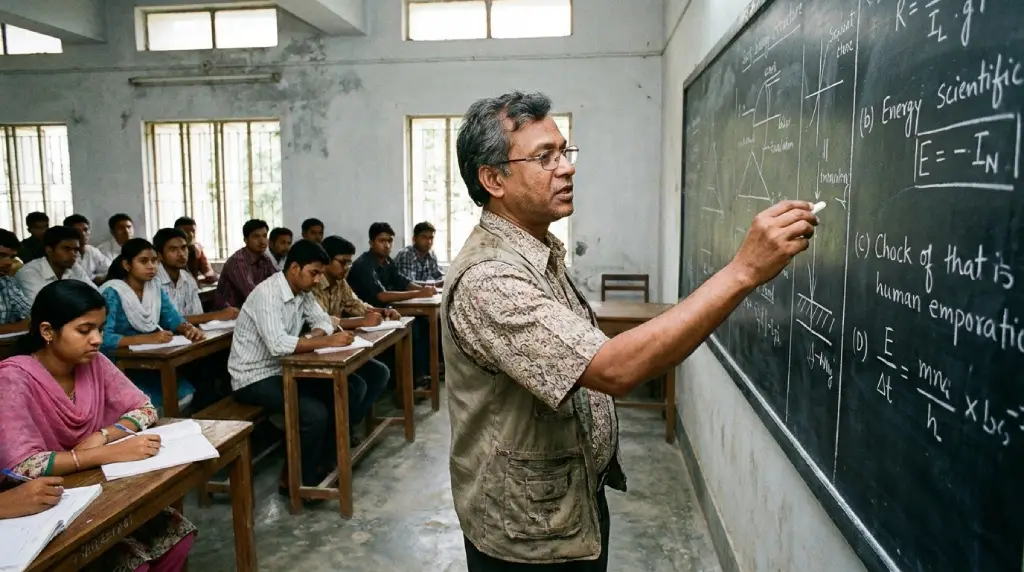
A good teacher is one of the greatest gifts a student can receive in life. Teaching is a very noble profession because a teacher shapes the mind and character of young people. A good teacher has strong knowledge of the subject and explains it in a way that every student can understand. The teacher does not just read from a textbook. Instead, the teacher uses simple examples from daily life to make lessons easy and clear. A good teacher is always patient and never becomes angry when a student asks the same question more than once. In Bangladesh, many students in colleges and higher secondary schools rely completely on their teachers because they do not have access to extra coaching or the internet. So the teacher’s role becomes even more significant in such situations. A good teacher truly cares about every student and wants each one to succeed.
Moreover, a good teacher creates a respectful and positive environment in the classroom. The teacher listens to students and encourages them to share their ideas freely. This makes students feel confident and motivated to learn. A good teacher never shows favouritism and gives equal attention to all students, whether they are strong or weak learners. In Bangladesh, where classrooms can be large and resources are sometimes limited, a good teacher finds creative ways to keep students engaged and focused. The teacher also communicates with parents to keep them informed about the student’s progress. This kind of teamwork between teachers and parents helps students grow both academically and personally.
Furthermore, a good teacher does much more than teach subjects. The teacher also builds important values in students, such as honesty, discipline, and a love for learning. These values prepare students not just for the HSC examination but for life itself. A good teacher inspires students to dream big and work hard to achieve their goals. In Bangladesh, many successful doctors, engineers, and leaders have said that a dedicated teacher changed their life. A good teacher is, therefore, not just an educator — the teacher is a life-changer who helps build the future of the entire nation.
Vocabulary Table
| Word | Bangla Meaning |
|---|---|
| good teacher | ভালো শিক্ষক |
| noble | মহৎ |
| knowledge | জ্ঞান |
| patient | ধৈর্যশীল |
| significant | গুরুত্বপূর্ণ |
| respectful | সম্মানজনক |
| confident | আত্মবিশ্বাসী |
| resources | সম্পদ |
| progress | অগ্রগতি |
| values | মূল্যবোধ |
| inspires | অনুপ্রাণিত করে |
| life-changer | জীবন পরিবর্তনকারী |
A Good Teacher Paragraph for HSC (Class 11–12) – 430 Words (Standard)
A good teacher is far more than a transmitter of academic knowledge — the teacher is an architect of human potential whose influence extends well beyond the classroom walls. At the higher secondary level in Bangladesh, where students prepare for the HSC examination and begin to define their career paths, the role of a good teacher becomes critically important. A good teacher at this stage possesses not only deep subject mastery but also a refined ability to connect complex ideas to real-world contexts. The teacher uses analytical discussions, research-based tasks, and thought-provoking questions to develop students’ higher-order thinking skills. In institutions like government colleges and HSC-level madrasas across Bangladesh, a good teacher helps students navigate both the pressures of public examinations and the broader demands of intellectual growth.
Moreover, a good teacher at the HSC level understands the psychological needs of adolescent learners. Students at this age often face academic stress, identity challenges, and uncertainty about the future. A good teacher provides not only academic mentorship but also emotional guidance, helping students manage anxiety and build resilience. The teacher fosters a classroom culture where questioning is welcomed and mistakes are treated as learning opportunities rather than failures. A good teacher also maintains strong professional ethics — arriving punctually, preparing lessons thoroughly, and treating every student with equal dignity regardless of their background or academic performance. In Bangladesh, where social and economic inequality remains a challenge, this ethical commitment to fairness is particularly vital.
Furthermore, a good teacher continuously invests in personal professional development. Institutions such as the National Academy for Educational Management (NAEM) and the Teacher’s Training College (TTC) in Bangladesh offer structured programmes to help teachers refine their pedagogy and stay current with evolving educational standards. A good teacher embraces these opportunities and also engages in self-directed learning — reading research, exploring new instructional strategies, and reflecting on classroom practice. This commitment to growth ensures that the teacher remains an effective guide even as curricula and student needs change over time. Because of such dedicated and well-trained teachers, Bangladesh has achieved consistent improvements in HSC pass rates and female participation in higher secondary education. A good teacher, ultimately, does not simply prepare students for an examination — the teacher prepares students for a lifetime of purposeful contribution to society and the nation.
Vocabulary Table
| Word | Bangla Meaning |
|---|---|
| architect | স্থপতি / নির্মাতা |
| HSC | উচ্চ মাধ্যমিক সার্টিফিকেট |
| subject mastery | বিষয়ে দক্ষতা |
| analytical | বিশ্লেষণমূলক |
| psychological | মনস্তাত্ত্বিক |
| mentorship | পথপ্রদর্শন |
| resilience | মানসিক দৃঢ়তা |
| professional ethics | পেশাদার নীতিবোধ |
| inequality | অসমতা |
| professional development | পেশাদার উন্নয়ন |
| National Academy for Educational Management (NAEM) | জাতীয় শিক্ষা ব্যবস্থাপনা একাডেমি |
| Teacher’s Training College (TTC) | শিক্ষক প্রশিক্ষণ কলেজ |
| pedagogy | শিক্ষাদান পদ্ধতি |
| practice | অনুশীলন / চর্চা |
| participation | অংশগ্রহণ |
| purposeful | উদ্দেশ্যমূলক |
A Good Teacher Paragraph for HSC (Class 11–12) – 490 Words (Advanced)
A good teacher represents one of the most profound and enduring forces in the intellectual and moral development of a civilisation. In the philosophical tradition, figures such as Socrates and Rabindranath Tagore — whose educational ideals have deeply influenced the Bengali intellectual heritage — conceived of teaching not as the mechanical transmission of facts but as the facilitation of self-discovery and critical consciousness. In the contemporary context of Bangladesh, where the education system serves over a million higher secondary students annually, this philosophical ideal of the good teacher remains urgently relevant. A good teacher at the HSC level is one who combines rigorous academic competence with a transformative pedagogical vision — guiding students not merely toward examination success but toward intellectual independence and civic awareness. The teacher understands that education is ultimately a political and moral act: it either reproduces existing social hierarchies or it emancipates learners from ignorance and limitation.
Moreover, the structural challenges facing the Bangladeshi education system demand that a good teacher possess extraordinary adaptability and commitment. Many higher secondary institutions across Bangladesh operate under conditions of resource scarcity — insufficient laboratory equipment, outdated textbooks, and overcrowded classrooms. Despite these systemic constraints, a good teacher leverages creativity, peer learning strategies, and contextualised instruction to deliver meaningful education. The teacher draws upon Bangladesh’s own historical and cultural narrative — from the Language Movement of 1952 to the Liberation War of 1971 — to make abstract concepts tangible and personally significant for students. A good teacher also actively combats gender bias and social prejudice in the classroom, recognising that the HSC cohort includes many first-generation female learners whose educational journey depends critically on a supportive and equitable learning environment.
Furthermore, a good teacher at this level engages in ongoing reflective practice — critically evaluating their own teaching methods, seeking feedback from students, and participating in structured professional development through bodies such as the National Academy for Educational Management (NAEM), the Bangladesh Teacher Education Network, and the Directorate of Secondary and Higher Education (DSHE). This institutional engagement ensures that the teacher’s methods remain aligned with national curriculum frameworks and global best practices in pedagogy. A good teacher also cultivates a sense of intellectual humility — acknowledging the limits of their own knowledge and modelling for students the lifelong pursuit of learning. In this way, the teacher becomes not merely an instructor but a co-learner, demonstrating that curiosity and growth are values to be embodied, not merely preached. The legacy of a good teacher is not measured in examination results alone, but in the quality of thought, the depth of empathy, and the strength of character that their students carry forward into Bangladeshi society and beyond. A truly good teacher does not merely educate a student — the teacher civilises a generation.
Vocabulary Table
| Word | Bangla Meaning |
|---|---|
| facilitation | সহায়তা / সুবিধা প্রদান |
| consciousness | সচেতনতা / চেতনা |
| competence | দক্ষতা / যোগ্যতা |
| civic awareness | নাগরিক সচেতনতা |
| emancipates | মুক্ত করে |
| adaptability | অভিযোজন ক্ষমতা |
| resource scarcity | সম্পদের অভাব |
| contextualised | প্রাসঙ্গিক করা |
| narrative | বর্ণনা / ইতিহাস |
| gender bias | লিঙ্গ-বৈষম্য |
| equitable | সমতাভিত্তিক |
| reflective practice | প্রতিফলনমূলক চর্চা |
| National Academy for Educational Management (NAEM) | জাতীয় শিক্ষা ব্যবস্থাপনা একাডেমি |
| Bangladesh Teacher Education Network | বাংলাদেশ শিক্ষক শিক্ষা নেটওয়ার্ক |
| Directorate of Secondary and Higher Education (DSHE) | মাধ্যমিক ও উচ্চ শিক্ষা অধিদপ্তর |
| curriculum frameworks | পাঠ্যক্রম কাঠামো |
| intellectual humility | বৌদ্ধিক বিনম্রতা |
| co-learner | সহ-শিক্ষার্থী |
| legacy | উত্তরাধিকার |
| civilises | সভ্য করে তোলে |
📝 How to Learn and Write This Paragraph in Exam – For Class 11 & 12
1. Key Points to Remember
- A good teacher is not merely an instructor but a facilitator of critical consciousness and intellectual independence — a philosophical idea rooted in both Socratic tradition and Rabindranath Tagore’s educational vision.
- At the HSC level in Bangladesh, a good teacher combines deep subject mastery with the ability to develop higher-order thinking, analytical reasoning, and civic awareness in students.
- Bangladesh’s structural challenges — overcrowded classrooms, resource scarcity, and social inequality — demand that a good teacher be especially adaptive, creative, and ethically committed.
- A good teacher actively opposes gender bias and ensures an equitable learning environment, particularly important for first-generation female HSC students across Bangladesh.
- Institutions like NAEM, the Bangladesh Teacher Education Network, and DSHE provide professional development pathways that good teachers must engage with to stay current and effective.
- A good teacher practices intellectual humility — modelling lifelong learning and treating students as co-learners rather than passive recipients of knowledge.
- The true legacy of a good teacher is measured not in HSC pass rates alone, but in the character, empathy, and civic responsibility their students demonstrate throughout life.
2. Memory Trick / Mnemonic
Remember TEACHER for A Good Teacher at HSC level:
- T = Transforms students through critical thinking and civic awareness
- E = Equitable — treats every student fairly regardless of gender or background
- A = Adaptable in resource-scarce and overcrowded Bangladeshi classrooms
- C = Committed to professional development through NAEM and DSHE
- H = Humble — models intellectual humility and lifelong learning as a co-learner
- E = Emancipates students from ignorance and social limitation through education
- R = Reflective — evaluates and improves teaching practice continuously
3. Exam Writing Checklist
✅ Did I include a philosophical or academic framing of the teacher’s role — referencing ideas from Socrates, Tagore, or the concept of critical consciousness? ✅ Did I mention Bangladesh-specific institutions such as NAEM, DSHE, or Teacher’s Training College (TTC) in connection with professional development? ✅ Did I address the structural challenges of the Bangladeshi education system — resource scarcity, overcrowding, gender bias — and how a good teacher responds to them? ✅ Did I write about the good teacher’s role in building civic awareness and moral character, beyond preparing students for the HSC examination? ✅ Did I use a thesis-style opening and closing sentence that frames teaching as a civilising or emancipatory force for Bangladesh’s society?
4. One-Line Summary
A good teacher is not merely an academic guide but a transformative force who, through knowledge, empathy, and ethical commitment, emancipates students from ignorance and shapes the intellectual and moral destiny of Bangladesh.
FAQ Section on A Good Teacher Paragraph – For Class 11 & 12
Q1: How does the philosophical concept of teaching as “facilitation of self-discovery” apply to a good teacher in Bangladesh’s HSC classrooms? Answer: The Socratic idea of teaching as guided self-discovery means a good teacher uses questioning and dialogue rather than rote instruction to help students arrive at understanding independently. In Bangladesh’s HSC context, this translates into discussion-based lessons, open-ended assignments, and a classroom culture where students are encouraged to think critically rather than simply memorise answers.
Q2: What is the significance of Rabindranath Tagore’s educational philosophy for understanding the role of a good teacher in the Bengali context? Answer: Tagore believed education should cultivate creativity, moral sensibility, and a deep connection to one’s cultural environment — ideas that directly challenge the exam-focused rote learning common in many Bangladeshi institutions. A good teacher who embodies Tagore’s vision prioritises the holistic development of the student over narrow academic performance metrics.
Q3: How does gender bias in Bangladesh’s higher secondary education system affect the responsibilities of a good teacher? Answer: Many female HSC students in Bangladesh are first-generation learners who face social pressure, early marriage risks, and limited family support for their education. A good teacher who actively combats gender bias by creating an equitable and encouraging classroom environment can be the decisive factor in whether such students complete their higher secondary education.
Q4: In what ways do institutions like NAEM and DSHE contribute to producing and sustaining good teachers in Bangladesh? Answer: NAEM provides structured leadership and pedagogy training for educators at all levels, while DSHE oversees curriculum policy and teacher deployment across Bangladesh’s secondary and higher secondary institutions. Together, these bodies create the institutional framework within which a committed teacher can develop professionally and contribute to national educational goals.
Q5: How does the concept of “reflective practice” distinguish a truly good teacher from an average one? Answer: Reflective practice requires a teacher to systematically evaluate the effectiveness of their own lessons, seek honest feedback from students, and adjust strategies based on evidence — a process that most average teachers bypass in favour of routine. A good teacher who reflects regularly is far more likely to identify learning gaps early and respond with targeted, innovative solutions.
Q6: Why is intellectual humility considered an advanced and essential quality of a good teacher at the HSC level? Answer: At the higher secondary level, students are beginning to engage with complex, contested knowledge — and a teacher who projects false certainty can stifle intellectual curiosity and discourage critical debate. A teacher who models intellectual humility, admitting uncertainty and inviting disagreement, teaches students that rigorous thinking is a process, not a destination.
Q7: How does a good teacher use Bangladesh’s historical and cultural narrative — such as the Language Movement and the Liberation War — as a pedagogical tool? Answer: By anchoring abstract concepts in the lived history of Bangladesh, a good teacher makes content emotionally meaningful and nationally relevant, transforming lessons from mere information transfer into acts of cultural identity formation. This approach also builds civic pride and motivates students to connect their personal academic growth to the broader story of their nation.
Q8: What is the relationship between a good teacher’s professional ethics and the reduction of social inequality in Bangladesh’s education system? Answer: A teacher who practises professional ethics — treating all students with equal dignity, refusing bribes or favouritism, and maintaining consistent standards — directly counteracts the patronage and inequality that pervade many educational institutions in Bangladesh. Over time, ethical teaching builds institutional trust and creates learning environments where merit, not social connections, determines student outcomes.
Q9: How can the concept of the teacher as a “co-learner” reshape the traditional power dynamic in Bangladeshi higher secondary classrooms? Answer: The traditional Bangladeshi classroom often positions the teacher as an unquestioned authority and the student as a passive recipient, which can suppress critical thinking and creative expression. When a good teacher adopts the posture of a co-learner — acknowledging gaps in knowledge, learning alongside students, and validating student contributions — the classroom becomes a collaborative intellectual space that produces deeper and more lasting learning.
Q10: How should the legacy of a good teacher be measured in the context of Bangladesh’s long-term national development goals? Answer: Rather than measuring a teacher’s legacy solely through student pass rates or examination scores, it should be assessed through the civic values, problem-solving capacity, and social empathy that their students demonstrate as adult citizens contributing to Bangladesh’s development. In a country working toward economic advancement, democratic governance, and social equity, the moral and intellectual qualities cultivated by good teachers are among the most valuable national assets.
প্রিয় শিক্ষার্থীবৃন্দ
আমরা আশা করি এই Dialogue গুলো তোমাদের পরীক্ষায় ভালো নম্বর অর্জনে সহায়ক হবে। যদি কন্টেন্টটি উপকারী মনে হয়, তাহলে তোমাদের মতামত ও প্রয়োজনীয় টপিক কমেন্ট সেকশনে জানাও।
নিয়মিত পরীক্ষার প্রস্তুতি ও গুরুত্বপূর্ণ আপডেট পেতে আমাদের
▶️ YouTube Channel সাবস্ক্রাইব করো এবং
ⓕ Facebook Page লাইক দিয়ে আমাদের সাথে যুক্ত থাকো 🚀
তোমাদের সফল প্রস্তুতিই আমাদের মূল লক্ষ্য 💪
🔗 Explore More for Preparation
📚 পরীক্ষার জন্য আরও প্রস্তুতি নাও
-
📌 Stories