

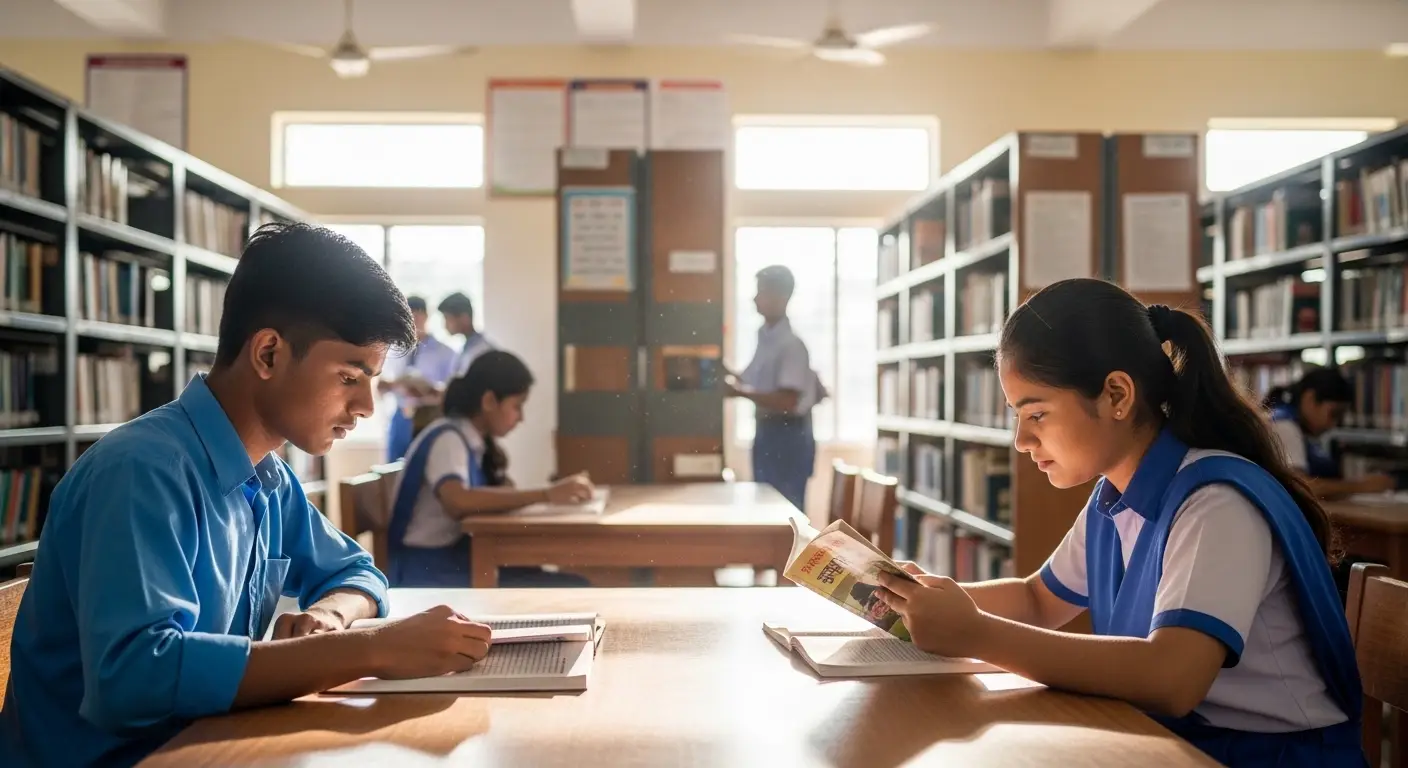
This My College Library Paragraph for HSC (Class 11–12) is prepared according to the Bangladesh board exam standard. It includes Easy, Standard, and Advanced story versions (300–600 words) to help students improve writing skills and perform well in exams.
This mobile phone dialogue covers both advantages and disadvantages of mobile phones in a clear, exam-friendly format. Important vocabulary is highlighted with Bangla meanings, and additional sections like
🔐 Key Points to Remember
📝 How to Learn and Write This Dialogue in Exam
🧠 Memory tricks (mnemonics) are included for better understanding and quick revision. 😊
My College Library Paragraph for HSC (Class 11–12) – 377 Words (Easy)
My college library is the most important educational resource in our institution. It is located in a separate two-story building on the eastern side of our college campus. The library was established in 1985 and has been serving students for nearly four decades. The building has a very nice design with large windows that allow plenty of natural light and fresh air. The main reading hall is on the ground floor and can accommodate about three hundred students at one time. There are comfortable wooden tables and chairs arranged in neat rows. The atmosphere inside the library is always peaceful and conducive to learning. Our head librarian, Professor Abdur Rahman, is a qualified professional with a master’s degree in Library and Information Science. He manages the library very efficiently with the help of three assistant librarians. The library remains open from 8 AM to 6 PM on all working days and till 2 PM on Fridays.
Moreover, our library has an impressive collection of more than twenty-five thousand books. The books are systematically organized according to different subjects and categories. There are complete sections for science, arts, commerce, and general knowledge. The library has an excellent collection of Bengali literature including works by Rabindranath Tagore, Kazi Nazrul Islam, Bankimchandra Chattopadhyay, and Begum Rokeya. We also have books by famous international authors like Shakespeare, Dickens, Tolstoy, and many others. The reference section has encyclopedias, atlases, and various types of dictionaries. The library subscribes to more than thirty newspapers and magazines including Prothom Alo, Daily Star, Samakal, and several educational journals. There is a special section for competitive examination books for BCS, bank jobs, and university admission tests. Recently, a digital corner has been set up with eight computers having internet connectivity. Students can access e-books, online journals, and digital databases through these computers.
Furthermore, the library plays a crucial role in our academic development and personality building. It helps us expand our knowledge beyond the regular curriculum. The library conducts orientation sessions for new students to help them understand how to use library resources. It also organizes book fairs, literary competitions, and seminars throughout the year. As a college student, I spend at least two hours daily in the library. I am truly grateful for this wonderful library.
Vocabulary Table
| Word | Bangla Meaning |
|---|---|
| Educational resource | শিক্ষা সম্পদ |
| Campus | ক্যাম্পাস |
| Design | নকশা |
| Natural light | প্রাকৃতিক আলো |
| Accommodate | ধারণ করা |
| Atmosphere | পরিবেশ |
| Conducive | অনুকূল |
| Qualified professional | যোগ্য পেশাদার |
| Library and Information Science | গ্রন্থাগার ও তথ্য বিজ্ঞান |
| Efficiently | দক্ষতার সাথে |
| Impressive collection | চমৎকার সংগ্রহ |
| Systematically organized | সুশৃঙ্খলভাবে সাজানো |
| Categories | শ্রেণী |
| Bengali literature | বাংলা সাহিত্য |
| International authors | আন্তর্জাতিক লেখক |
| Reference section | তথ্য বিভাগ |
| Dictionaries | অভিধান |
| Subscribes | গ্রাহক হওয়া |
| Samakal | সমকাল |
| Educational journals | শিক্ষামূলক জার্নাল |
| Competitive examination | প্রতিযোগিতামূলক পরীক্ষা |
| Admission tests | ভর্তি পরীক্ষা |
| Digital corner | ডিজিটাল কোণা |
| Connectivity | সংযোগ |
| E-books | ই-বুক |
| Online journals | অনলাইন জার্নাল |
| Digital databases | ডিজিটাল ডাটাবেস |
| Crucial role | গুরুত্বপূর্ণ ভূমিকা |
| Academic development | শিক্ষাগত উন্নয়ন |
| Personality building | ব্যক্তিত্ব গঠন |
| Curriculum | পাঠ্যক্রম |
| Conducts | পরিচালনা করে |
| Orientation sessions | পরিচিতি অধিবেশন |
| Literary competitions | সাহিত্য প্রতিযোগিতা |
| Seminars | সেমিনার |
My College Library Paragraph for HSC (Class 11–12) – 455 Words (Standard)
My college library stands as a beacon of knowledge and intellectual enrichment in our educational institution. Located in a beautifully designed three-story building adjacent to the main academic complex, the library was established in 1982 when our college received government approval as a higher secondary institution. The library has undergone several modernization initiatives over the years to meet the changing needs of higher education. The architectural design of the building reflects both functionality and aesthetics with spacious halls, adequate ventilation, and optimal lighting arrangements. The ground floor houses the main reading hall with a seating capacity of three hundred and fifty students, while the first floor contains the reference section and periodical room. The second floor is dedicated to the digital resource center equipped with modern technology. The entire infrastructure creates an ambience that is highly conducive to serious study and research work. Professor Abdul Karim, our head librarian, holds an M.A. in Library and Information Science from Dhaka University and brings twenty-five years of professional experience to managing this valuable institutional resource.
Moreover, the library boasts an extensive collection of over thirty thousand volumes covering all academic disciplines relevant to higher secondary education. The cataloging system follows the internationally recognized Dewey Decimal Classification which ensures efficient retrieval of books. There are specialized collections for science, humanities, commerce, and technical subjects. The literature section is particularly rich with complete works of classical and contemporary writers from Bangladesh and around the world. We have comprehensive collections of Rabindranath Tagore, Kazi Nazrul Islam, Sarat Chandra Chattopadhyay, Begum Rokeya, Shamsur Rahman, Sunil Gangopadhyay, Shakespeare, Jane Austen, and Gabriel García Márquez. The reference section houses numerous encyclopedias, biographical dictionaries, atlases, and subject-specific reference works essential for college-level research. The library subscribes to more than forty periodicals including leading newspapers, literary magazines, and academic journals such as University of Dhaka Studies, Bangladesh Journal of Scientific Research, and Dhaka University Journal of Biological Sciences.
Furthermore, the digital resource center provides access to online databases, e-journals, and digital libraries through fifteen computer terminals with high-speed internet. Students can access resources like JSTOR, Project Gutenberg, Bangladesh Journals Online, and various open-access academic repositories. The circulation policy is very student-friendly, allowing borrowing of up to five books for three weeks with renewal facilities. The library also maintains a reserved book collection for high-demand titles and textbooks. Throughout the year, the library organizes intellectual activities including book exhibitions, author interactions, literary discussions, and research methodology workshops. The library has a reciprocal agreement with Dhaka University Central Library, allowing our students to access specialized resources. These initiatives significantly contribute to creating a vibrant academic culture. Our college library is truly an indispensable asset that supports holistic education and prepares us for university-level studies and lifelong learning.
Vocabulary Table
| Word | Bangla Meaning |
|---|---|
| Beacon of knowledge | জ্ঞানের আলোকবর্তিকা |
| Intellectual enrichment | বুদ্ধিবৃত্তিক সমৃদ্ধি |
| Academic complex | শিক্ষা কমপ্লেক্স |
| Government approval | সরকারি অনুমোদন |
| Modernization initiatives | আধুনিকীকরণ উদ্যোগ |
| Higher education | উচ্চ শিক্ষা |
| Architectural design | স্থাপত্য নকশা |
| Functionality | কার্যকারিতা |
| Aesthetics | সৌন্দর্য |
| Adequate ventilation | পর্যাপ্ত বাতাস চলাচল |
| Optimal lighting | সর্বোত্তম আলো |
| Capacity | ধারণক্ষমতা |
| Reference section | তথ্য বিভাগ |
| Periodical room | সাময়িকী কক্ষ |
| Digital resource center | ডিজিটাল সম্পদ কেন্দ্র |
| Technology | প্রযুক্তি |
| Infrastructure | অবকাঠামো |
| Ambience | পরিবেশ |
| Conducive | অনুকূল |
| Research work | গবেষণা কাজ |
| Dhaka University | ঢাকা বিশ্ববিদ্যালয় |
| Professional experience | পেশাগত অভিজ্ঞতা |
| Institutional resource | প্রাতিষ্ঠানিক সম্পদ |
| Extensive collection | বিস্তৃত সংগ্রহ |
| Academic disciplines | শিক্ষাগত বিষয় |
| Higher secondary education | উচ্চ মাধ্যমিক শিক্ষা |
| Cataloging system | তালিকা পদ্ধতি |
| Dewey Decimal Classification | ডিউই দশমিক শ্রেণীবিভাগ |
| Efficient retrieval | দক্ষ পুনরুদ্ধার |
| Specialized collections | বিশেষায়িত সংগ্রহ |
| Technical subjects | কারিগরি বিষয় |
| Literature section | সাহিত্য বিভাগ |
| Classical | ক্লাসিক্যাল |
| Contemporary writers | সমসাময়িক লেখক |
| Shamsur Rahman | শামসুর রাহমান |
| Sunil Gangopadhyay | সুনীল গঙ্গোপাধ্যায় |
| Jane Austen | জেন অস্টেন |
| Gabriel García Márquez | গাব্রিয়েল গার্সিয়া মার্কেজ |
| Biographical dictionaries | জীবনী অভিধান |
| Subject-specific reference works | বিষয়ভিত্তিক তথ্য গ্রন্থ |
| College-level research | কলেজ-স্ত��ের গবেষণা |
| Periodicals | সাময়িকী |
| Literary magazines | সাহিত্য পত্রিকা |
| Academic journals | শিক্ষাগত জার্নাল |
| Scientific Research | বৈজ্ঞানিক গবেষণা |
| Dhaka University Journal of Biological Sciences | ঢাকা বিশ্ববিদ্যালয় জীববিজ্ঞান জার্নাল |
| Online databases | অনলাইন ডাটাবেস |
| E-journals | ই-জার্নাল |
| Digital libraries | ডিজিটাল লাইব্রেরি |
| JSTOR | জেস্টোর |
| Project Gutenberg | প্রজেক্ট গুটেনবার্গ |
| Bangladesh Journals Online | বাংলাদেশ জার্নাল অনলাইন |
| Open-access academic repositories | উন্মুক্ত শিক্ষা ভাণ্ডার |
| Circulation policy | বই দেওয়া-নেওয়ার নিয়ম |
| Student-friendly | শিক্ষার্থী-বান্ধব |
| Renewal facilities | নবায়ন সুবিধা |
| Reserved book collection | সংরক্ষিত বই সংগ্রহ |
| Textbooks | পাঠ্যপুস্তক |
| Intellectual activities | বুদ্ধিবৃত্তিক কার্যক্রম |
| Exhibitions | প্রদর্শনী |
| Author interactions | লেখক মিথস্ক্রিয়া |
| Literary discussions | সাহিত্য আলোচনা |
| Research methodology workshops | গবেষণা পদ্ধতি কর্মশালা |
| Reciprocal agreement | পারস্পরিক চুক্তি |
| Dhaka University Central Library | ঢাকা বিশ্ববিদ্যালয় কেন্দ্রীয় গ্রন্থাগার |
| Initiatives | উদ্যোগ |
| Vibrant academic culture | প্রাণবন্ত শিক্ষা সংস্কৃতি |
| Indispensable asset | অপরিহার্য সম্পদ |
| Holistic education | সামগ্রিক শিক্ষা |
| University-level studies | বিশ্ববিদ্যালয়-স্তরের পড়াশোনা |
| Lifelong learning | আজীবন শিক্ষা |
My College Library Paragraph for HSC (Class 11–12) – 578 Words (Advanced)
My college library represents far more than a mere repository of books; it is the intellectual heart and cultural nerve center of our educational institution. Established in 1980 when Notre Dame College (or insert your college name) was elevated to higher secondary status through the philanthropic initiative of our founding principal, the library has evolved into a state-of-the-art learning facility that embodies the progressive vision of modern tertiary education. The library occupies a purpose-built four-story structure designed by renowned architect Rahman and Associates, whose architectural philosophy seamlessly blends functionality with aesthetic appeal. The building features eco-friendly design elements including natural ventilation systems, energy-efficient lighting, solar panels, and rainwater harvesting mechanisms that align with sustainable development goals. The ground floor accommodates the main reading hall with ergonomic furniture and a seating capacity of four hundred students. The first floor houses the reference collection, special collections, and a rare books section containing first editions and manuscripts of historical significance. The second floor is dedicated to the Digital Information Commons equipped with cutting-edge information technology infrastructure including thirty computer terminals and Wi-Fi connectivity. The third floor serves as a collaborative learning space with discussion rooms and seminar halls. Professor Shahabuddin Ahmed, our chief librarian, brings a wealth of expertise with his M.Phil in Library Science from Dhaka University and membership in the Bangladesh Association of Librarians and Information Scientists.
Moreover, the library’s collection comprises over forty thousand volumes spanning all domains of knowledge relevant to collegiate education. The classification system adheres to the Dewey Decimal Classification supplemented by a computerized cataloging system using KOHA library management software that enables seamless search and retrieval. The collection is meticulously curated to support both the HSC curriculum and independent intellectual inquiry. Our literature repository includes comprehensive collections of canonical works by Rabindranath Tagore, Kazi Nazrul Islam, Michael Madhusudan Dutt, Begum Rokeya, Jibanananda Das, Buddhadeva Bose, Al Mahmud, alongside international luminaries such as Shakespeare, Homer, Dante, Virginia Woolf, Chinua Achebe, Toni Morrison, and Haruki Murakami. The reference section features authoritative encyclopedias, specialized dictionaries, bibliographic resources, and subject-specific handbooks essential for advanced academic work. The library maintains subscriptions to over fifty scholarly journals and periodicals including Journal of Asiatic Society of Bangladesh, Bangladesh Historical Studies, Contemporary South Asia, Economic and Political Weekly, and all leading national newspapers.
Furthermore, the Digital Information Commons provides unprecedented access to global knowledge resources through institutional subscriptions to premium databases like JSTOR, EBSCO, ProQuest, DOAJ (Directory of Open Access Journals), Bangladesh Journals Online, and various open educational resources platforms. Students can access thousands of peer-reviewed journals, research papers, e-books, and digital archives. The library’s circulation policy reflects progressive pedagogical principles, allowing borrowing of up to seven books for one month with flexible renewal options and online reservation facilities through the library web portal.
Moreover, a reciprocal borrowing agreement with Dhaka University Central Library and British Council Library extends our students’ access to specialized academic resources and international publications. The library serves as a vibrant intellectual space hosting regular literary events, book launches, author talks, research seminars, poetry recitations, and inter-college debates. The annual Literary Festival and Book Week organized by the library have become landmark events in our college calendar, attracting renowned scholars, writers, and intellectuals. These enrichment programs cultivate critical thinking, cultural awareness, information literacy, and scholarly disposition among students. Our college library exemplifies the transformative power of knowledge institutions in shaping informed, engaged, and intellectually curious citizens capable of contributing meaningfully to Bangladesh’s socio-economic development and global knowledge economy.
Vocabulary Table
| Word | Bangla Meaning |
|---|---|
| Repository | ভাণ্ডার |
| Intellectual heart | বুদ্ধিবৃত্তিক কেন্দ্র |
| Cultural nerve center | সাংস্কৃতিক স্নায়ু কেন্দ্র |
| Notre Dame College | নটরডেম কলেজ |
| Elevated | উন্নীত |
| Philanthropic initiative | দানশীল উদ্যোগ |
| Principal | অধ্যক্ষ |
| State-of-the-art learning facility | অত্যাধুনিক শিক্ষা সুবিধা |
| Embodies | মূর্ত করে |
| Progressive vision | প্রগতিশীল দৃষ্টিভঙ্গি |
| Tertiary education | তৃতীয় স্তরের শিক্ষা |
| Purpose-built | বিশেষ উদ্দেশ্যে নির্মিত |
| Architectural philosophy | স্থাপত্য দর্শন |
| Functionality | কার্যকারিতা |
| Aesthetic appeal | নান্দনিক আবেদন |
| Eco-friendly design elements | পরিবেশ-বান্ধব নকশা উপাদান |
| Natural ventilation systems | প্রাকৃতিক বায়ু চলাচল ব্যবস্থা |
| Energy-efficient lighting | শক্তি-সাশ্রয়ী আলো |
| Solar panels | সৌর প্যানেল |
| Rainwater harvesting | বৃষ্টির পানি সংরক্ষণ |
| Sustainable development goals | টেকসই উন্নয়ন লক্ষ্য |
| Ergonomic furniture | এরগনমিক আসবাবপত্র |
| Reference collection | তথ্য সংগ্রহ |
| Special collections | বিশেষ সংগ্রহ |
| Rare books section | দুর্লভ বই বিভাগ |
| First editions | প্রথম সংস্করণ |
| Manuscripts | পাণ্ডুলিপি |
| Digital Information Commons | ডিজিটাল তথ্য সাধারণ স্থান |
| Information technology infrastructure | তথ্য প্রযুক্তি অবকাঠামো |
| Wi-Fi connectivity | ওয়াই-ফাই সংযোগ |
| Collaborative learning space | সহযোগিতামূলক শিক্ষা স্থান |
| Discussion rooms | আলোচনা কক্ষ |
| Seminar halls | সেমিনার হল |
| Expertise | দক্ষতা |
| Dhaka University | ঢাকা বিশ্ববিদ্যালয় |
| Bangladesh Association of Librarians | বাংলাদেশ গ্রন্থাগারিক সমিতি |
| Information Scientists | তথ্য বিজ্ঞানী |
| Volumes | খণ্ড |
| Domains of knowledge | জ্ঞানের ক্ষেত্র |
| Collegiate education | কলেজ শিক্ষা |
| Classification system | শ্রেণীবিভাগ পদ্ধতি |
| Dewey Decimal Classification | ডিউই দশমিক শ্রেণীবিভাগ |
| Computerized cataloging system | কম্পিউটারাইজড তালিকা পদ্ধতি |
| KOHA library management software | কোহা লাইব্রেরি ম্যানেজমেন্ট সফটওয়্যার |
| Seamless search | নির্বিঘ্ন অনুসন্ধান |
| Retrieval | পুনরুদ্ধার |
| Meticulously curated | সতর্কতার সাথে সংগৃহীত |
| HSC curriculum | এইচএসসি পাঠ্যক্রম |
| Independent intellectual inquiry | স্বাধীন বুদ্ধিবৃত্তিক অনুসন্ধান |
| Literature repository | সাহিত্য ভাণ্ডার |
| Canonical works | ক্যাননিকাল রচনা |
| Michael Madhusudan Dutt | মাইকেল মধুসূদন দত্ত |
| Jibanananda Das | জীবনানন্দ দাশ |
| Buddhadeva Bose | বুদ্ধদেব বসু |
| Al Mahmud | আল মাহমুদ |
| International luminaries | আন্তর্জাতিক দিকপাল |
| Homer | হোমার |
| Dante | দান্তে |
| Virginia Woolf | ভার্জিনিয়া উলফ |
| Chinua Achebe | চিনুয়া আচেবে |
| Toni Morrison | টনি মরিসন |
| Haruki Murakami | হারুকি মুরাকামি |
| Authoritative encyclopedias | প্রামাণিক বিশ্বকোষ |
| Specialized dictionaries | বিশেষায়িত অভিধান |
| Bibliographic resources | গ্রন্থপঞ্জি সম্পদ |
| Subject-specific handbooks | বিষয়ভিত্তিক হ্যান্ডবুক |
| Advanced academic work | উন্নত শিক্ষাগত কাজ |
| Subscriptions | সাবস্ক্রিপশন |
| Scholarly journals | পণ্ডিতপূর্ণ জার্নাল |
| Periodicals | সাময়িকী |
| Asiatic Society | এশিয়াটিক সোসাইটি |
| Contemporary South Asia | সমসাময়িক দক্ষিণ এশিয়া |
| Economic and Political Weekly | অর্থনৈতিক ও রাজনৈতিক সাপ্তাহিক |
| Unprecedented access | অভূতপূর্ব প্রবেশাধিকার |
| Global knowledge resources | বৈশ্বিক জ্ঞান সম্পদ |
| Institutional subscriptions | প্রাতিষ্ঠানিক সাবস্ক্রিপশন |
| Premium databases | প্রিমিয়াম ডাটাবেস |
| EBSCO | এবসকো |
| ProQuest | প্রোকোয়েস্ট |
| DOAJ | ডিওএজে |
| Bangladesh Journals Online | বাংলাদেশ জার্নাল অনলাইন |
| Open educational resources | উন্মুক্ত শিক্ষা সম্পদ |
| Peer-reviewed journals | পিয়ার-রিভিউড জার্নাল |
| Research papers | গবেষণাপত্র |
| E-books | ই-বুক |
| Digital archives | ডিজিটাল সংরক্ষণাগার |
| Circulation policy | বই দেওয়া-নেওয়ার নীতি |
| Progressive pedagogical principles | প্রগতিশীল শিক্ষাগত নীতি |
| Flexible renewal options | নমনীয় নবায়ন বিকল্প |
| Online reservation | অনলাইন সংরক্ষণ |
| Web portal | ওয়েব পোর্টাল |
| Reciprocal borrowing agreement | পারস্পরিক ঋণ চুক্তি |
| Dhaka University Central Library | ঢাকা বিশ্ববিদ্যালয় কেন্দ্রীয় গ্রন্থাগার |
| British Council Library | ব্রিটিশ কাউন্সিল লাইব্রেরি |
| Specialized academic resources | বিশেষায়িত শিক্ষাগত সম্পদ |
| International publications | আন্তর্জাতিক প্রকাশনা |
| Vibrant intellectual space | প্রাণবন্ত বুদ্ধিবৃত্তিক স্থান |
| Literary events | সাহিত্য অনুষ্ঠান |
| Book launches | বই প্রকাশনা |
| Author talks | লেখক বক্তৃতা |
| Research seminars | গবেষণা সেমিনার |
| Poetry recitations | কবিতা আবৃত্তি |
| Inter-college debates | আন্তঃকলেজ বিতর্ক |
| Literary Festival | সাহিত্য উৎসব |
| Book Week | বই সপ্তাহ |
| Landmark events | উল্লেখযোগ্য ঘটনা |
| Scholars | পণ্ডিত |
| Writers | লেখক |
| Intellectuals | বুদ্ধিজীবী |
| Enrichment programs | সমৃদ্ধকরণ কর্মসূচি |
| Critical thinking | সমালোচনামূলক চিন্তা |
| Cultural awareness | সাংস্কৃতিক সচেতনতা |
| Information literacy | তথ্য সাক্ষরতা |
| Scholarly disposition | পাণ্ডিত্যপূর্ণ মনোভাব |
| Exemplifies | উদাহরণ দেয় |
| Transformative power | রূপান্তরকারী শক্তি |
| Knowledge institutions | জ্ঞান প্রতিষ্ঠান |
| Informed | সচেতন |
| Engaged | নিয়োজিত |
| Intellectually curious | বুদ্ধিবৃত্তিকভাবে কৌতূহলী |
| Socio-economic development | আর্থ-সাম��জিক উন্নয়ন |
| Global knowledge economy | বৈশ্বিক জ্ঞান অর্থনীতি |
📝 How to Learn and Write This Paragraph in Exam – For Class 11 & 12
1. Key Points to Remember
- Conceptual definition: The college library is an intellectual hub and cultural center supporting higher secondary education and preparing students for university-level studies
- Historical context: Mention establishment year (1980-1985), founding initiative when college was elevated to higher secondary status, modernization over decades
- Physical infrastructure: Describe multi-story building (3-4 floors), architectural features (eco-friendly design, solar panels, natural ventilation, ergonomic furniture), specialized sections (reading hall, reference section, rare books, digital commons, collaborative spaces)
- Collection specifics: State volume count (25,000-40,000 books), classification system (Dewey Decimal using KOHA software), diverse categories including HSC curriculum support
- Professional management: Name the head librarian with advanced qualifications (M.A./M.Phil in Library Science from Dhaka University), professional affiliations (Bangladesh Association of Librarians and Information Scientists)
- Digital resources: Mention specific databases (JSTOR, EBSCO, ProQuest, DOAJ, Bangladesh Journals Online), Wi-Fi connectivity, online reservation portal
- Circulation and policies: Explain borrowing limits (5-7 books), duration (3 weeks-1 month), online renewal, reserved book collections
- Reciprocal agreements: Mention partnerships with Dhaka University Central Library and British Council Library for extended access
- Intellectual activities: List specific collegiate events (Literary Festival, Book Week, author talks, research seminars, inter-college debates, poetry recitations)
- Broader impact: Discuss role in developing critical thinking, information literacy, research skills, and preparation for university education and global knowledge economy
2. Memory Trick / Mnemonic
Remember COLLEGE LIBRARY for My College Library:
- C = Collegiate level (higher secondary education focus)
- O = Organized by Dewey Decimal Classification using KOHA software
- L = Location and layout (multi-story, separate sections for reading, reference, digital, collaborative)
- L = Literature collection (canonical and contemporary – name 6-8 authors)
- E = Establishment in 1980s when elevated to higher secondary status
- G = Global access (JSTOR, EBSCO, ProQuest, DOAJ databases)
- E = Eco-friendly infrastructure (solar panels, rainwater harvesting, natural ventilation)
- L = Librarian qualifications (M.Phil from Dhaka University, professional associations)
- I = Intellectual events (Literary Festival, Book Week, seminars, debates)
- B = Books count (25,000-40,000 volumes, reference works, journals)
- R = Reciprocal agreements (Dhaka University Central Library, British Council)
- A = Activities and programs (author talks, workshops, poetry recitations)
- R = Rules and circulation policy (7 books, 1 month, online portal)
- Y = Your personal experience (hours spent daily, preparation for university)
3. Exam Writing Checklist
✅ Did I mention the establishment year (1980-1985) when my college was elevated to higher secondary status and describe eco-friendly architectural features like solar panels and rainwater harvesting?
✅ Did I state a specific collection size (25,000-40,000 volumes) and mention the Dewey Decimal Classification system managed by KOHA library management software?
✅ Did I name the chief librarian (Professor Shahabuddin Ahmed or Professor Abdul Karim) with M.Phil in Library Science from Dhaka University and membership in Bangladesh Association of Librarians and Information Scientists?
✅ Did I include at least 6-8 specific author names (Rabindranath Tagore, Jibanananda Das, Buddhadeva Bose, Al Mahmud, Shakespeare, Virginia Woolf, Toni Morrison, Haruki Murakami) and four digital databases (JSTOR, EBSCO, ProQuest, DOAJ, Bangladesh Journals Online)?
✅ Did I mention reciprocal borrowing agreements with Dhaka University Central Library and British Council Library, and describe at least four intellectual activities (Literary Festival, Book Week, author talks, research seminars, inter-college debates, poetry recitations)?
4. One-Line Summary
My college library serves as a state-of-the-art intellectual hub with extensive physical and digital resources, reciprocal university partnerships, professional management, and vibrant cultural programs that collectively prepare higher secondary students for university-level research, critical thinking, and participation in the global knowledge economy.
FAQ Section on My College Library Paragraph – For Class 11 & 12
Q1: How does a college library differ from a school library?
Answer: A college library has a larger collection focused on higher secondary and pre-university level subjects with more advanced research materials. It also provides access to scholarly journals, digital databases, and collaborative learning spaces that support deeper academic inquiry and preparation for university education.
Q2: What is KOHA library management software and why is it used?
Answer: KOHA is an open-source integrated library system used for cataloging, circulation, and managing library operations digitally. It enables students to search books online, reserve materials through a web portal, and allows librarians to efficiently manage the entire collection with barcode scanning and automated processes.
Q3: What are reciprocal borrowing agreements between libraries?
Answer: Reciprocal borrowing agreements are formal partnerships allowing college students to access and borrow materials from partner institutions like Dhaka University Central Library or British Council Library. This significantly expands the range of specialized academic resources available beyond the college’s own collection.
Q4: How do digital databases like JSTOR and EBSCO support HSC students?
Answer: These premium databases provide access to thousands of peer-reviewed scholarly journals, research papers, and academic articles across all subjects. HSC students can use these resources for assignments, projects, and developing deeper understanding of topics beyond textbooks in preparation for university-level studies.
Q5: What is the Digital Information Commons in a college library?
Answer: The Digital Information Commons is a technology-equipped space with computer terminals, Wi-Fi, and access to online databases, e-books, and digital archives. It combines traditional library services with modern technology infrastructure to support digital literacy and online research skills.
Q6: Why are collaborative learning spaces important in college libraries?
Answer: Collaborative learning spaces with discussion rooms allow students to work together on group projects, study collectively, and engage in academic discussions. These spaces recognize that learning happens not just through silent reading but also through peer interaction and collaborative inquiry.
Q7: What is the significance of organizing a Literary Festival in a college library?
Answer: Literary Festivals bring renowned writers, scholars, and intellectuals to campus for book launches, author talks, and literary discussions. They expose students to contemporary intellectual discourse, inspire creative and critical thinking, and create a vibrant academic culture beyond regular classroom instruction.
Q8: How does a college library prepare students for university education?
Answer: College libraries familiarize students with research methodologies, scholarly databases, citation practices, and independent inquiry skills essential for university success. The advanced collection, research seminars, and information literacy programs bridge the gap between secondary and tertiary education.
Q9: What role do reference sections with biographical dictionaries and specialized handbooks play?
Answer: Reference sections provide authoritative, comprehensive information on specific subjects that students cannot borrow but can consult in the library. Biographical dictionaries, subject handbooks, and encyclopedias serve as reliable starting points for research and provide verified information for academic work.
Q10: How do eco-friendly features like solar panels and rainwater harvesting relate to a library’s educational mission?
Answer: Eco-friendly infrastructure demonstrates the institution’s commitment to sustainable development goals and environmental responsibility. It serves as a practical model of green technology, educating students about sustainability while reducing the library’s environmental footprint and operational costs.
প্রিয় শিক্ষার্থীবৃন্দ
আমরা আশা করি এই Dialogue গুলো তোমাদের পরীক্ষায় ভালো নম্বর অর্জনে সহায়ক হবে। যদি কন্টেন্টটি উপকারী মনে হয়, তাহলে তোমাদের মতামত ও প্রয়োজনীয় টপিক কমেন্ট সেকশনে জানাও।
নিয়মিত পরীক্ষার প্রস্তুতি ও গুরুত্বপূর্ণ আপডেট পেতে আমাদের
▶️ YouTube Channel সাবস্ক্রাইব করো এবং
ⓕ Facebook Page লাইক দিয়ে আমাদের সাথে যুক্ত থাকো 🚀
তোমাদের সফল প্রস্তুতিই আমাদের মূল লক্ষ্য 💪
🔗 Explore More for Preparation
📚 পরীক্ষার জন্য আরও প্রস্তুতি নাও
-
📌 Stories