




Pohela Boishak Paragraph for Class 6 & 7 (150 words)
Pohela Boishak is the first day of the Bengali calendar celebrated on 14 April every year. It marks the Bengali New Year and is one of the most important cultural festivals in Bangladesh and West Bengal. The word “Pohela” means “first” and “Boishak” is the name of the first month in the Bengali calendar. This celebration has ancient roots that predate modern borders, making it a secular festival celebrated by all Bengalis regardless of religion.
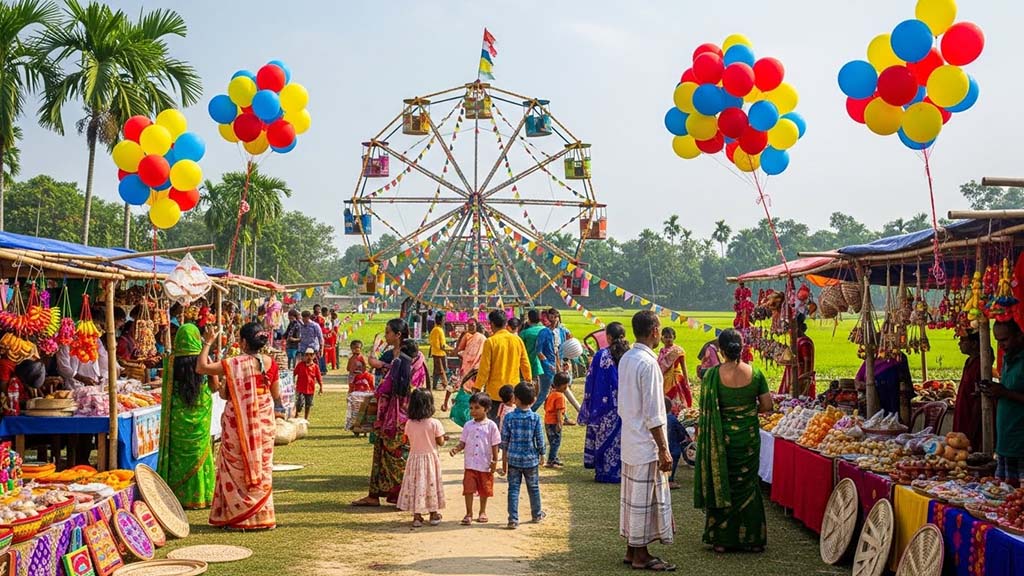
On Pohela Boishak, people celebrate by wearing traditional Bengali clothes like sarees and panjabis, particularly those with red and white colors. The festival features vibrant cultural programs, music, dance, and theatrical performances. Markets and streets are decorated with colorful designs and rangoli (decorative patterns). Pohela Boishak melas (fairs) are organized in cities and villages where people gather to enjoy traditional food, handicrafts, and cultural activities. The celebration emphasizes unity, joy, and renewal as communities welcome the new year together. This festival represents Bengali identity and cultural pride for millions of people.
Key Vocabulary:
| English Word | Bangla Meaning |
|---|---|
| Pohela Boishak | পহেলা বৈশাখ |
| Bengali calendar | বাংলা ক্যালেন্ডার |
| Bengali New Year | বাংলা নববর্ষ |
| Cultural festival | সাংস্কৃতিক উৎসব |
| Traditional clothes | ঐতিহ্যবাহী পোশাক |
| Saree | শাড়ি |
| Panjabi | পাঞ্জাবী |
| Rangoli | রঙ্গোলি |
| Mela | মেলা |
| Secular | ধর্মনিরপেক্ষ |
Pohela Boishak Paragraph for Class 7 & 8 (250 words)
Pohela Boishak represents a cultural cornerstone of Bengali civilization, marking the commencement of the Bengali calendar year on 14 April. The festival embodies syncretic traditions blending Hindu, Muslim, Buddhist, and Christian elements, creating a secular celebration that transcends religious boundaries. This multifaceted festival carries historical significance, with traditions traceable to the Mughal era when Emperor Akbar implemented the Bengali calendar for agricultural taxation purposes.
The traditional observances of Pohela Boishak encompass diverse cultural expressions. Communities celebrate by wearing traditional attire: women don embroidered sarees with red and white motifs, while men wear traditional panjabis. The festival generates elaborate street decorations, artistic installations, and decorative rangoli transforming public spaces into visual celebrations. Pohela Boishak melas function as cultural hubs where traditional music, folk performances, Jatra (traditional theater), and classical dance forms captivate audiences. Culinary traditions play a vital role: communities prepare traditional sweets like payesh and rosogolla, traditional breads, and special dishes, creating festive meals that foster community bonding.
The commercial dimensions of the festival manifest through business communities conducting traditional accounting practices, particularly in older shops. Baishakhi melas showcase traditional handicrafts, textiles, pottery, and artisan work, supporting local craftspeople and artisans. Contemporary celebrations increasingly incorporate modern performances and commercial entertainment alongside traditional elements.
Pohela Boishak’s significance extends beyond mere festive celebration. The festival reinforces Bengali cultural identity, promotes social cohesion across religious and ethnic communities, and creates collective moments of joy and renewal. The celebration affirms that despite historical divisions and geographic fragmentation, Bengalis share a unified cultural heritage worthy of collective commemoration and intergenerational transmission.
Key Vocabulary:
| English Word | Bangla Meaning |
|---|---|
| Cultural cornerstone | সাংস্কৃতিক ভিত্তিপ্রস্তর |
| Commencement | শুরু |
| Syncretic traditions | সমন্বিত ঐতিহ্য |
| Multifaceted festival | বহুমুখী উৎসব |
| Historical significance | ঐতিহাসিক গুরুত্ব |
| Traditional attire | ঐতিহ্যবাহী পোশাক |
| Street decorations | রাস্তার সাজসজ্জা |
| Jatra | যাত্রা |
| Culinary traditions | রন্ধনশৈলী ঐতিহ্য |
| Baishakhi melas | বৈশাখী মেলা |
| Handicrafts | কারুশিল্প |
| Cultural identity | সাংস্কৃতিক পরিচয় |
| Social cohesion | সামাজিক সংহতি |
Pohela Boishak Paragraph for SSC / Class 9 & 10 (350 words)
Pohela Boishak constitutes a foundational cultural institution within Bengali civilization, functioning simultaneously as calendrical marker, communal celebration, and repository of cultural memory. The festival’s historical origins intersect with Mughal administrative practices: Emperor Akbar’s implementation of the Bengali calendar (approximately 1556 CE) established a solar calendar system facilitating agricultural management and tax collection. This administrative innovation eventually transformed into a popular cultural celebration, transcending its bureaucratic origins to become emblematic of Bengali cultural identity.
The ritual dimensions of Pohela Boishak encompass multivalent observances reflecting Bengal’s religious diversity. The festival demonstrates syncretism—the integration of Hindu, Muslim, Buddhist, and Christian traditions into a unified secular celebration. This religious pluralism represents a distinctive aspect of Bengali culture, emphasizing that national celebrations can transcend theological boundaries while maintaining cultural coherence. The wearing of traditional Bengali attire, particularly red and white garments, carries symbolic significance: red traditionally represents prosperity and auspiciousness, while white symbolizes purity and new beginnings.
Urban celebrations manifest through Pohela Boishak melas featuring traditional performances, classical music, folk theater, and contemporary artistic expressions. These public gatherings create democratic spaces where diverse social groups interact freely, temporarily transcending class, caste, and religious hierarchies. The commercial dimensions—including traditional business accounting practices (particularly khata pujaon in older trading communities) and artisan markets—maintain economic dimensions of cultural practice.
Culinary traditions constitute significant cultural markers: preparation of traditional sweets, regional delicacies, and festive meals represents more than sustenance; these practices transmit intergenerational knowledge and reinforce family bonds. The gastronomic celebrations vary regionally, with distinct regional cuisines reflecting local agricultural products and cultural variations.
Contemporary Pohela Boishak celebrations face modernization pressures: commercialization, urban alienation, and globalization present challenges to traditional transmission. However, the festival’s persistence and popular enthusiasm demonstrate its resilient cultural significance. Educational institutions, cultural organizations, and community initiatives actively work to preserve and promote Pohela Boishak, ensuring the festival remains vital cultural practice rather than merely historical remembrance, thereby strengthening collective Bengali consciousness across geographic and political boundaries.
Key Vocabulary:
| English Word | Bangla Meaning |
|---|---|
| Foundational cultural institution | ভিত্তিস্থাপক সাংস্কৃতিক প্রতিষ্ঠান |
| Calendrical marker | ক্যালেন্ডার চিহ্নক |
| Communal celebration | সম্প্রদায়ের উদযাপন |
| Repository of cultural memory | সাংস্কৃতিক স্মৃতির ভাণ্ডার |
| Administrative practices | প্রশাসনিক অনুশীলন |
| Solar calendar | সৌর ক্যালেন্ডার |
| Emblematic | প্রতীকী |
| Ritual dimensions | আচার মাত্রা |
| Multivalent observances | বহুমূল্যবান পালন |
| Syncretism | সমন্বয়বাদ |
| Religious pluralism | ধর্মীয় বৈচিত্র্য |
| Auspiciousness | শুভলক্ষণ |
| Democratic spaces | গণতান্ত্রিক স্থান |
| Khata pujaon | খাতা পূজন |
| Intergenerational knowledge | প্রজন্মান্তর জ্ঞান |
| Gastronomic celebrations | রন্ধনসম্পর্কীয় উদযাপন |
| Modernization pressures | আধুনিকীকরণ চাপ |
| Intangible heritage | অদৃশ্য ঐতিহ্য |
Pohela Boishak Paragraph for HSC / Class 11 & 12 (450 words)
Pohela Boishak embodies a complex cultural phenomenon operating across multiple registers: temporal consciousness, communal identity formation, political symbolism, and contested negotiations between tradition and modernity. The festival’s genealogy intersects with pre-Islamic Bengali kingdoms, Islamic administrative innovations, and colonial modernization, generating a palimpsestic cultural text wherein successive historical layers accumulate without complete effacement. Emperor Akbar’s Bengali calendar implementation, ostensibly a utilitarian administrative reform, eventually transformed into a powerful cultural symbol, demonstrating how institutional practices acquire affective dimensions and become sacred within popular consciousness.
The phenomenological dimensions of Pohela Boishak reveal how collective celebrations construct imagined communities transcending geographic fragmentation and political divisions. The festival’s secular character—embracing Hindu, Muslim, Buddhist, and Christian observances without privileging any theological framework—represents a distinctive Bengali philosophical orientation rejecting both communal essentialism and assimilationist homogenization. This syncretic vision challenges monolithic nationalism, proposing instead that cultural identity can accommodate religious plurality while maintaining coherent meaning.
Semiotic analysis reveals rich symbolic systems embedded within Pohela Boishak observances. The red and white color symbolism carries deep cultural resonance: red signifies auspiciousness, fertility, and vital energy, while white represents purity, renewal, and new beginnings. Traditional attire, particularly embroidered garments featuring regional motifs, function as cultural texts encoding geographic identity and artisanal heritage. The wearing of traditional dress constitutes embodied performance of cultural identity, literally inscribing Bengali consciousness onto bodies moving through public spaces.
Contemporary Pohela Boishak celebrations reveal tensions between commodification and cultural authenticity. The festival’s commercialization—through melas featuring mass-produced goods, corporate sponsorships, and entertainment industries—creates paradoxes: commercialization simultaneously democratizes access to celebrations while diluting traditional meanings. Critical analysis must acknowledge these ambivalences rather than romanticizing either traditional authenticity or dismissing celebrations as merely commodified spectacle.
Digital transformation introduces novel performative dimensions: social media platforms enable transnational participation, allowing diaspora communities to celebrate Pohela Boishak across geographic boundaries, creating virtual collective spaces. Yet digital mediation simultaneously introduces algorithmic curation, commercial filtering, and decontextualization risks.
Postcolonial scholarship examines how Pohela Boishak functions in postindependence nationalism, particularly regarding Bangladesh’s distinct national identity differentiation from Pakistan and India. The festival’s appropriation by nationalist discourses demonstrates how cultural symbols become political resources, yet also reveals grassroots agency wherein communities maintain celebrations independent of state instrumentalization.
Ultimately, Pohela Boishak persists not through static preservation but through dynamic adaptation, wherein communities negotiate between inherited traditions and contemporary realities, continuously reproducing the festival as living practice embodying Bengali cultural consciousness and collective aspirations.
Key Vocabulary:
| English Word | Bangla Meaning |
|---|---|
| Complex cultural phenomenon | জটিল সাংস্কৃতিক ঘটনা |
| Multiple registers | একাধিক স্তর |
| Temporal consciousness | সময়গত সচেতনতা |
| Communal identity formation | সম্প্রদায়গত পরিচয় গঠন |
| Political symbolism | রাজনৈতিক প্রতীকবাদ |
| Genealogy | বংশধারা |
| Palimpsestic cultural text | পুনর্লেখিত সাংস্কৃতিক পাঠ্য |
| Utilitarian | ব্যবহারিক |
| Phenomenological dimensions | ঘটনাবিষয়ক মাত্রা |
| Imagined communities | কল্পিত সম্প্রদায় |
| Secular character | ধর্মনিরপেক্ষ বৈশিষ্ট্য |
| Theological framework | দেবতত্ত্ব কাঠামো |
| Communal essentialism | সম্প্রদায়গত সারবত্তা |
| Semiotic analysis | সংকেত বিশ্লেষণ |
| Embodied performance | মূর্তিমান পরিবেশনা |
| Commodification | পণ্যকরণ |
| Transnational participation | আন্তর্জাতিক অংশগ্রহণ |
| Diaspora communities | প্রবাসী সম্প্রদায় |
| Algorithmic curation | অ্যালগরিদম নির্বাচন |
| Postcolonial scholarship | উত্তর-ঔপনিবেশিক বৃত্তান্ত |
| Grassroots agency | তৃণমূল প্রভাব |
| Dynamic adaptation | গতিশীল অভিযোজন |
Exam-Style FAQs on Pohela Boishak Paragraph
Q1: When is Pohela Boishak celebrated, and why is this date significant?
Answer: Pohela Boishak is celebrated on 14 April every year, marking the first day of the Bengali calendar. The date is significant because it represents the commencement of the Bengali New Year, marking the beginning of the Boishak month, and carries historical origins tracing to Emperor Akbar’s implementation of the Bengali calendar system.
Q2: What is the historical origin of Pohela Boishak, and how did it become a cultural celebration?
Answer: Emperor Akbar implemented the Bengali calendar (approximately 1556 CE) as an administrative tool for agricultural management and tax collection. What began as a bureaucratic practice gradually transformed into a popular cultural festival, eventually becoming emblematic of Bengali cultural identity and collective consciousness.
Q3: Why is Pohela Boishak considered a secular festival despite Bangladesh’s religious diversity?
Answer: Pohela Boishak is secular because it is celebrated by Hindus, Muslims, Buddhists, and Christians without privileging any particular religious theology. The festival embodies syncretism—the integration of diverse religious traditions into a unified celebration emphasizing shared cultural heritage over theological boundaries, demonstrating Bengali culture’s distinctive capacity for religious pluralism.
Q4: Describe the traditional attire worn during Pohela Boishak celebrations and explain their symbolic significance.
Answer: Women wear embroidered sarees with red and white motifs, while men wear traditional panjabis. Red symbolizes prosperity and auspiciousness, while white represents purity and new beginnings. This traditional dress constitutes embodied performance of cultural identity, inscribing Bengali consciousness onto bodies moving through public spaces.
Q5: What are Pohela Boishak melas, and what cultural functions do they serve?
Answer: Pohela Boishak melas (fairs) are public gatherings featuring traditional performances, classical music, folk theater, traditional food, and artisan handicrafts. These melas function as cultural hubs creating democratic spaces where diverse social groups interact, temporarily transcending class, caste, and religious hierarchies, while supporting local craftspeople and artisans.
Q6: What culinary traditions are associated with Pohela Boishak, and why are they culturally significant?
Answer: Pohela Boishak celebrations involve preparing traditional sweets like payesh and rosogolla, traditional breads, and special regional dishes. These culinary traditions are significant because they transmit intergenerational knowledge, reinforce family bonds, and vary regionally, reflecting local agricultural products and cultural variations across Bengal.
Q7: How does commercialization affect Pohela Boishak celebrations, and what are the paradoxes this creates?
Answer: Commercialization through mass-produced goods, corporate sponsorships, and entertainment industries simultaneously democratizes access to celebrations while potentially diluting traditional meanings. This creates paradoxes: commercialization makes celebrations more accessible to broader populations yet may reduce authentic cultural transmission through overcommercialization and decontextualization.
Q8: What symbolic significance do red and white colors carry in Pohela Boishak traditions?
Answer: Red signifies auspiciousness, fertility, and vital energy, representing prosperity and good fortune. White represents purity, renewal, and new beginnings, symbolizing the fresh start that the Bengali New Year represents. Together, these colors embody the festival’s essence of joy, renewal, and hopeful transformation.
Q9: How does digital technology transform Pohela Boishak celebrations, particularly for diaspora communities?
Answer: Social media platforms enable transnational participation, allowing diaspora communities to celebrate Pohela Boishak across geographic boundaries, creating virtual collective spaces that transcend physical distances. However, digital mediation introduces algorithmic curation, commercial filtering, and decontextualization risks that may affect authentic cultural transmission.
Q10: How has Pohela Boishak been appropriated in postcolonial nationalism, particularly in Bangladesh?
Answer: Pohela Boishak has been appropriated by nationalist discourses to assert Bengali cultural distinctiveness separate from Pakistan and India. The festival functions as a political symbol for national identity, yet grassroots communities maintain independent celebrations, demonstrating agency and preventing complete state instrumentalization of this cultural symbol.