


Poem: “Time, You Old Gipsy Man”
Poet: Ralph Hodgson
Textbook: English for Today
Unit: 11
Lesson: 4
For: Class 9, Class 10 & SSC
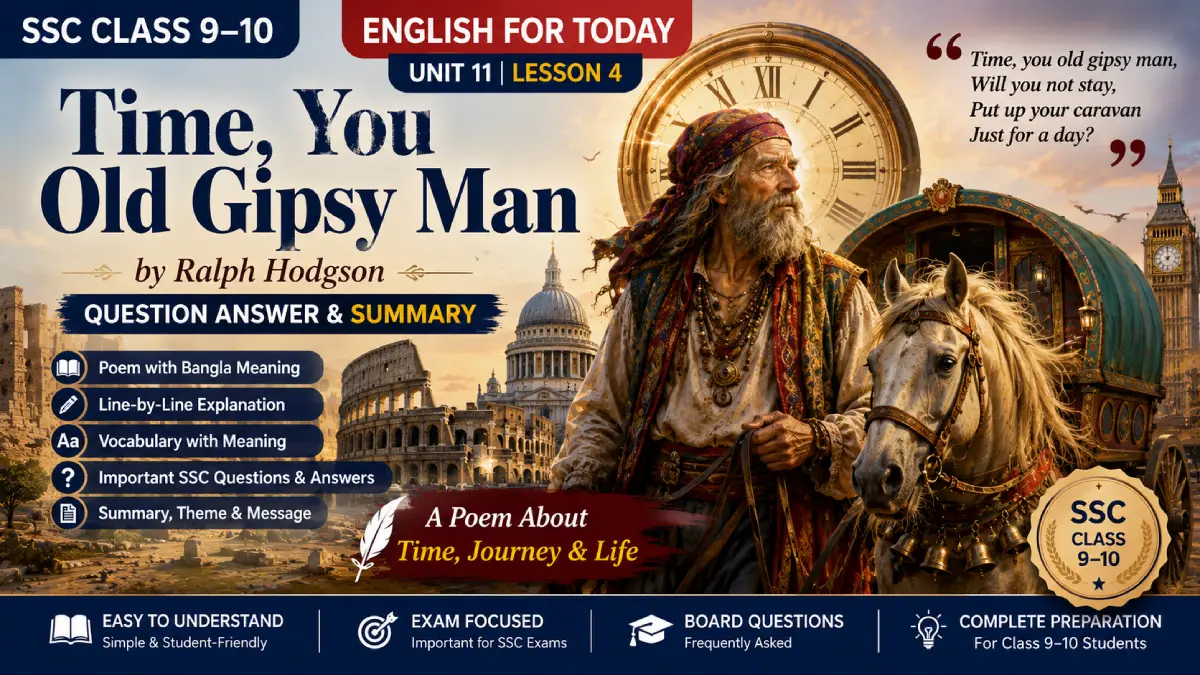
“Time, You Old Gipsy Man” by Ralph Hodgson is a thoughtful poem about the fast, continuous, and unstoppable movement of time. The poet imagines Time as an old wandering gipsy man who travels from place to place without stopping. The speaker asks Time to stay for just one day and offers many valuable gifts, but Time keeps moving. By referring to Babylon, Rome, modern London, and future cities, the poem shows that nothing can stop time and even great civilizations cannot escape its power. The poem teaches us to value every moment of life because time never waits for anyone.
The Poem: “Time, You Old Gipsy Man”
Time, You Old Gipsy Man
by Ralph Hodgson
Time, you old gipsy man,
Will you not stay,
Put up your caravan
Just for a day?
All things I’ll give you,
Will you be my guest?
Bells for your jennet
Of silver the best,
Goldsmiths shall beat you
A great golden ring,
Peacocks shall bow to you,
Little boys sing,
Oh, and sweet girls will
Festoon you with May.
Time, you old gipsy,
Why hasten away?
Last week in Babylon,
Last night in Rome,
Morning, and in the crush
Under Paul’s dome;
Under Paul’s dial
You tighten your rein—
Only a moment,
And off once again;
Off to some city
Now blind in the womb,
Off to another
Ere that’s in the tomb.
Time, you old gipsy man,
Will you not stay,
Put up your caravan
Just for a day?
“Time, You Old Gipsy Man” কবিতার বাংলা অর্থ
Time, you old gipsy man,
হে সময়, তুমি এক বৃদ্ধ যাযাবর।
Will you not stay,
তুমি কি একটু থামবে না?
Put up your caravan
তোমার কাফেলা কি এখানে থামাবে না,
Just for a day?
শুধু একটি দিনের জন্য?
All things I’ll give you,
আমি তোমাকে সবকিছু দেব,
Will you be my guest?
তুমি কি আমার অতিথি হবে?
Bells for your jennet
তোমার ঘোড়াটির জন্য ঘণ্টা দেব,
Of silver the best,
সেরা রূপার তৈরি ঘণ্টা।
Goldsmiths shall beat you
স্বর্ণকারেরা তোমার জন্য তৈরি করবে
A great golden ring,
একটি বড় সোনার আংটি।
Peacocks shall bow to you,
ময়ূররা তোমার সামনে মাথা নত করবে,
Little boys sing,
ছোট ছেলেরা গান গাইবে,
Oh, and sweet girls will
আর মিষ্টি মেয়েরা
Festoon you with May.
বসন্তের মে ফুল দিয়ে তোমাকে সাজিয়ে দেবে।
Time, you old gipsy,
হে সময়, তুমি এক বৃদ্ধ যাযাবর,
Why hasten away?
তুমি এত দ্রুত কেন চলে যাচ্ছ?
Last week in Babylon,
গত সপ্তাহে তুমি ছিলে প্রাচীন ব্যাবিলনে,
Last night in Rome,
গত রাতে ছিলে রোমে,
Morning, and in the crush
আজ সকালে তুমি ছিলে প্রচণ্ড ভিড়ের মধ্যে,
Under Paul’s dome;
সেন্ট পলের গম্বুজের নিচে।
Under Paul’s dial
সেন্ট পলের ঘড়ির নিচে
You tighten your rein—
তুমি ঘোড়ার লাগাম টেনে ধরো,
Only a moment,
শুধু একটি মুহূর্তের জন্য,
And off once again;
তারপর আবার ছুটে চলে যাও।
Off to some city
তুমি ছুটে যাও এমন কোনো শহরের দিকে,
Now blind in the womb,
যা এখনও ভবিষ্যতের গর্ভে জন্ম নেয়নি,
Off to another
আর ছুটে যাও অন্য একটি শহরের দিকে,
Ere that’s in the tomb.
যা কালের গর্ভে ধ্বংস হয়ে যাওয়ার আগ পর্যন্ত।
Time, you old gipsy man,
হে সময়, তুমি এক বৃদ্ধ যাযাবর,
Will you not stay,
তুমি কি একটু থামবে না?
Put up your caravan
তোমার কাফেলা কি থামাবে না,
Just for a day?
শুধু একটি দিনের জন্য?
Vocabulary & Key Terms
| Word / Phrase | Easy English Meaning | বাংলা অর্থ |
|---|---|---|
| Gipsy man | A wandering person who does not stay in one place | ভবঘুরে যাযাবর ব্যক্তি |
| Caravan | A vehicle or wagon used by travelling people | যাযাবরদের কাফেলা / ভ্রাম্যমাণ গাড়ি |
| Jennet | A small riding horse | ছোট জাতের ঘোড়া |
| Goldsmiths | People who make gold jewellery | স্বর্ণকার |
| Peacocks | Large birds with beautiful feathers | ময়ূর |
| Festoon | Decorate with flowers or other things | ফুল বা মালা দিয়ে সাজানো |
| May | Spring flowers, especially hawthorn | মে মাসের ফুল |
| Hasten | Move or go quickly | দ্রুত ছুটে চলা / তাড়াহুড়ো করা |
| Babylon | An ancient city and civilization | প্রাচীন ব্যাবিলন নগরী ও সভ্যতা |
| Rome | An ancient and powerful city of the Roman Empire | প্রাচীন রোম নগরী ও সভ্যতা |
| Crush | A very crowded or busy place | প্রচণ্ড ভিড় |
| Paul’s dome | The dome of St. Paul’s Cathedral | সেন্ট পলের গির্জার গম্বুজ |
| Paul’s dial | The clock or clock face at St. Paul’s | সেন্ট পলের ঘড়ি |
| Tighten your rein | Pull the reins and slow down briefly | লাগাম টেনে সাময়িকভাবে থামা |
| Blind in the womb | Not yet born or created | এখনও জন্ম না নেওয়া / ভবিষ্যতের |
| Ere | Before | পূর্বে / আগে |
| In the tomb | Destroyed or buried by time | ধ্বংসপ্রাপ্ত / কালের গর্ভে বিলীন |
Short Summary of “Time, You Old Gipsy Man”
“Time, You Old Gipsy Man” is about the unstoppable movement of time. The poet imagines Time as an old gipsy man travelling with a caravan. He asks Time to stop for only one day and offers many valuable gifts, such as silver bells, a golden ring, songs, and flowers. But Time does not stop.
The poet says that Time has already travelled through Babylon, Rome, and London and continues towards future cities. Some cities are not yet born, while others will eventually disappear into the tomb of time. The poem shows that no person, wealth, city, or civilization can stop time.
বাংলা সারসংক্ষেপ
‘Time, You Old Gipsy Man’ কবিতায় কবি সময়ের দ্রুত ও অপ্রতিরোধ্য গতির কথা বলেছেন। তিনি সময়কে একজন বৃদ্ধ যাযাবরের সঙ্গে তুলনা করেছেন, যে তার কাফেলা নিয়ে এক জায়গা থেকে আরেক জায়গায় ছুটে চলে।
কবি সময়কে মাত্র এক দিনের জন্য থামতে বলেন এবং রূপার ঘণ্টা, সোনার আংটি, ফুল, গান ও নানা সম্মান দেওয়ার প্রস্তাব দেন। কিন্তু সময় কোনো উপহার বা অনুরোধে থামে না।
সময় ব্যাবিলন, রোম ও আধুনিক শহর অতিক্রম করে ভবিষ্যতের শহরের দিকে ছুটে যায়। কবিতাটি শেখায় যে সময়কে থামানো যায় না এবং কোনো শক্তি বা সম্পদ সময়ের গতিকে নিয়ন্ত্রণ করতে পারে না।
Time, You Old Gipsy Man SSC Question Answer
These questions combine your supplied questions with recent SSC board-question patterns. In the 2026 board-question material, questions specifically appeared on why Time is called an “old gipsy man,” what the poet offers Time, the caravan metaphor, personification, Time as a traveller, and how the poet addresses Time.
The answers below are rewritten in very easy English so students can understand them quickly and learn them after reading them once or twice.
⭐⭐⭐ Most Important Questions
1. What is the main theme of the poem “Time, You Old Gipsy Man”?
Answer: The main theme is the unstoppable movement of time. The poem shows that no person, wealth, or power can stop time.
2. Why does the poet compare Time to an “Old Gipsy Man”?
Answer: A gipsy is a traveller who moves from place to place. In the same way, Time never stays in one place and always moves forward.
3. What request does the poet make to Time?
Answer: The poet asks Time to stop its journey and stay for just one day.
4. What things will the poet offer Time if it stays for a day?
Answer: He offers the best silver bells, a great golden ring, songs by little boys, bows from peacocks, and May flowers from sweet girls.
5. Why can Time not stay despite the poet’s offers?
Answer: Time cannot stay because it always moves forward and never waits for anyone.
6. What does “put up your caravan” mean?
Answer: It means stop your journey and stay in one place for some time.
7. What does “tighten your rein” mean in the poem?
Answer: It means pull the horse’s reins and slow down or stop briefly.
8. How does the poet portray Time as a traveller?
Answer: The poet portrays Time as an old, restless traveller who moves from one place to another without stopping.
9. How does the poet personify Time?
Answer: He gives Time human qualities and presents it as an old gipsy man travelling with a caravan and a horse.
10. What message does the poem convey about human helplessness before Time?
Answer: It shows that humans are powerless to stop or control time, no matter how rich or powerful they are.
⭐⭐ Important Questions
11. What is the significance of the “caravan” in the poem?
Answer: The caravan represents Time’s continuous journey from one place and age to another.
12. What is the significance of Babylon and Rome in the poem?
Answer: Babylon and Rome were great ancient civilizations, but they could not escape time. Their mention shows that even powerful civilizations are destroyed by time.
13. What do “cities blind in the womb” represent?
Answer: They represent future cities that have not yet been built or born.
14. What does “a city in the tomb” represent?
Answer: It represents a city or civilization that has already been destroyed by time.
15. What does “Time, you old gipsy, / Why hasten away?” mean?
Answer: The poet asks why Time moves away so quickly without allowing people to enjoy the present for longer.
16. Why does the poet describe Time as “old”?
Answer: Time is called old because it has existed for a very long time and has passed through countless generations and civilizations.
17. How does the poet plan to honor Time if it becomes his guest?
Answer: He plans to honor Time with valuable gifts, music, flowers, and respect.
18. What does “festoon you with May” mean?
Answer: It means decorate Time with beautiful spring flowers.
19. What happens under Paul’s dome?
Answer: Time briefly passes through the busy crowd under St. Paul’s dome in London.
20. What happens under Paul’s dial?
Answer: Time briefly slows down by tightening the reins, but then it quickly moves forward again.
21. Why does the poet repeat the opening lines at the end?
Answer: The repetition shows the poet’s strong desire and desperate wish to make Time stop.
22. What does the poem teach us about life?
Answer: It teaches us to value every moment because time never stops or returns.
Additional Practice Questions
23. What does “All things I’ll give you, / Will you be my guest?” mean?
Answer: The poet is ready to offer valuable things to Time if it agrees to stay for one day.
24. What will the goldsmiths make for Time?
Answer: The goldsmiths will make a great golden ring for Time.
25. What will the jennet receive from the poet?
Answer: The jennet will receive the best silver bells.
26. What will the peacocks do for Time?
Answer: The peacocks will bow to Time.
27. What will the little boys do for Time?
Answer: The little boys will sing for Time.
28. What will the sweet girls do for Time?
Answer: The sweet girls will decorate Time with May flowers.
29. Which places are mentioned in the journey of Time?
Answer: The poem mentions Babylon, Rome, St. Paul’s in London, and future cities.
30. What does “crush” mean in the poem?
Answer: “Crush” means a large and busy crowd of people.
31. What is the significance of the “great golden ring”?
Answer: It represents great wealth and the valuable things people are willing to offer to keep Time.
32. Why does Time ignore the poet’s offers?
Answer: Time ignores them because it cannot stop its natural movement.
33. How does the poem show that nothing is permanent?
Answer: The poem shows that cities and civilizations rise, change, and finally disappear with time.
34. What mood is created by the images of ancient and future cities?
Answer: They create a thoughtful and serious mood about the passing of time and the temporary nature of life.
35. What tone does the speaker use while addressing Time?
Answer: The speaker uses an emotional, pleading, respectful, and slightly sad tone.
36. How does the poem reflect the speaker’s feelings about life?
Answer: It shows that the speaker knows life is short and wants to enjoy precious moments before they disappear.
37. What lesson can readers learn from the poem?
Answer: Readers should use their time wisely because every moment passes and never comes back.
38. How would you explain “Time” as a “gipsy man” in one sentence?
Answer: Time is like a gipsy man because it travels endlessly and never stays in one place.
Detailed Summary of “Time, You Old Gipsy Man”
Time as a Gipsy Man
The poet begins by addressing Time as an “old gipsy man.” A gipsy is a wandering person who does not remain permanently in one place. The poet uses this image because Time also keeps travelling.
The Poet’s Request
The poet asks Time to stop and put up its caravan for only one day. He wants to enjoy the present moment a little longer.
The Gifts Offered to Time
The poet offers many beautiful gifts to persuade Time. These include silver bells for its horse, a great golden ring, peacocks bowing before it, songs by boys, and flowers from young girls.
These gifts represent the beauty, wealth, honour, and pleasure of human life.
Time Refuses to Stop
Time does not accept the offer. It continues its journey. The poet sadly asks:
“Time, you old gipsy, / Why hasten away?”
The question reflects the universal human desire to slow down time.
Time Travels Through History
The poet mentions Babylon and Rome, two great ancient civilizations. He shows that Time has already passed through them.
This suggests that even the most powerful civilizations cannot escape the effects of Time.
Modern London and Paul’s Clock
Time reaches the busy area under St. Paul’s dome and dial. It seems to slow down for only a moment by tightening its reins.
But the pause is extremely brief.
Future and Past
Time then moves toward future cities that have not yet been built. It also moves toward cities that will eventually disappear into the “tomb.”
This presents time as a force that connects the past, present, and future.
Final Plea
At the end, the poet repeats his opening request:
“Will you not stay, / Put up your caravan / Just for a day?”
The repetition shows that although people deeply wish to hold onto time, Time never stops for anyone.
Structure of the Poem
| Part | Main Idea |
|---|---|
| Opening Appeal | The poet asks Time to stay for one day. |
| The Gifts | He offers silver, gold, songs, and flowers. |
| Time’s Journey | Time continues moving from place to place. |
| Historical Cities | Babylon and Rome show the power of Time over civilizations. |
| Modern City | Time briefly passes through St. Paul’s in London. |
| Future Cities | Time travels toward cities not yet born. |
| Cities in the Tomb | Time will eventually destroy present civilizations. |
| Final Appeal | The poet again asks Time to stop. |
The poem moves from:
Request → Gifts → Refusal → Journey → History → Future → Final Plea
Main Theme of “Time, You Old Gipsy Man”
English Theme
The main theme of “Time, You Old Gipsy Man” is the swift and unstoppable movement of time.
The poet presents Time as an old wandering gipsy who never stops. The speaker offers valuable gifts, but Time cannot be persuaded to stay.
The references to Babylon and Rome show that even great civilizations cannot escape Time. The poem therefore reminds us that nothing is permanent and every moment is valuable.
মূলভাব
কবিতাটির মূলভাব হলো সময়ের দ্রুত, চিরন্তন ও অপ্রতিরোধ্য গতি। কবি সময়কে একজন বৃদ্ধ যাযাবরের সঙ্গে তুলনা করেছেন, যে কখনো এক জায়গায় স্থির থাকে না।
মানুষ সোনা, রূপা, ফুল, গান ও নানা উপহার দিয়ে সময়কে থামাতে চাইলেও তা সম্ভব নয়। ব্যাবিলন ও রোমের মতো শক্তিশালী সভ্যতাও সময়ের কাছে টিকে থাকতে পারেনি। তাই আমাদের প্রতিটি মুহূর্তকে মূল্য দিতে হবে।
Line-by-Line Explanation of “Time, You Old Gipsy Man”
“Time, you old gipsy man”
The poet directly addresses Time as an old wandering man.
Easy idea: Time is always travelling like a gipsy.
“Will you not stay”
The poet asks Time to stop.
Easy idea: He wants Time to slow down.
“Put up your caravan / Just for a day?”
He asks Time to stop its caravan for one day.
Easy idea: He wants Time to stay for only one day.
“All things I’ll give you, / Will you be my guest?”
The poet promises valuable gifts.
Easy idea: He is ready to offer anything to make Time stay.
“Bells for your jennet / Of silver the best”
He offers the best silver bells for Time’s horse.
Easy idea: He offers a valuable gift for the horse.
“Goldsmiths shall beat you / A great golden ring”
He promises a beautiful golden ring.
Easy idea: He offers gold to persuade Time.
“Peacocks shall bow to you”
The peacocks will show respect to Time.
Easy idea: Time will receive honour.
“Little boys sing”
Young boys will sing for Time.
Easy idea: Time will be welcomed with music.
“Sweet girls will / Festoon you with May”
Girls will decorate Time with spring flowers.
Easy idea: Time will be welcomed beautifully.
“Time, you old gipsy, / Why hasten away?”
The poet asks why Time moves so quickly.
Easy idea: He is sad that time passes so fast.
“Last week in Babylon, / Last night in Rome”
Time has passed through great ancient civilizations.
Easy idea: Time has already travelled through history.
“Morning, and in the crush / Under Paul’s dome”
Now Time has reached busy London.
Easy idea: Time moves from ancient places to modern cities.
“Under Paul’s dial / You tighten your rein”
Time slows down briefly under the clock.
Easy idea: Time seems to pause for only a moment.
“Only a moment, / And off once again”
The pause does not last.
Easy idea: Time quickly starts moving again.
“Off to some city / Now blind in the womb”
Time moves toward a future city that has not yet been created.
Easy idea: Time travels into the future.
“Off to another / Ere that’s in the tomb”
Time also moves toward cities that will eventually be destroyed.
Easy idea: Time brings both creation and destruction.
“Time, you old gipsy man, / Will you not stay”
The poet repeats his request.
Easy idea: Humans always wish time would stop.
“Put up your caravan / Just for a day?”
The poet ends with the same desperate plea.
Easy idea: Time never stops, even when people deeply wish it would.
Important Literary Devices in “Time, You Old Gipsy Man”
Personification
The poet gives Time human qualities.
Time:
- travels,
- rides a horse,
- has a caravan,
- tightens its reins,
- can be invited as a guest.
Easy idea: Time is presented like a real travelling man.
Metaphor
Time is directly presented as an “old gipsy man.”
The caravan represents the continuous journey of Time.
Repetition
The opening and closing lines are repeated:
“Time, you old gipsy man”
and
“Will you not stay, / Put up your caravan / Just for a day?”
This emphasizes the speaker’s strong desire to stop Time.
Historical Allusion
The poem refers to:
- Babylon
- Rome
- St. Paul’s
These places help show Time’s journey through history.
Imagery
The poem creates vivid pictures through:
- Silver bells
- Golden ring
- Peacocks
- May flowers
- Caravan
- Ancient cities
- Busy London
Contrast
The poem contrasts:
Past → Present → Future
It also contrasts human wishes with the unstoppable movement of Time.
Tone of “Time, You Old Gipsy Man”
The tone of the poem is mainly:
- Pleading
- Reflective
- Melancholic
- Thoughtful
- Admiring
Exam-ready answer: The tone is pleading and reflective, with a touch of sadness because the speaker wants Time to stay but knows it will not.
Message of “Time, You Old Gipsy Man”
The poem teaches that time never stops or waits for anyone.
No amount of money, beauty, power, honour, or pleading can stop it. Great civilizations also rise and disappear with time.
Therefore, we should value the present moment and use our time wisely.
Quick Revision Notes
| Topic | Easy Answer |
|---|---|
| Poet | Ralph Hodgson |
| Main theme | Unstoppable movement of time |
| Time is compared to | An old gipsy man |
| Gipsy | A wandering traveller |
| Caravan | Symbol of Time’s continuous journey |
| Jennet | Time’s small horse |
| Silver bells | Gift for the jennet |
| Golden ring | Gift for Time |
| Babylon | Ancient civilization |
| Rome | Ancient powerful city |
| Paul’s dome | St. Paul’s Cathedral |
| Paul’s dial | St. Paul’s clock |
| Blind in the womb | Future city not yet created |
| In the tomb | City destroyed by time |
| Personification | Time is shown as a travelling man |
| Main lesson | Value every moment because time never stops |
Frequently Asked Questions
Who wrote “Time, You Old Gipsy Man”?
Answer: Ralph Hodgson wrote the poem.
Why is Time called an “old gipsy man”?
Answer: Because Time travels continuously like a wandering gipsy and never stays in one place.
What does “put up your caravan” mean?
Answer: It means stop travelling and stay in one place.
What does the poet offer Time?
Answer: He offers silver bells, a golden ring, music, peacock bows, and May flowers.
What does “tighten your rein” mean?
Answer: It means slow down or stop the horse for a short time.
Why are Babylon and Rome mentioned?
Answer: They show that even great civilizations could not escape the power of Time.
What are “cities blind in the womb”?
Answer: They are future cities that have not yet been built.
What does “in the tomb” mean?
Answer: It means destroyed or buried by time.
What is the main message of the poem?
Answer: The poem teaches us to value every moment because Time never stops.
What literary device is mainly used to describe Time?
Answer: The poet mainly uses personification by presenting Time as an old travelling gipsy man.
🔗 Explore More for Preparation
📚 পরীক্ষার জন্য আরও প্রস্তুতি নাও