

Comilla Board 2026 | SSC English 1st Paper Question with Answer| Full Solution
Here is the complete Comilla Board SSC English 1st Paper Question with Answer 2026 Paper with full answers written naturally.
According to Syllabus 2026 Subject Code: 107 | Time: 3 Hours | Full Marks: 100
PART A — READING TEST
Marks: 70
Read the following passage carefully and answer questions 1, 2 and 3:
Meherjan lives in a slum on the Sirajgonj Town Protection Embankment. The whispering wind from the river Jamuna makes the fire unsteady. The dancing flames remind Meherjan of the turmoil in her life.
Not long ago Meherjan had everything — a family, arable land and cattle. The erosion of Jamuna gradually consumed all her land property. It finally claimed her only shelter during the last monsoon. It took the river only a day to devour Meher’s house, trees, vegetable garden and the bamboo bush. She had a happy family once. Over the years, she lost her husband and her family to diseases that cruel hunger and poverty brought to her family. Now, she is the only one left to live on with her loss and the pain. The greedy Jamuna has shattered her dreams and happiness.
There are thousand others waiting to share the same fate like Meherjan. Bangladesh is a land of rivers, some of whose banks overflow or erode during monsoon. Erosion is a harsh reality for the people living along the river banks. During each monsoon many more villages are threatened by the mighty rivers like the Jamuna, the Padma and the Meghna. It is estimated that river erosion makes at least 1,00,000 people homeless every year in Bangladesh. In fact, river erosion is one of the main dangers caused by climate change. If we can’t take prompt action to adapt to climate change, there will be thousands of more Meherjans in our towns and villages every year.
Question 1: Choose the correct answer from the alternatives given. (1×7=7)
(a) There is/are ——— in Meherjan’s family. (i) many members (ii) a few members (iii) one member (iv) few members
Answer: (iii) one member
(b) ——— has made Meherjan’s life miserable. (i) old age (ii) sickness (iii) frustration (iv) river erosion
Answer: (iv) river erosion
(c) All her land property ——— gradually by the erosion of Jamuna. (i) consumed (ii) was consumed (iii) consumes (iv) is consumed
Answer: (ii) was consumed
(d) The people who live by the side of the river lead a very ——— life. (i) happy (ii) anxious (iii) nice (iv) luxurious
Answer: (ii) anxious
(e) The word ‘tremble’ mentioned in the passage means ———. (i) steady (ii) stable (iii) throb (iv) vibrate
Answer: (iv) vibrate
(f) Which is the figure related to the homeless people in Bangladesh every year? (i) 10,00,000 (ii) 1,000 (iii) 10,000 (iv) 1,00,000
Answer: (iv) 1,00,000
(g) What is the main purpose of the author of the passage? (i) To explain the importance of big rivers (ii) To describe the impact of river erosion (iii) To depict the impact of the monsoon (iv) To describe the destiny of a woman
Answer: (ii) To describe the impact of river erosion
Question 2: Answer the following questions in your own words. (2×5=10)
(a) What do you know about the early life of Meherjan?
In her early life, Meherjan was a happy woman. She had a family, arable land and cattle. She lived peacefully before the river Jamuna gradually eroded everything she owned and destroyed her life.
(b) What does Meherjan use to make fire for cooking foods?
Meherjan uses bamboo and other available materials found near the embankment slum to make fire for cooking. The passage mentions “dancing flames” near which she sits, suggesting she cooks over an open fire on the embankment.
(c) Why is the phrase ‘greedy Jamuna’ used to describe the river?
The phrase ‘greedy Jamuna’ is used because the river greedily devoured everything Meherjan owned — her house, land, trees, vegetable garden and bamboo bush — just like a greedy person who takes everything and leaves nothing for others.
(d) In which season is the river erosion most likely to occur?
River erosion is most likely to occur during the monsoon season. The passage says that during each monsoon, many villages are threatened by mighty rivers like the Jamuna, the Padma and the Meghna, whose banks overflow and erode.
(e) What is the central idea of the passage?
The central idea of the passage is the devastating impact of river erosion on the lives of the people of Bangladesh. Using Meherjan’s tragic story, the author shows how erosion destroys homes, land, families and dreams, and warns that thousands more will suffer if climate change is not addressed promptly.
Question 3: Fill in each gap with a suitable word based on the passage. (1×5=5)
River erosion is still posing (a) ——— to the lives and properties of thousands of people (b) ——— close to the rivers. They are most (c) ——— the worst victims of river erosion. Each year about one lac people (d) ——— homeless for river erosion in Bangladesh. Meherjan’s life is just one (e) ———.
Answer: (a) threat/danger (b) residing/living (c) likely/often (d) become (e) example
Read the passage carefully and answer questions 4 and 5:
Bangladesh is blessed with huge inland open water resources. It has numerous rivers, canals, beels, lakes and vast areas of flood plains. Hakaluki Haor is one of the major wetlands of Bangladesh. With a land area of 18,386 hectares, it supports a rich biodiversity and provides direct and indirect livelihood benefits to nearly 1,90,000 people. This haor was declared an ecologically critical area in April 1999 by the Government of Bangladesh. Hakaluki is a complex ecosystem, containing more than 238 interconnecting beels and jalmahals. The haor falls into two administrative districts — Maulovibazar and Sylhet. Some 1,90,000 people live in the area surrounding the haor.
The haor is a very important resting place of migratory water-fowls flying in from the north. The interesting species is the Barheaded Goose which is now hardly seen in fresh water wetlands. Hakaluki Haor is known as a good grazing land in winter. The haor had very dense swamp forests in the past, but deforestation and lack of conservation practices have virtually destroyed this unique forest in the last two decades.
Question 4: Complete the table below with information from the above passage. (1×5=5)
About Hakaluki Haor
| Who/What | Event/Activity | Speciality/area | Place/time |
|---|---|---|---|
| Hakaluki Haor | is a major water land | with an area of (i) 18,386 hectares | in Bangladesh |
| The haor | was declared | Ecologically critical area | (ii) in April 1999 |
| It | falls | into two districts | (iii) Maulovibazar and Sylhet |
| (iv) The Barheaded Goose | is seen | which is the most interesting water fowl | in fresh water |
| The haor | (v) is known | as good grazing land | in winter |
Question 5: Write a summary of the above passage in your own words. (10)
Answer:
Bangladesh has a large number of water resources including rivers, canals, beels and lakes. Among its wetlands, Hakaluki Haor is one of the most important. It covers an area of 18,386 hectares and provides livelihoods to nearly 1,90,000 people. Because of its ecological importance, the government declared it an ecologically critical area in 1999. It falls under the districts of Maulovibazar and Sylhet and contains more than 238 beels and jalmahals. The haor is a resting place for migratory birds, especially the rare Barheaded Goose. In winter it serves as grazing land. However, the haor’s dense swamp forests have been largely destroyed due to deforestation and lack of conservation. Proper steps must be taken to protect this precious ecosystem.
Question 6: Match the parts of sentences given in Column A, B and C to write five complete sentences. (1×5=5)
Answer:
(a) Morality develops the conscience by which man can judge good or bad and right and wrong.
(b) It helps a man guide himself in a proper way and cultivate all the virtues to become a complete man.
(c) It is such a great natural power that it grows naturally in human behavior which cannot ignore logic and reason.
(d) But nowadays moral erosion is increasing and we are losing the invaluable virtue of morality.
(e) If we do not practise morality, from our childhood, we shall fall in every aspect of life.
Question 7: Put the following parts of the story in correct order. (1×8=8)
(a) He earned a lot of money from his dynamite business. (b) This award was named after Alfred Nobel. (c) He was an engineer. (d) Dr. Alfred Nobel was born on 21 October, 1833 at Stockholm, Sweden. (e) So, it was called the Nobel Prize. (f) He invented dynamite after some years of joining his father’s company. (g) This award was also given for setting up peace in the world. (h) He undertook a plan to give an award for encouraging the creative work.
Answer: d + c + f + a + h + b + e + g
PART B — WRITING TEST
Marks: 30
Question 8: Answer any five of the following questions from the poems. (2×5=10)
(a) How does Whitman view the role of humanity in “O Me! O Life!”?
In “O Me! O Life!”, Walt Whitman views humanity as the most powerful answer to life’s struggles. He believes that every individual has a unique role to play in the grand performance of life. Even in times of doubt and despair, each person contributes something meaningful, and that contribution gives life its purpose and worth.
(b) What does the phrase “The powerful play goes on” mean in “O Me! O Life!”?
The phrase “The powerful play goes on” means that life continues regardless of individual suffering or doubt. Whitman compares life to a grand theatrical performance that never stops. Every person is an actor in this play, and their contribution — no matter how small — adds meaning to the ongoing drama of human existence.
(c) What does the poem ‘Books’ suggest about reading as a mental journey?
The poem ‘Books’ suggests that reading is a powerful mental journey that takes the reader to places and experiences beyond physical reach. Books open new worlds in the mind, allowing readers to travel through imagination. Just as a physical journey broadens one’s horizons, reading enriches the inner world and expands the mind.
(d) What does the poem ‘Two Mothers Remembered’ suggest about patience?
The poem ‘Two Mothers Remembered’ suggests that patience is one of the most beautiful qualities of a mother. Mothers silently endure pain, hardship and sacrifice for their children without complaint. Their patience is a quiet strength that never fades — a quality worth remembering and honouring throughout life.
(e) What does the poet suggest about human resilience in “The Sands of Dee”?
In “The Sands of Dee”, the poet suggests that human resilience is tested by nature’s unpredictable power. Though the young girl Mary is tragically lost to the tides, the poem implies that humans must remain aware of nature’s dangers. True resilience lies in accepting life’s harsh realities while continuing forward with courage.
(f) Why does the poet use the metaphor of a caravan in “Time, You Old Gipsy Man”?
The poet uses the metaphor of a caravan to represent time as a travelling gipsy who never stays in one place. Just as a caravan moves constantly, time moves forward without pausing for anyone. The metaphor highlights the unstoppable and wandering nature of time and urges humans to make the most of every moment before it passes.
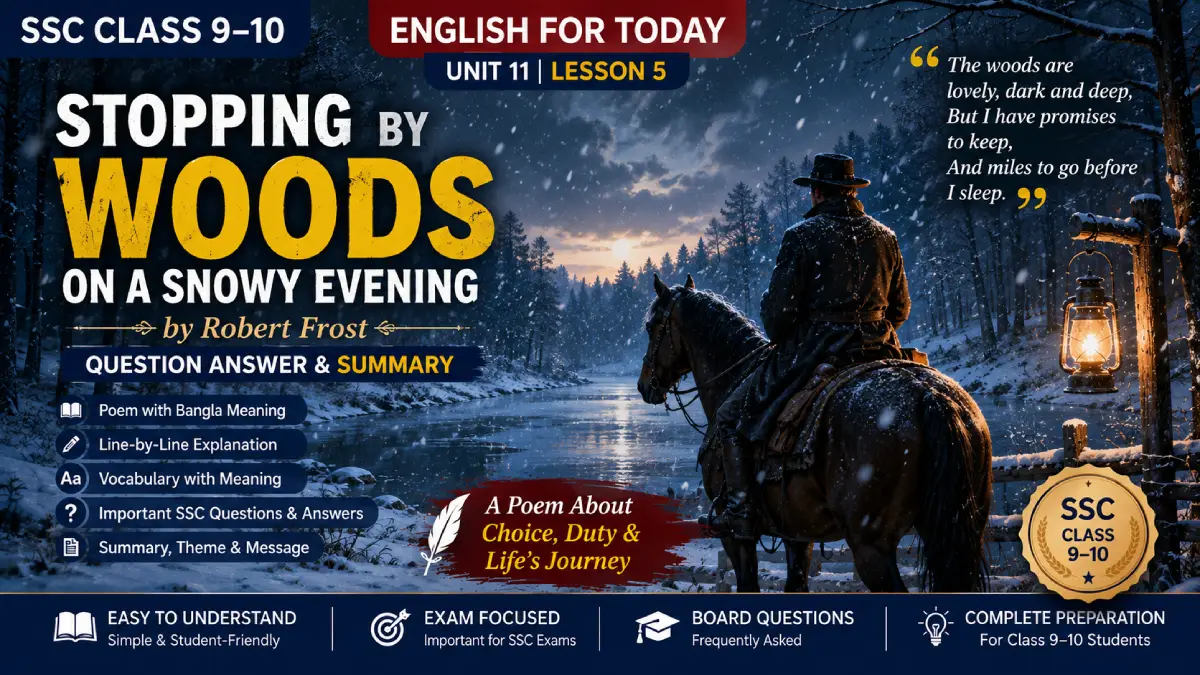
(g) What is the role of snow in “Stopping by Woods on a Snowy Evening”?
In the poem, snow plays a symbolic role. The snow-covered woods represent the temptation to rest and escape from responsibilities. The speaker is drawn to the peaceful beauty of the woods but resists it, reminding himself of duties ahead — “miles to go before I sleep.” Snow thus symbolises both the beauty of nature and the allure of escape from life’s burdens.
(h) What does the poet mean by “Be glad and your friends are many” in “Solitude”?
The poet Ella Wheeler Wilcox means that happiness naturally attracts people. When a person is cheerful and positive, others gather around them and offer friendship. Joy is a magnet for companionship. The line encourages people to cultivate happiness not only for themselves but also to build meaningful relationships with others.
Question 9: Answer any five of the following questions from the stories. (2×5=10)
(a) How does Sonabhan react to Moti’s death in the story “Mr. Moti”?
Sonabhan is deeply grief-stricken by Moti’s death. She weeps uncontrollably and finds it very hard to accept that her beloved dog is gone. For her, Moti was not just a pet but a loyal companion who gave her unconditional love and his death leaves a painful emptiness in her life.
(b) What marks a significant change in Sonabhan’s routine after Moti’s death in “Mr. Moti”?
After Moti’s death, Sonabhan’s daily routine changes drastically. She no longer has anyone to wake up for in the morning, to feed, or to take for walks. The house feels unusually quiet and empty. The absence of Moti disrupts the rhythm of her life and she struggles to find meaning in her everyday activities.
(c) Who had brought the news of Mr. Brently Mallard’s death in “The Story of an Hour”?
The news of Mr. Brently Mallard’s death was brought by his friend Richards. Richards had received the news from the telegraph office where a list of those killed in a railroad accident had arrived. He came along with Josephine, Mrs. Mallard’s sister, to break the news as gently as possible.
(d) What does the purple jar symbolise in “The Purple Jar”?
The purple jar symbolises the danger of choosing appearance over necessity. Young Rosamond is attracted to the beautiful purple jar in a shop window and insists on having it instead of the new pair of shoes she badly needs. When she gets it, it turns out to be ordinary glass with coloured liquid inside. It symbolises how superficial attractions lead to poor and regrettable decisions.
(e) What did Portia emphasise about God’s mercy in “The Merchant of Venice”?
Portia emphasised that mercy is a divine quality that cannot be forced. She argued that it falls freely like gentle rain from heaven and blesses both the giver and the receiver. Mercy is greater than earthly power and is most godlike when practised by those who are powerful.
(f) What was Antonio’s primary occupation in “The Merchant of Venice”?
Antonio was a wealthy merchant in Venice. His primary occupation was sea trade. He owned several ships that carried goods across the seas. His wealth and livelihood depended on the success of these ships, and it was because of a business arrangement that he became entangled in the conflict with Shylock.
(g) What was Mrs. Mallard’s reaction when he entered the house in “The Story of an Hour”?
When Brently Mallard unexpectedly walked through the front door, Mrs. Mallard died of shock. She had spent the past hour feeling a powerful sense of freedom after believing herself to be a widow. The sudden return of her husband shattered that feeling completely and her weak heart could not bear it.
(h) Why did Mrs. Mallard die at the end of “The Story of an Hour”?
Mrs. Mallard died because of the sudden shock of seeing her husband alive after believing him dead. During the hour she thought herself a widow, she had embraced the joy of a free and independent life. When that dream collapsed in an instant, the loss was too overwhelming for her weak heart to endure, and she died.
Question 10: Complete the story and give a suitable title. (15)
Opening: Once there lived a happy cobbler who passed his days in working and singing from morning till night. He had a rich neighbour, a banker, who, one day, said to him, “How much do you earn a year?” The cobbler replied, “…………”
Title: Money Can not Brings Happiness
Once there lived a happy cobbler who passed his days in working and singing from morning till night. He had a rich neighbour, a banker, who, one day, said to him, “How much do you earn a year?” The cobbler replied, “I never count what I earn, sir. I only know that at the end of every day, I have enough to feed my family and sleep peacefully at night.”
The banker laughed and said, “You are a foolish man. Let me give you a hundred gold coins. Keep them safely and your worries will be over forever.” The cobbler took the coins gratefully and went home.
That night, he hid the coins under his bed and tried to sleep. But sleep would not come. He kept thinking about the coins, afraid that someone might steal them. The next morning he did not sing. Nor did he sing the day after. Days passed and the cobbler grew pale, anxious and restless.
One morning, he picked up the bag of coins and walked straight to his neighbour’s door. “Take your gold back, sir,” he said firmly. “Before your gift, I was rich in sleep and song. Now I have gold but I have lost my peace.” The banker was speechless. He quietly took the coins back.
That very evening, the cobbler sat at his workbench, mended an old shoe and sang louder than ever before. His neighbours smiled to hear him. He had understood the greatest truth of life — that true happiness lies not in gold but in contentment.
Moral: Contentment is the greatest wealth and money can not bring happiness
Question 11:
Education is very important for the development of a nation. Suppose, you are Nadi and your friend is Adiba. You have a discussion with your friend about the importance of education. Now write a dialogue between you and your friend about the importance of education.
A Dialogue on the Importance of Education in National Development
Nadi: Hello Adib! You look quite thoughtful today. What are you thinking about?
Adib: Hi Nadi! I was just reading about why some countries are more developed than others. It seems education plays a very big role in it.
Nadi: You are absolutely right. Education is the foundation of national development. Without educated citizens, a nation simply cannot move forward.
Adib: But how exactly does education help in national development? Can you explain a little?
Nadi: Of course. First of all, education creates skilled workers — engineers, doctors, teachers and scientists. They drive the economy and improve the quality of life for everyone.
Adib: That makes sense. What else does education do?
Nadi: Education makes people aware of their rights and responsibilities. Educated citizens participate in democracy, follow laws and contribute honestly to society. This creates a peaceful and well-organised nation.
Adib: True. I have also noticed that educated people are more conscious about health and hygiene. That must also help the country.
Nadi: Exactly! When people understand nutrition, sanitation and disease prevention, public health improves greatly. This reduces poverty and raises the overall standard of living.
Adib: What about women’s education? Is that equally important?
Nadi: It is perhaps the most important of all. When women are educated, families become healthier, children perform better in school and the whole community benefits. A nation cannot truly develop if half of its population is left behind.
Adib: We in Bangladesh still have challenges in ensuring quality education for everyone, don’t we?
Nadi: Yes, but things are improving. Free books, stipends for girls and new schools in rural areas are positive steps. But we as students also have a responsibility — to study sincerely and one day contribute to our country.
Adib: Well said, Nadi. I feel truly motivated now. Let us promise to take our education seriously and work for the development of Bangladesh.
Nadi: That is the spirit! Education is not just for ourselves — it is for our nation and for future generations.
Adib: Thank you, Nadi. This has been a very inspiring conversation.
Nadi: Anytime, Adib. See you in class tomorrow!
প্রিয় শিক্ষার্থীবৃন্দ
আমরা আশা করি এই Comilla Board SSC English 1st Paper full question and answer 2026টি তোমাদের পরীক্ষায় ভালো নম্বর অর্জনে সহায়ক হবে। যদি কন্টেন্টটি উপকারী মনে হয়, তাহলে তোমাদের মতামত ও প্রয়োজনীয় টপিক কমেন্ট সেকশনে জানাও।
নিয়মিত পরীক্ষার প্রস্তুতি ও গুরুত্বপূর্ণ আপডেট পেতে আমাদের
▶️ YouTube Channel সাবস্ক্রাইব করো এবং
ⓕ Facebook Page লাইক দিয়ে আমাদের সাথে যুক্ত থাকো 🚀
তোমাদের সফল প্রস্তুতিই আমাদের মূল লক্ষ্য 💪
🔗 Explore More for Preparation
📚 পরীক্ষার জন্য আরও প্রস্তুতি নাও
-
📌 Stories